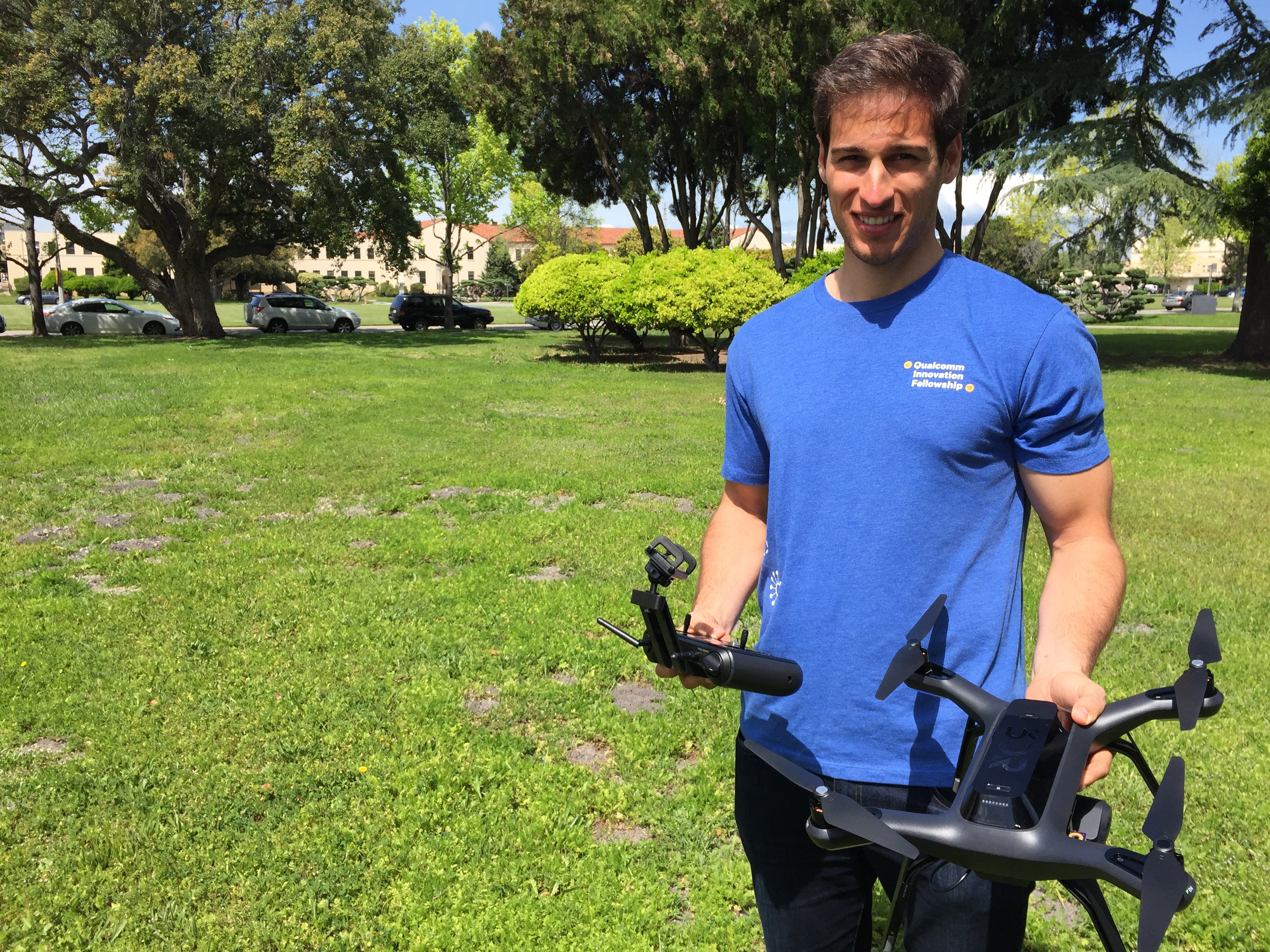
In a 2017 photograph, João Diogo Falcão stands on a sunny patch of grass holding a drone. He wears a blue Qualcomm Innovation Fellowship T-shirt; the aircraft looks ready to make considerably more noise than its owner. At Carnegie Mellon’s Silicon Valley campus, he was helping a research team teach machines to recognize objects and navigate physical space. Years later, his work would turn up above convenience-store shelves and inside basketball arenas. The drone had somewhere to go. The store had something to learn.
Falcão, usually called JD in AiFi’s public conversations, became the company’s chief executive in September 2025. He had already helped build its technology and engineering organization. The promotion brought a familiar technical ambition into the CEO’s office: give physical places a digital understanding of what happens inside them. A shopping basket is one application. His horizon extends across the room.
A machine needs somewhere to practise
The research project was called VIPER, the Virtual Image Processing Environment for Research. Professor Bob Iannucci’s team included Falcão, Ervin Teng and Cef Ramirez. They were investigating real-time deep learning for drones, including how an operator could help an aircraft identify the object it should follow.
Training posed an awkward problem. A drone needs experience of its surroundings, but gathering that experience in the actual surroundings can take time and data that a researcher does not have. The team used a video game engine to construct a virtual environment resembling the real one. The Matrix makes an apt analogy. Science fiction, on this occasion, supplied the explanation rather than the aircraft.
The photograph catches Falcão during a career already moving between institutions and disciplines. He earned a bachelor’s degree at Instituto Superior Técnico, followed by a master’s at Cornell in robotics and a Carnegie Mellon doctorate focused on cyber-physical systems. His doctoral years ran from 2014 to 2021. The research and the commercial career would overlap.
Another strand of his work concerned wireless emergency alerts. In a 2018 paper with Sumeet Kumar, Hakan Erdogmus, Bob Iannucci and Martin Griss, he examined ways to improve how messages communicate a changing situation. The team evaluated extensions through two public usability trials. Precise location, maps and information that people could readily interpret mattered.
A drone tracking an object, a phone presenting an alert, a store registering a purchase: these are different tasks. Each depends on context. What happened? Where? What should follow? That recurring problem offers a useful way to read Falcão’s career without pretending that every early project was secretly a business plan.
The ceiling does the unfamiliar work
Falcão joined AiFi as a software engineer and technology lead in November 2017. Director of engineering followed in July 2018, then vice president of engineering in January 2019 and CTO in October 2020. Those titles chart a widening set of responsibilities, from building software to organizing the people and decisions behind it.
By September 2022, AiFi’s technology was operating in 86 stores across North America, Asia, Europe and the Middle East. A Loop Neighborhood Market in Union City, California, doubled as a place to test product changes. Its beverage cases, slushie machines and orange-and-white branding were entirely recognizable. The unusual part was overhead: 109 cameras.
Falcão emphasized the ability to keep a retailer’s existing physical setup. The cameras recorded interactions with shelves, and the system assembled the events into a transaction when a shopper left. The store also gained information about time spent in aisles and items picked up and returned. A sale has an ending; shopping contains a great many drafts.
His emphasis on familiar layouts gives the technical work a concrete purpose. Customers bring habits into a shop. Retailers have reasons for putting products where they put them. Every additional ritual at the entrance or exit becomes something a shopper has to learn. Keeping the environment recognizable asks the machinery to shoulder more of that adjustment.
Conceptual sequence, not a specification of every deployment.
A receipt is a demanding little document
Falcão’s academic work made room for approaches beyond the company’s commercial camera-based stores. In October 2020, he and Carlos Ruiz, Shijia Pan, Hae Young Noh and Pei Zhang published FAIM, an autonomous inventory-monitoring framework that combined vision, shelf-weight changes and knowledge of where items were placed.
The experiment used 85 items representing 33 products in a setup modeled on a local convenience store. The fused approach reached up to 92.6 percent item-identification accuracy. That result belongs to that research setup. It describes the work of investigating a problem, with a defined collection of items and a defined measure of success.
Earlier that year, Falcão helped organize the inaugural AutoCheckout Competition with researchers from AiFi, Carnegie Mellon, Stanford and UC Merced. Eight teams from four continents took part online during CPS-IoT Week. They had to generate customer receipts from recorded sensor data and an inventory database.
The rules were pleasingly unforgiving. A receipt counted as correct only when every item matched the actual receipt. The winning Carnegie Mellon team tested scenarios with multiple shoppers, items put back and misplaced products. The competition gave researchers access to a common problem and conditions under which they could compare their answers.
That insistence on the whole receipt explains why checkout makes such a useful proving ground. A system can recognize many objects and still misunderstand a shopping trip. Someone returning an item has changed the answer. The final account has to preserve that change. The customer does not buy a percentage of a correct basket.
Ten seconds, with a race to get back to
At Phoenix Raceway’s November 2022 championship races, the technology faced a crowd with another event on its mind. At the store, called Pit Stop, customers tapped a credit card, selected their purchases and left. The receipt followed on their phones.
“For a couple hours, there was a transaction every 10 seconds.”
JD Falcão, describing Phoenix Raceway in 2022
He treated that sustained pace as a milestone. The raceway’s president, Julie Giese, pointed to the speed of getting the store running and fans returning to their seats. The venue planned to bring the AiFi store back for the following spring’s race. A repeat engagement is a useful sort of applause for infrastructure.
Sports venues later became a substantial part of AiFi’s growth. At the Intuit Dome, home of the Los Angeles Clippers, a deployment of more than 40 stores contributed heavily to the company’s expansion in 2024. The setting gives autonomous retail a plainly human objective. People came for basketball; buying refreshments should occupy a smaller share of the evening.
The same setting also enlarges the engineering challenge. A single working shop must become a collection of working shops. Traffic arrives unevenly. Every transaction still matters. Success at this scale depends on the less photogenic parts of technology: repeatable deployment, operational discipline and teams able to keep the system working.
The engineer inherits the whole company
Progressive Grocer named Falcão a 2024 GenNext honoree while he was CTO. His remit covered research and engineering as well as product and technical operations. The recognition captured a career that had moved well beyond an individual research contribution.
On September 10, 2025, AiFi announced a planned leadership transition. Steve Carlin, who had led the business since 2022, would return to Translink Capital as a venture partner and continue advising the company. Falcão would become CEO. Carlin’s tenure had included partnerships with Microsoft and Aldi and expansion into sports venues.
The company reported more than 300 autonomous stores and over 90 petabytes of spatial data processed annually at the time of the handover. Falcão brought continuity in the underlying technology and a new scope of accountability. An engineering leader can ask whether a system works. A chief executive must also ask where it should go, who will buy it and how the organization will deliver it.
From stores to deployments
2022 and 2025 figures count autonomous stores; 2026 counts deployments across AiFi’s platform. Dated milestones, not an identical reporting series.
A search box for the room
By April 2026, AiFi’s Azure-based platform encompassed more than 370 deployments and 40 clients. Its engine, eddie, turns camera observations into structured information that operators can query. The name expands to Event Driven Data Interpretation Engine, a phrase with rather more syllables than its owner.
The platform analyzed more than 60 million human interactions monthly. Falcão’s earlier ambition for a model that could reason across an entire physical environment had gained practical support from larger AI models and years of deployment data. Checkout supplied a starting point for a broader understanding of indoor activity.
“Our mission is to bring that visibility.”
João Diogo Falcão, April 2026
The ambition now reaches beyond retail toward airports and other large indoor spaces. It returns to the question visible in that early drone project: how can a machine understand the environment around it well enough to be useful? The hardware, customers and responsibilities have changed. The physical world remains a complicated place to read.
Falcão’s career can be followed through photographs, papers, engineering titles and an appointment announcement. Its practical test is less ceremonial. A person enters a shop, considers a few things, changes their mind and takes what they want. Somewhere above them, the system must keep up. Ideally, the shopper has something more interesting to think about.