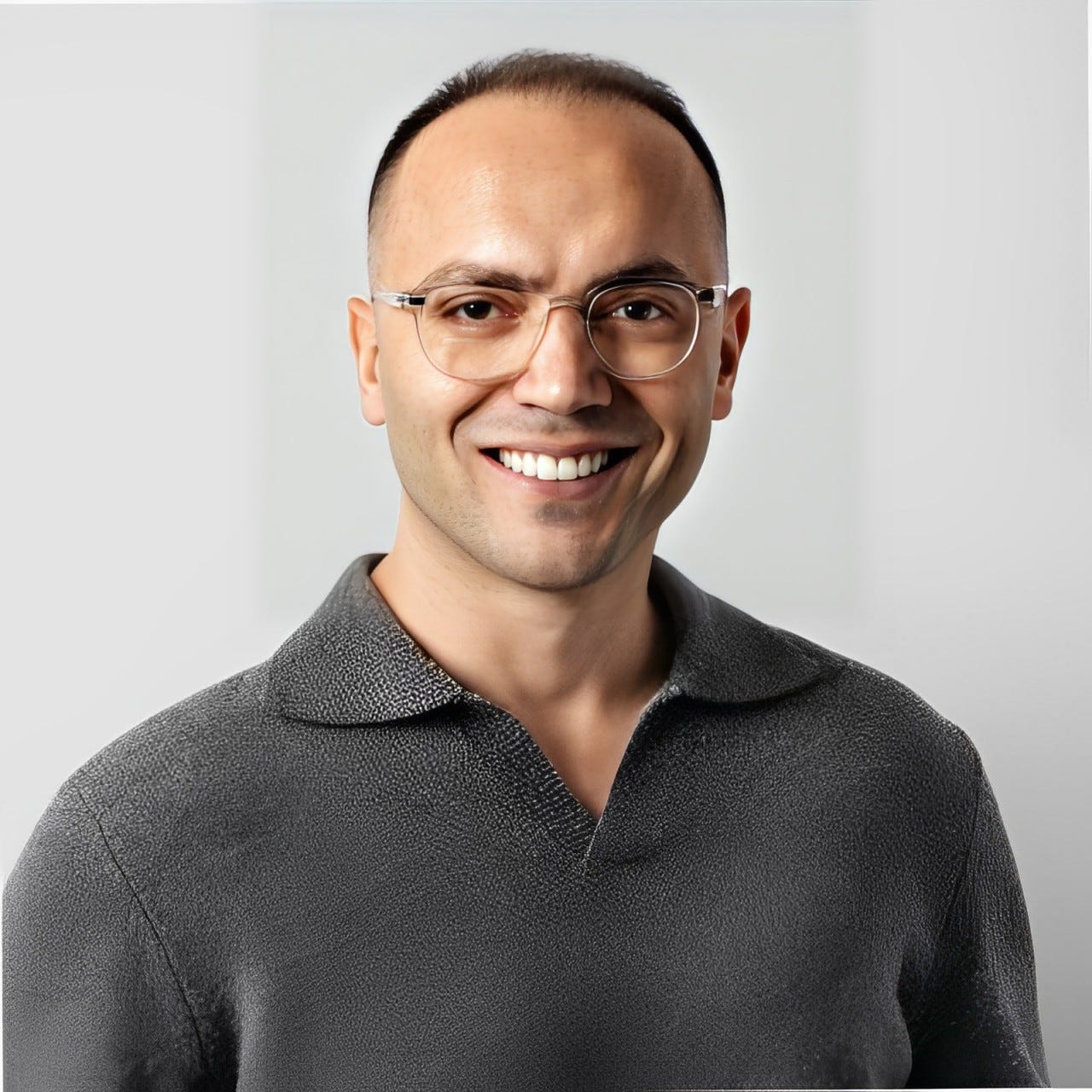
The founder story that Sercan Esen tells about Intenseye - the New York AI company he started in 2018 and now runs as CEO - opens on a production line making ice cream. He is not eating the ice cream. He is helping make it. He is also, if you take him at his word, taking notes: about where the operators put their hands, about which of the yellow floor lines get respected and which get treated as suggestions, about the ladder that lives just outside the frame of one of the ceiling-mounted CCTV cameras. Intenseye's software - the whole reason for the trip - does not exist yet. That will come later, informed by the ice cream.
Esen and his co-founder trained as software engineers, not as safety inspectors, and spent the first two years of the company inside more than fifty industrial facilities: automotive plants, food and beverage, warehouses, distribution centers. They did the work. They also watched the work. The thesis they arrived at, and that Intenseye has since spent $94 million or so building out, is not that factories need new cameras. Factories already have plenty of cameras. The cameras are just not paying attention.
Serious injuries and fatalities in industrial workplaces are, globally, a very large problem that most software people do not think about. Esen quotes the figure of 2.4 million lives a year lost to industrial accidents, which is a number that starts to feel abstract at that size but is composed, at the operational level, of a person putting a hand where a hand should not be, a forklift that reversed with a blind spot, a coworker who took a shortcut across a marked zone. Intenseye's platform is designed to catch those in the moment. It is also designed, and this is the part Esen returns to unprompted, to catch them without turning the workforce into surveillance targets.
The privacy problem, stated out loud
Selling AI cameras to factory floors is a fraught business. Workers - reasonably - do not want to be watched all day by a system whose priorities they cannot see. Esen's answer, delivered in interviews the same way, is that Intenseye is "aggressively cautious about the implementation of computer vision technology because immediate reaction might be, 'Hey, this is Big Brother.'" The product decisions follow from that. Data is anonymized. The system's outputs are unsafe conditions, not individual behavior scores. He tells the Turkish Journal, in the closest thing he has to a mission statement, "We take both workplace safety and employee privacy seriously at Intenseye." Which is the sort of thing many companies say and few structure their SKUs around.
Before Intenseye: Boğaziçi, Sony, and the AI-consultant years
Esen holds two degrees from Boğaziçi University in Istanbul - a bachelor's in Management Information Systems and a master's in Computer Science - which is an unusual pairing that reads, in retrospect, like a preview. Someone who wants both the systems side and the engineering side of the same problem tends to end up running a company that has to do both. He joined Sony in 2014 as an Artificial Intelligence Consultant and spent four years there defining AI use cases for the business and leading proof-of-concept teams. This was before "AI consultant" was a widely recognized job title. It was also before the market had decided that computer vision was going to be an enterprise category.
By 2018 he had left, moved the professional center of his life to New York, and opened Intenseye's headquarters at 220 W 19th Street. From there he directs go-to-market, EHS customer success, and product. He also, according to interviewers who have tracked his travel, keeps visiting facilities. The field trips did not stop when the software started shipping.
The Series B that reset the category
In February 2024, Intenseye announced a $64 million Series B led by Lightspeed Venture Partners, with existing investors Insight Partners, Point Nine and Air Street Capital following on. Coverage at the time - Silicon Angle, AlleyWatch, Business Wire - flagged it as the largest Series B ever raised in the workplace-safety AI category. The round put the company's total funding around $94 million and, more importantly, validated a market that had spent years being described as "adjacent to EHS software" rather than a category of its own.
The 120-model catalogue
Ask Esen what Intenseye actually does and you get a list rather than a slogan. The platform runs more than 120 computer-vision models covering more than 50 safety scenarios: PPE compliance, overhead crane exclusion zones, worker-vehicle proximity, ergonomic risk in repetitive lifts, housekeeping hazards, ladder use, confined-space entries, high-risk zone monitoring. Each model is a small, specific claim about a small, specific way people get hurt. In aggregate they add up to something closer to a safety operating system than a single feature. The company describes the ambition as a "journey to zero" - a phrase that would be marketing filler in most contexts and that here has the useful property of being unambiguously wrong to stop pursuing.
What kind of CEO he is
The tell for Esen's operating style is that his most-repeated anecdote is not a customer win, a fundraising round or an executive hire. It is the two years he spent visiting fifty factories. Founders who lead with a war story about the field tend to keep leading with it. Interviewers report he continues to travel to customer facilities across six continents. He also, per NYSE Floor Talk and a Columbia University talk in 2025, spends more time than most peers explaining the domain - what serious injuries and fatalities actually look like in a plant, why the "leading indicator" problem in EHS is so hard, why the camera on the ceiling is the leverage point - than pitching the company.
The public record, in brief
He is a contributor to the World Economic Forum's Agenda, writing on industrial safety and AI. He was named a WEF Technology Pioneer in 2023, a designation that has previously been given to companies at the point where the market has decided they are a category, not a curiosity. He has spoken at the New York Stock Exchange on AI + computer vision for workplace safety. His Medium archive, quiet but present, catalogues an engineer's-eye view of the space.
What's next
Intenseye has, at the pace it is going, the kind of trajectory where the next disclosed number will be larger than the last. Esen has not publicly signaled a Series C timing. He has, in the same conversations, been fairly consistent about the goalposts: expand model coverage into new hazard categories, increase depth in existing customer accounts, keep global expansion moving from the current 26-country footprint. The mission - preventing serious injuries and fatalities at scale - is unlikely to run out of surface area.
The unglamorous version of the story is that a Turkish engineer, trained at Boğaziçi and Sony, moved to Manhattan and built the kind of company that does not photograph well but that a lot of people are safer because of. The unglamorous version is also the accurate one.