A dent has the good manners to be visible. You can point to it, photograph it, argue about it. Everything that follows is less obliging. An insurer needs an estimate. A repairer needs approval. Someone needs a part. The driver needs the car on Monday. Each participant can do a perfectly respectable job while the customer spends another afternoon on hold.
This is the little absurdity at the centre of Roadzen, a company applying artificial intelligence to auto insurance. The obvious sales pitch is that a machine can recognise vehicle damage. The more interesting proposition is that recognising damage ought to set something in motion. A diagnosis without an appointment is a rather expensive way of knowing you have a problem.
- What it does: connects insurance sales, vehicle inspection, driver safety, claims and repair coordination.
- Who pays: insurers, automakers, fleets and distribution partners, through usage fees and policy commissions.
- The telling move: acquiring VehicleCare brought workshop operations into the picture.
- The arithmetic: FY2026 revenue reached $55 million; the company still recorded a net loss.
The dent is the easy part
Consider a damaged car as a workflow rather than an object. First comes evidence: what happened, what was damaged, what was there before? Then comes judgement: what is covered, what should be repaired, what must be replaced? Finally comes execution: authorisation, parts, labour and settlement. Roadzen has been assembling products around these successive questions.
Via handles computer vision inspections. XClaim supports digital claims processing. StrandD coordinates roadside assistance. These are different doors into a common commercial problem: information arrives in fragments, and the next person in the chain often has to reconstruct it. For a fleet, an idle vehicle adds another urgency. It is supposed to be earning its keep.
In December 2024, National Insurance Company in India expanded its XClaim contract from ten regional offices to fourteen, effective the following January. That is a useful kind of evidence. A customer that has already lived with the product chose a broader deployment. It does not prove every promise in a sales presentation, but it tells us more than a demonstration conducted under flattering conditions.
- 01SeeInspection and damage evidence
- 02DecideCoverage, estimate and approval
- 03ArrangeWorkshop, parts and repair
- 04CloseSettlement and feedback
An editorial map of the connected workflow, rather than a promise that every claim follows one automatic path.
The important addition arrived in January 2026. Roadzen acquired VehicleCare, whose platform connects insurers with vehicle repairs and workshop management. The strategic direction is visible: extend a claims decision into the work that makes the decision useful. Faster paperwork has limited charm when the car remains parked outside the garage.
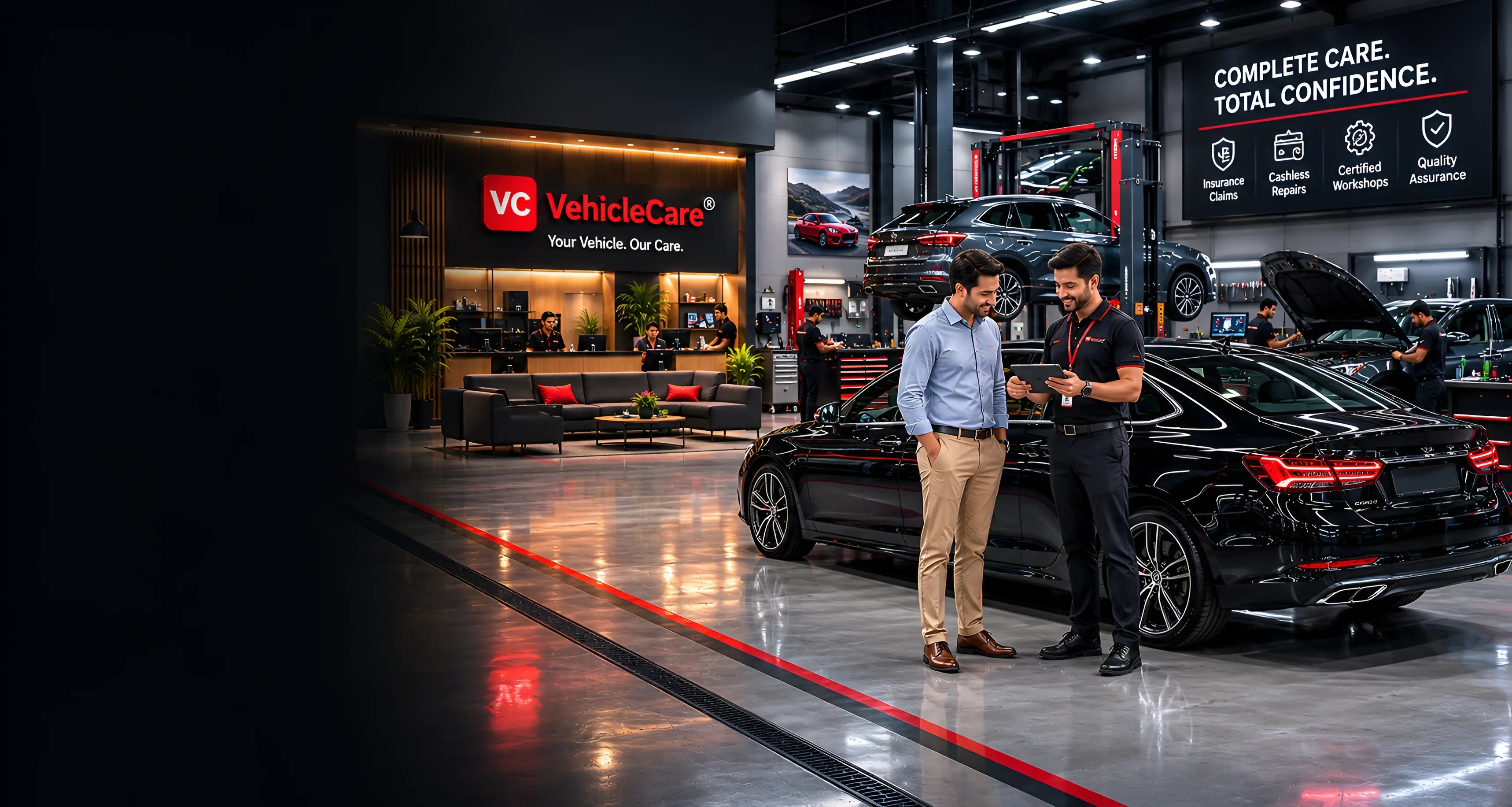
In May, VehicleCare announced a partnership with the TISAG-TEMOT auto-parts network. VehicleCare co-founder Amit Kumar put the problem plainly: “Our garages need consistent access to genuine parts at the right price.” A good estimate cannot make a missing component materialise. Parts supply belongs inside the claims conversation because the customer experiences the whole journey as one service.
A researcher meets the repair network
Roadzen’s founder and CEO, Rohan Malhotra, studied AI and robotics at Carnegie Mellon. Before Roadzen, he ran Avacara, an enterprise software and data analytics business. The company’s COO, Ankur Kamboj, came through a different door: AXA Assistance in India, where he built networks, and earlier roles in multi-brand vehicle repair.
Those backgrounds make the product collection easier to understand. One supplies the machinery for interpreting data. The other knows why an assistance network can turn a neat digital instruction into a messy afternoon. Roadzen’s expertise combines model building with insurance distribution and automotive operations. The latter two are where a pleasing interface meets permissions, contracts and people.
Another product, drivebuddyAI, moves the intervention earlier. Its cameras and neural networks monitor the driver and the road, supporting fatigue detection, distraction warnings and contextual risk assessment. A speeding event means something different on a wet road or late at night. The commercial purpose is to help fleets prevent losses and give insurers a better view of risk.
Roadzen reports accident reductions in some deployments. Treat those as company-reported outcomes tied to deployment conditions. A camera does not coach a driver by itself; alerts, management response and driver behaviour belong in the result. The practical question for a fleet buyer is how performance changes on its routes, with its drivers, against its own baseline.
MixtapeAI, launched in October 2024, adds conversational agents connected to insurance knowledge and operational systems. Its intended jobs include policy administration, claims workflows and assistance scheduling. The attraction is an agent that can retrieve the relevant information and carry a task forward. An eloquent answer is of modest comfort if the tow truck has not been booked.
Selling the policy, charging for the work
Roadzen is best understood as an infrastructure supplier with a distribution business attached. It serves insurers, carmakers, fleets, dealerships and agents; drivers encounter its capabilities through those relationships. Named customers in its public materials include AXA, Allianz, Tata and Audi. It operates across North America, Europe and Asia.
The money comes in two principal forms. Technology customers pay per vehicle or per use. Brokerage operations earn commissions and fees associated with policies distributed through partners. Roadzen says it does not carry underwriting risk on its own balance sheet. The insurance carrier remains central to the arrangement.
Quarter ended June 30, 2026. These are revenue shares, not profit margins.
This breadth shapes its competitive position. Tractable offers AI damage appraisal; Samsara offers fleet video safety and coaching. An insurer can also assemble specialist tools and retain existing brokers or administrators. Roadzen’s pitch is that connected services reduce the work of joining them together. That is a proposition about coordination, not evidence that it wins every individual product comparison.
For an automaker, the attraction is insurance integrated into an existing customer journey. For an insurer, it is inspection and claims capacity. For a fleet, it is safer driving and less disruption. The same platform has to earn its place in three rather different budgets.
The regulator reaches for the handbrake
The awkward chapter concerns Britain’s Guaranteed Asset Protection insurance, which covers a financial shortfall after a vehicle is written off or stolen. In February 2024, the Financial Conduct Authority announced a pause in sales by firms accounting for 80% of that market. Its concern was consumer value. In the data prompting the intervention, only 6% of premiums went back to customers as claims.
That was a market-wide intervention, rather than a finding specific to Roadzen. Roadzen nevertheless disclosed a significant hit to its UK business. Its carrier partner later received approval to resume sales. Several firms elsewhere in the market also restarted after making changes, including lower distribution commissions.
A faster system still needs permission to sell.
The setback is instructive because the constraint sat outside the model. Roadzen’s own recent history supplies a concrete answer to what can fail: distribution can stop when the underlying product does not satisfy regulatory expectations. The later expansion into other markets and repair services broadens the business, although the public record does not establish one private moment when management changed its mind.
Growth has a financing bill
Roadzen went public through its Vahanna business combination in September 2023. Subsequent financial results make a more interesting story than the listing ceremony. Revenue fell from $46.7 million in FY2024 to $44.3 million in FY2025, then rose to $55.0 million in FY2026. The recovery was real. So was the loss.
Fiscal years end March 31. Bars start at zero; values are rounded.
FY2026 net loss attributable to ordinary shareholders was approximately $22.5 million. In the June 2026 quarter, revenue reached $16.2 million and adjusted EBITDA loss narrowed to $0.37 million. Net loss was $9.8 million, including a substantial non-cash fair-value charge. Adjusted EBITDA helps describe operations, but it does not turn a reported loss into a profit.
The strategy also has a purchase price. VehicleCare’s contractual consideration was about $5.28 million, mostly shares in Roadzen’s Indian subsidiary, plus roughly $0.87 million in cash. Its accounting fair value was slightly different. Roadzen raised approximately $8 million in a May 2026 equity offering. The annual filing still carried an auditor’s going-concern warning.
In July, Roadzen agreed to buy an unnamed European rental-insurance business for approximately $15 million, half payable at closing and half through a three-year earn-out. The announced closing was expected in early calendar Q4. The proposed target’s revenue and earnings were forecasts. A signed agreement earns a place in the strategy; it has yet to earn a place in completed results.
Copy the handoff, measure the result
There is a practical lesson here for anyone purchasing enterprise AI. Start with a customer’s stalled task. Identify who needs which information next, then connect that decision to the action that follows. Roadzen’s move into repairs gives that lesson unusually literal form. The handoff ends with someone doing work on a car.
A buyer can copy the measurement discipline too: compare claims cycle time, vehicle downtime, repair cost and safety outcomes before and after deployment. Keep human escalation available for disputed coverage and difficult damage. Check whether the data and systems needed for the next step are actually accessible.
The approach is least useful when the bottleneck is beyond its reach: unavailable parts, overloaded workshops, withheld carrier approvals or poor input data. Roadzen’s challenge is to make its growing collection of capabilities behave like one dependable service. The driver will judge it with an admirably simple test: when can I have my car back?
Keep following the car
Explore Roadzen, VehicleCare and the company’s latest announcements.
Find Roadzen on LinkedIn, X, Instagram, Facebook and Medium.
Watch the March 2025 founder interview, the October 2025 expansion interview, or visit Roadzen’s video channel.