A truck on a map is a reassuring little thing. It has a position, a direction, perhaps a neat label. It seems thoroughly accounted for. Yet knowing where a vehicle is leaves plenty of business unfinished. Who needs it next? How is it being used? What should the person watching the screen do? Mohannad Alhaj has built a career around the space between that moving dot and a useful decision.
He founded Saferoad in 2009 in Al Khobar, in Saudi Arabia’s Eastern Province. The business began in a small warehouse. Today, its work stretches across connected vehicles, fleet operations and Internet of Things systems. The address and the year are modest details, but they give this story somewhere to stand. Before the platform, the partnerships and the professional recognition, there was a company to get running.
Alhaj’s route into the business combined computing with commerce. He completed a bachelor’s degree from Al Ahliyya Amman University in 2005 and a business-development role at MTData beginning in 2007. Two years later, he became a founder. That sequence helps explain the shape of his work: technology had to meet an organization prepared to use it, and someone had to bring the two together.
A warehouse is an honest starting point
The warehouse origin suits a business whose software depends on something physical. A connected-vehicle service needs equipment in the vehicle as well as a screen in the office. Between those two sit communications, software and the daily habits of the customer. A pleasing demonstration is one hurdle. Becoming part of the working day is another, and a rather less forgiving one.
Saferoad’s stated purpose included improving driving behavior. That gives the company’s name a practical connection to its work. Vehicle information can reveal patterns that a position alone does not explain. The business Alhaj set out to build had to make that information usable to organizations managing fleets, with all the coordination that fleet management entails.
There is a useful distinction between inventing a device and building a company around it. The first asks whether something can work. The second asks who will use it, who will support it and how it will fit into an existing operation. Alhaj’s early business-development experience belongs in that second conversation. His career moved from helping develop a business to taking responsibility for one of his own.
- 2005Computing degree at Al Ahliyya Amman University
- 2007Business development at MTData
- 2009Saferoad established in Al Khobar
- 2017Selected as an Endeavor Entrepreneur in Sofia
Sofia enters the itinerary
In 2017, Alhaj joined the Endeavor network through its 75th International Selection Panel in Sofia, Bulgaria. The panel selected 25 entrepreneurs from 11 countries. For a founder running a company out of Al Khobar, it marked a place in an international entrepreneurial network. The business had acquired a context beyond its home market.
At the time of his selection, Saferoad was described as operating in Saudi Arabia, Bahrain, Jordan and China. Its connected-car platform helped corporate customers locate, monitor and communicate with fleets in real time. Those three verbs give a concise account of the operating proposition. A vehicle could be found, its activity understood and a connection made back to the people responsible for it.
The international footprint also put a different kind of work on the founder’s agenda. A service used in several countries has to make sense across several operating environments. An expanding business brings questions about customers, organization and delivery alongside questions about the product. The Endeavor milestone sits at that intersection: a company with working technology, and a founder facing the demands of taking it further.
The founder goes back to class
Alhaj’s education continued after he became a CEO. In 2018, he completed the Endeavor Innovation and Growth Program at Stanford University Graduate School of Business. In 2022, he completed Endeavor’s Scaling Entrepreneurial Ventures program at Harvard Business School. These were executive programs undertaken during his working career.
The chronology is revealing. The Stanford program came nine years after Saferoad’s establishment; Harvard followed thirteen years after it. By then, the subject was a running company, with customers and responsibilities attached. A founder returning to a classroom at that stage brings a different set of questions from someone preparing to launch.
It is tempting to turn university names into decorative credentials. Here, their dates do more useful work. They show continued professional education across the life of the business. Launch, growth and scale each arrive with their own puzzles. Study remained part of the journey while the company continued to operate.
Innovation and Growth
Scaling Entrepreneurial Ventures
Give the partnership a job
In May 2020, Saferoad announced an exclusive partnership with the digital freight platform TruKKer. The intended work covered cargo security, transportation management and improved vehicle utilization. Freight demand and information about vehicles were being brought into the same conversation. For a telematics business, that was a concrete way to connect its capabilities with another part of the transport operation.
Alhaj’s public statement focused on what the partnership could mean for customers. He emphasized the commercial opportunities that the agreement could create for existing and future clients. The thought is plain enough to pass unnoticed at a signing ceremony. It deserves a second look. It puts the customer’s business alongside the customer’s vehicle.
“creates direct commercial opportunities for our existing and future clients”
Mohannad Alhaj, on the TruKKer partnership, May 2020
TruKKer founder Gaurav Biswas, meanwhile, pointed to Saferoad’s combination of hardware knowledge and adaptable software development. The two statements describe different sides of the same agreement. One concerns the capability being brought to the partnership; the other concerns the opportunity expected to follow. Together, they give Alhaj’s work a sharper outline than a list of product features would.
A partnership announcement is still an announcement. Its stated aims are useful because they show what the parties wanted to build together. In this case, the goals stayed close to the work of freight: managing a shipment, understanding an asset and improving its use. Even technology needs a day job.
The rental counter joins the story
In 2024, Lumi signed an agreement with Saferoad. Lumi’s CEO, Azfar Shakil, later discussed using data-based technical support to simplify its fleet services in Saudi Arabia. The collaboration placed Alhaj’s company in another operating setting, where the vehicle’s next customer matters as much as its current position.
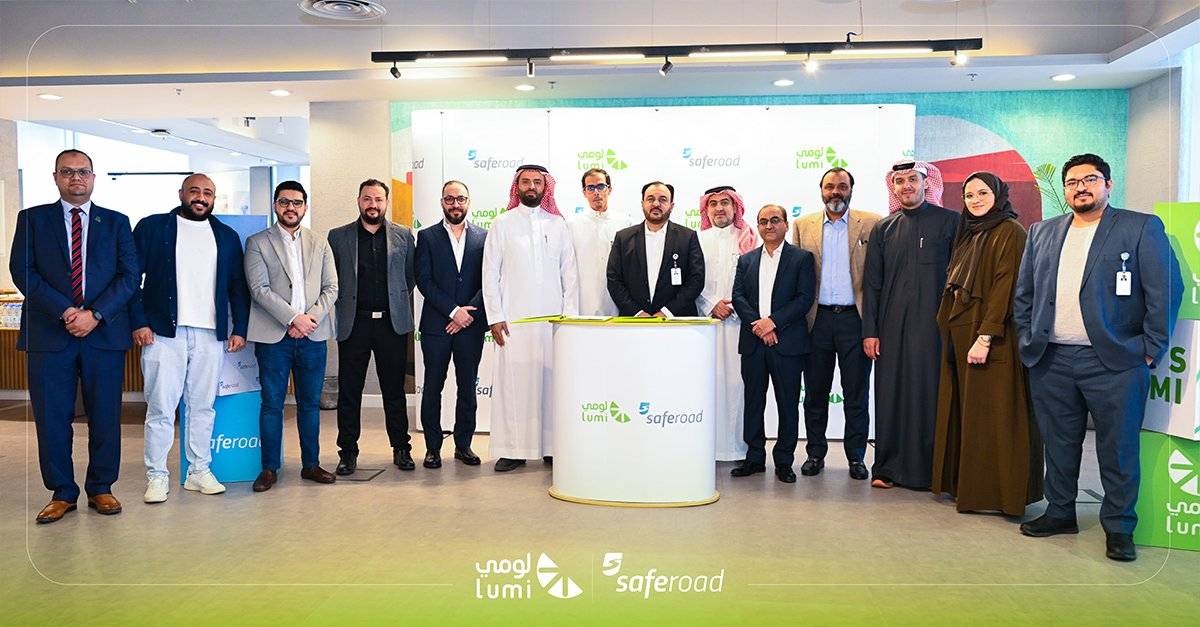
Rental operations give the connected-vehicle question a familiar setting. Cars are booked, collected, returned and prepared for another journey. The useful information has to fit those rhythms. The partnership’s stated purpose was to support digital innovation and fleet services, tying Saferoad’s technology to the rental business’s practical demands.
Another 2024 agreement widened the setting again. At LEAP24, Mobily and Saferoad announced a memorandum of understanding aimed at collaboration on locally developed, multi-sector IoT and smart-city solutions. The scope reached beyond one fleet category. As an agreement to collaborate, it records an intended direction rather than a finished result.
The partnership sequence is particularly useful for understanding his role. TruKKer brought the freight marketplace into view. Lumi brought rental services. The Mobily agreement introduced collaboration on broader IoT applications. A founder has to hold those different conversations together while keeping the company’s capabilities intelligible to each partner. The same vehicle information can matter for different reasons in different businesses. Understanding those reasons is part of the commercial work, and it gives the computing graduate’s later career a clear connection to his time in business development.
The distance keeps changing
Saferoad now describes in-house development spanning devices, firmware, cloud infrastructure, analytics and mobile applications, with data hosted within Saudi Arabia. That range is the technical backdrop to Alhaj’s role as founder and CEO. The organization has to keep the physical equipment and the software working as parts of one service.
An explanation of the workflow, not a performance measurement.
The company’s current offerings include fleet intelligence, car sharing and an AI framework named SAIF. The vocabulary has expanded since 2009. The operating question remains recognizable: how can information gathered from vehicles help the people managing them? A dashboard earns its place through the work it helps someone carry out.
Alhaj’s public career gives that question a human sequence. A computing education. A business-development role. A warehouse startup. An international network. Further study. Agreements with businesses that need vehicles to do useful work. Each stage adds another organization, another responsibility or another setting in which the technology has to make sense.
The moving dot is still there. It is an economical little symbol for a much larger undertaking. Behind it sit equipment, software, customers and people deciding what happens next. Mohannad Alhaj’s story runs through that distance, from the warehouse in Al Khobar to the working decisions a connected vehicle makes possible.