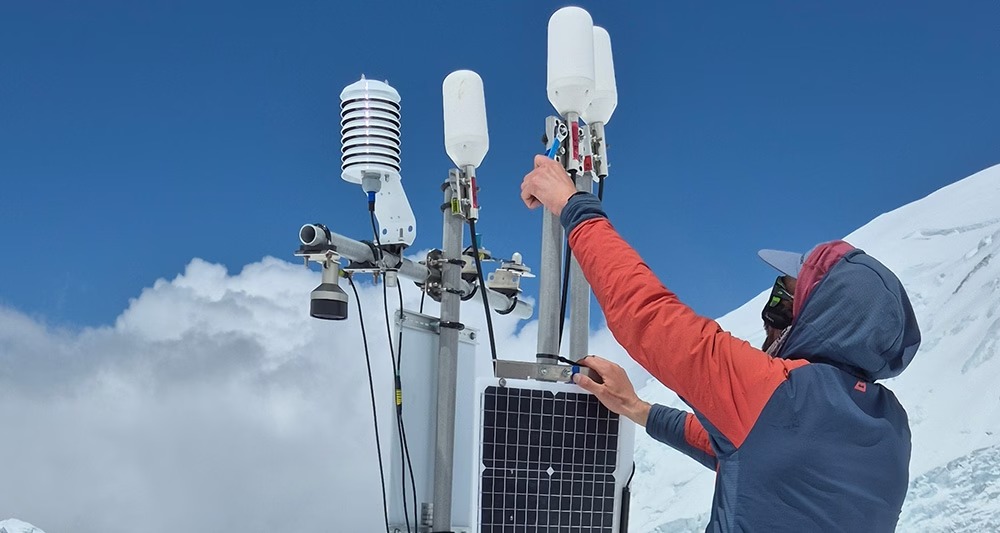
On Mount Everest, a data download can spare someone a climb. At research sites above 6,500 metres in the Western Cwm, instruments measure ice temperatures, snow and weather. Getting those observations home once meant waiting for a team to retrieve the loggers. Ground Control helped connect the equipment by satellite, allowing scientists to examine readings while the instruments remained on the glacier.
The work, with researchers from Leeds and Aberystwyth universities, puts the company’s purpose in unusually sharp relief. Its RockREMOTE Mini connects Campbell Scientific loggers and permits remote access for adjustments. The useful achievement is wonderfully unglamorous: a researcher can troubleshoot equipment without returning to an exceptionally awkward place.
Ground Control occupies the practical end of the space business. It designs communications hardware, sells satellite and cellular airtime, and supplies software to manage what happens between a distant instrument and somebody’s screen. Its market is full of machines with modest conversational needs. They might have only a water level or a location to report. Silence, however, can be expensive.
Four stations. A surprisingly small data bill.
Consider RWE’s hydropower operations in Snowdonia. Until 2016, people went into the mountains to take measurements. The work was slow and potentially hazardous, and the resulting picture was incomplete. RWE wanted automated hydrology stations, but the sites lacked terrestrial power and communications. The equipment also needed to sit discreetly in the landscape.
Ground Control worked with Viasat, OTT Hydromet and ASTECH Engineering Services on four solar-powered stations using Hughes 9502 terminals. They collect measurements every 15 minutes and normally transmit every three hours. When readings stray outside expected parameters, reporting accelerates. When conditions settle, it slows.
That distinction between measuring and transmitting is the story’s most useful engineering detail. RWE gets alerts that help it manage water flows and plan maintenance; the case study reports no more than 2 MB of monthly data per site. Readers can copy the design principle: collect enough to understand the situation, then make the communications schedule answer to the decision. There is little merit in paying to send the same uneventful news repeatedly.
Up to 2 MB per site per month in the documented deployment.
A flood will not wait for a better signal
Green Stream Technologies faces a different clock. Its flood-monitoring systems need readings to reach communities and infrastructure operators while there is still time to act. Cellular service can be economical where coverage is strong, yet storms can disrupt precisely the networks an alert depends on.
Its answer is a site-by-site communications choice. Some stations use LTE; remote ones can use Iridium as the primary path; particularly important sites can combine LTE with satellite failover. The case study describes five-minute reporting and rejects multi-hour gaps as unsuitable for flash-flood monitoring.
Green Stream also began moving from RockBLOCK 9603 to the newer 9704 family. The earlier device handled compact reports. Larger messages create room for additional context, including field images. Here, the initial constraint was capacity rather than a documented broken product. The need changed: a measurement could benefit from a picture of what was happening around it.
Buy the right-sized conversation
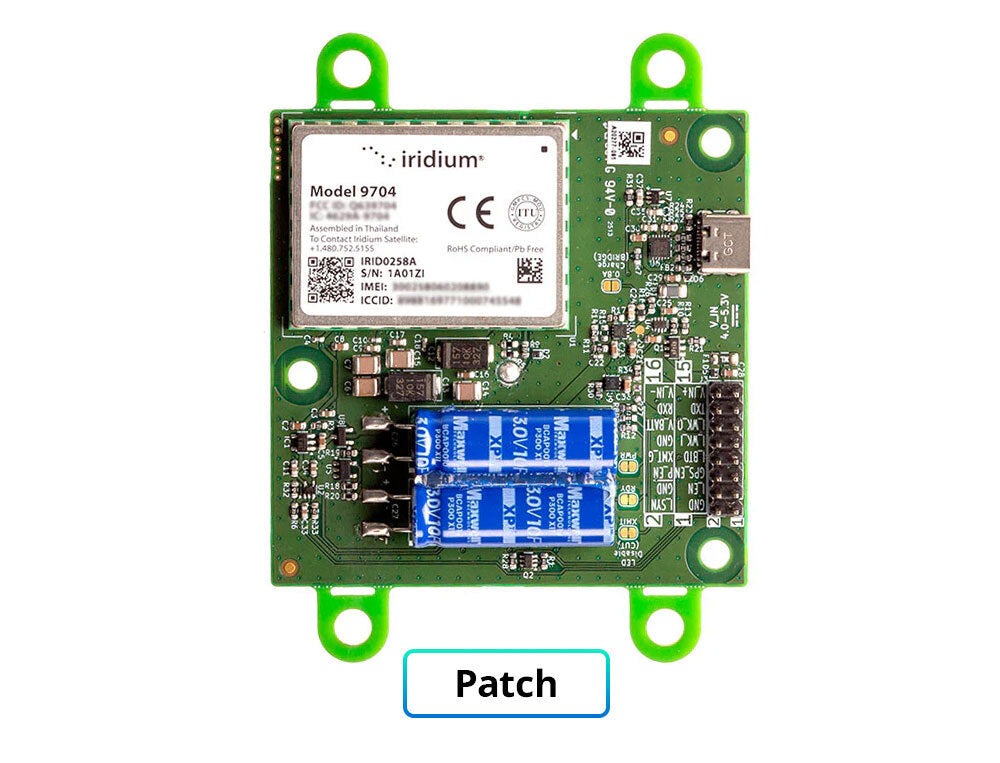
The product range follows those differences. RockBLOCK 9603 serves devices sending short bursts of telemetry. RockBLOCK 9704 uses Iridium Messaging Transport, or IMT, for two-way messages up to 100 KB. A developer can connect the board over USB-C or integrate it through a serial interface. It is a component for building connected equipment, with engineering still required around it.
Packaged versions take on more of that work. RockBLOCK Plus 9704 adds an enclosure, integrated GNSS and field-oriented connections. RockBLOCK Pro handles tasks such as queuing and retries. For equipment needing an IP connection, RockREMOTE Mini offers rated speeds of 22 Kbps up and 88 Kbps down. Those numbers describe a link for remote operational work, not a household broadband subscription.
Ground Control also sells tracking and messaging equipment for people, aircraft, vehicles and vessels. The buying question is less “Which satellite gadget looks best?” than “What must this asset tell me, and what instructions must I send back?” Answering that first helps avoid paying for capabilities a sensor will never use.
The $299 board is the opening payment
At the time of research, the official store listed the patch-antenna RockBLOCK 9704 at $299. Airtime comes separately. Published prepaid IMT pricing includes a $15 monthly access fee and a 64 KB data pack costing $29, with larger packs available. Prices are in US dollars, excluding tax; the published tariffs are representative.
Buy that board, one month of access and the smallest pack, and the arithmetic reaches $343 before tax, shipping or other equipment. This is an illustrative starting basket, not the cost of a finished installation. Sensors, power, housing, integration and subsequent usage can all change the bill. Unused prepaid data expires after 12 months.
The recurring fees explain the commercial model: the initial hardware sale opens a longer relationship involving network access, usage and management. For buyers, the sensible calculation covers a deployment’s working life. A cheap terminal with an unsuitable reporting schedule can become an expensive way to collect ordinary readings.
Somebody has to mind the messages
Cloudloop gives the company a role after the hardware leaves the warehouse. Its services handle subscriptions, data delivery, supported-device management and tracking. A fleet operator needs to activate equipment, see usage, route reports and work out why a distant device has gone quiet. Those jobs become harder when a pilot grows into a distributed estate.
Cloudloop Data supports delivery through interfaces including MQTT and webhooks, connecting satellite messages to customers’ applications. Ground Control also publishes developer documentation and an official RockBLOCK 9704 library on GitHub. The proposition is partly about removing integration chores: buyers get a path from the terminal to their existing software.
That helps explain its market position. Cellular telemetry is an alternative where coverage and resilience meet the requirement. Other satellite integrators, or an engineering team assembling its own modem solution, offer other routes. Ground Control competes on the combination of equipment, integration and ongoing service. Iridium and Viasat supply network capabilities within that offering; treating them simply as rival boxes on a comparison chart misses the relationship.
- 01 Field sensor
- 02 Ground Control terminal
- 03 Satellite network
- 04 Cloudloop → your application
Three businesses had to learn to act as one
The breadth came through consolidation. Mark Wright founded the original US Ground Control in 2002. Phil Rouse’s Wireless Innovation followed in 2004. In 2017, Horizon Capital committed £20 million to a buy-and-build strategy starting with Wireless Innovation. That was a commitment to the strategy, not a conventional startup funding round.
Wireless Innovation acquired Rock Seven in 2018 and Ground Control in 2019. Alastair MacLeod arrived in 2020 to lead the combined operation. In a 2022 interview, he described the continuing task of getting three teams to function as one business. Putting related products under one name did not itself finish the management job.
That history also makes a single founding date slightly misleading. Today’s company carries several lineages. Ric Searle, Rock Seven’s co-founder and Ground Control’s CTO, links the current operation to the tracking hardware and software behind it. The company describes a customer-led engineering culture; published examples include customized geofences and heart-rate-monitor connections for its RockSTAR tracker.

A buoy’s message can save a fishing trip
Blue Ocean Gear makes the economics tangible. Its buoys track the location, movement and depth of fishing equipment. A boat’s radio link is useful nearby, but fixed gear often stays behind when the vessel leaves. Satellite messaging keeps the owner connected to it.
The company’s buoys can alert fishermen when submerged gear resurfaces, helping them recover equipment and catch. There is no external on/off switch, and the electronics sit protected inside. The case study describes work with Ground Control from the pilot phase and the use of small Iridium Short Burst Data packets.
Oshen uses RockBLOCK 9603 in metre-long ocean robots built for weather and environmental observation. These examples reveal the same commercial niche from different directions. Ground Control supplies a communications element that lets another company sell a more useful product. The fisherman or researcher need not become a satellite specialist to benefit from it.
A new owner, and a second opinion on position
Ground Control joined CLS in September 2025, with the acquisition announced publicly in October. CLS’s environmental and satellite-data activities give its terminals and cloud services a natural set of adjacent applications, from marine monitoring to infrastructure. The combination extends the business beyond the earlier private-equity consolidation story.
“Together, we offer end-to-end solutions, hardware, connectivity, platform, support, with stronger global coverage and shared environmental values.”Alastair MacLeod · CLS acquisition announcement
By 2026, another problem was prominent in the catalogue: a ship can receive a plausible position that is wrong. RockFLEET Assured compares GNSS data with an independent Iridium PNT reference, flagging divergence and reporting integrity events. Its published accuracy varies with latitude and operating conditions. It is a specific check on position confidence, not a promise that navigation has become infallible.
The limits remain physical as well as financial. Antennas need suitable sky visibility; power supplies must support the chosen equipment; the data path must match the time available to respond. A compact messaging device is poorly suited to a job demanding continuous high-volume traffic. Ground Control’s appeal is clearest when the requirement is precise: get this reading home, within this interval, from this difficult place.