The unglamorous truth about the Internet of Things is that the “thing” is often the easy part. A refrigeration engineer knows temperature. A crane maker knows motors, loads and fatigue. A battery company knows voltage. Then someone asks for a live dashboard, and suddenly the team is shopping for modems, negotiating data plans, managing SIMs, rotating certificates, tuning antennas, routing cloud events and planning firmware updates for equipment bolted to a roof three states away.
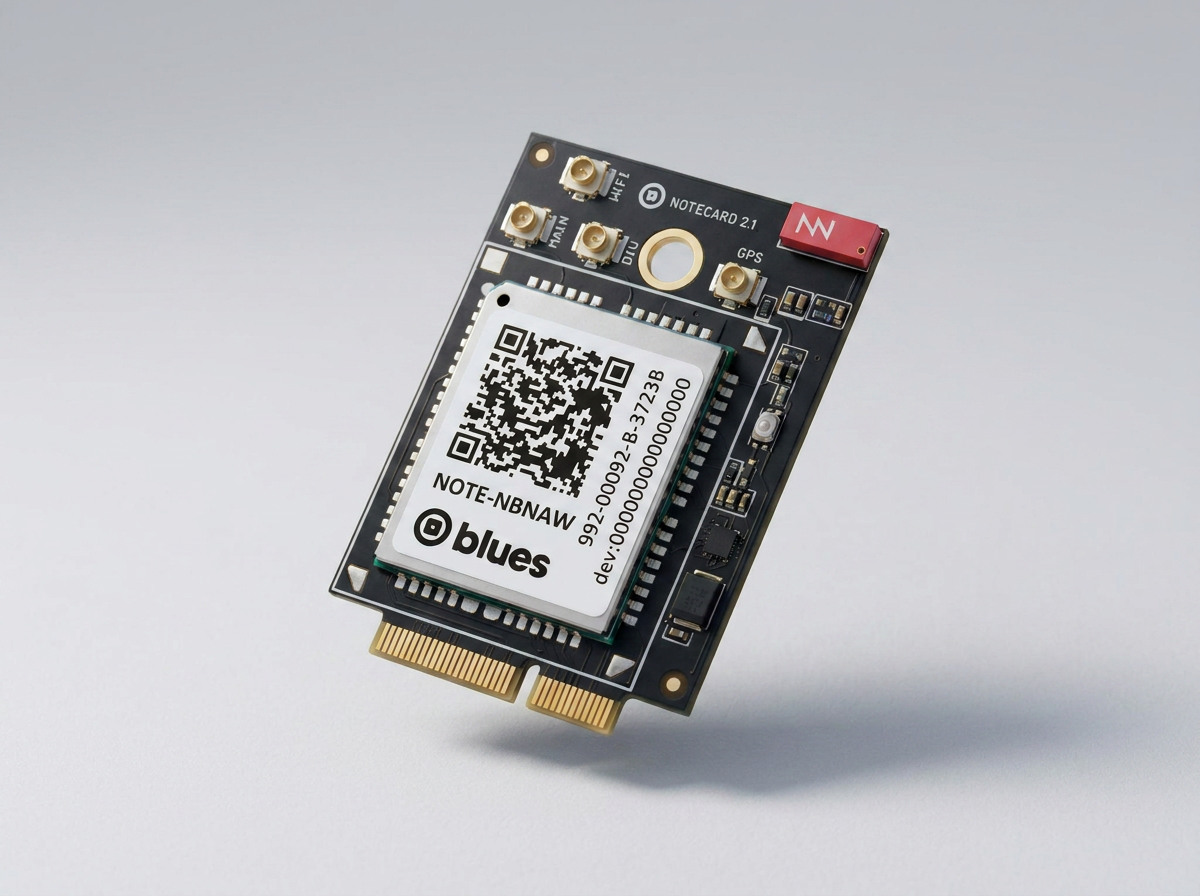
Blues exists to make that second project disappear. The Boston company sells Notecard, a system-on-module roughly 30 by 35 millimeters, and Notehub, the cloud service on the other end. A product sends a compact JSON request to the card. The card gets the message off the machine through cellular, Wi-Fi, LoRa or satellite. Notehub authenticates the device, manages the fleet and sends the data onward to the customer’s own cloud or application.
This is not a consumer gadget company hiding behind an IoT label. Blues is infrastructure for physical-product makers: forklifts wandering a warehouse, compressors on a roof, meters in a field, medical devices in a patient’s home. Its customers include startups, nonprofits, integrators and industrial enterprises. The shared need is small amounts of valuable data from places where Wi-Fi is absent, unreliable or somebody else’s problem.
The first thing that failed was the easy story
The company’s origin runs through a nuclear disaster. After the 2011 Fukushima accident, Blues founder Ray Ozzie became involved with Safecast, the volunteer radiation-monitoring effort. Building a low-power sensor was one challenge. Reliably and securely moving readings from scattered devices was a stack of them. Connectivity, security, device integration, cloud integration and the final application each had its own vendors, tools and ways to break.
That experience changed the target. The valuable invention would not be another clever sensor. It would be a reusable data pump that let domain experts avoid rebuilding the same communications machinery for every product. Ozzie, who created Lotus Notes and later served as Microsoft’s chief software architect, founded Blues Wireless in 2019. Notecard reached general availability in late 2020.

The project hiding inside the project
What Blues actually did
Notecard is the physical wedge. Cellular versions arrive carrier-certified, with an embedded SIM, bundled data and location features. Some variants automatically fail over between Wi-Fi and cellular; newer configurations add Skylo satellite backup. A LoRa version uses the same application pattern for private or community networks. All are designed for low power and intermittent communication, so a remote device can sleep, wake, collect a reading, send it and go quiet again.
The interface is an unusually important choice. Instead of making a web developer learn modem command sets, Blues exposes JSON requests. A host microcontroller can add a note, ask for location or change a setting through a compact command. That familiar grammar widens the pool of people who can prototype connected hardware and reduces the amount of connectivity-specific code embedded in the customer’s product.
Notehub completes the loop. It provisions devices without a technician typing credentials into every unit, stores and displays events, organizes fleets, supports over-the-air updates and routes records into AWS, Microsoft Azure, Google Cloud or a custom endpoint. Blues also sells carrier boards, antennas and development kits, plus design reviews and “idea to market” advisory work. The expertise is not only in radios. It is in the handoffs between electrical design, networking, security, manufacturing and cloud operations.
“Complexity kills.”Ray Ozzie’s two-word diagnosis of industrial IoT
The bill: hardware first, events later
Blues borrowed an idea Ozzie once compared with Amazon’s Kindle: bundle connectivity into the hardware so a buyer can start without opening a separate carrier account. Cellular Notecards include 500 MB of data and up to 10 years of service. That is ample for a machine sending small sensor readings, health pings and occasional commands. It is comically inadequate for video, which is precisely the point.
The cloud side uses consumption. Under Blues’ 2025 pricing update, a standard Notehub event costs one consumption credit, listed at $0.000750, while a broad set of diagnostic platform events is free. Early experiments receive allowances. Larger fleets buy credits or negotiate enterprise agreements with volume discounts, support and price protection. Hardware creates the first sale; event volume, enterprise service and advisory work create the recurring relationship.
The public customer evidence is more useful than a generic “lower total cost” claim. American Crane & Equipment Corporation said its Blues-powered smart-crane architecture was expected to cut upfront cost by a factor of ten against traditional out-of-the-box systems that can run into hundreds of thousands of dollars. Its device monitors load, motion, motor current, faults, emergency stops, temperature and vibration. Remote diagnosis can replace some technician visits and give smaller operators access to predictive maintenance.
The real product is deleted work
Blues competes with Particle’s integrated platform, connectivity providers such as Hologram, 1NCE, Soracom, EMnify and KORE, module makers such as Telit Cinterion and Quectel, and the do-it-yourself combination of a modem, SIM vendor, cloud IoT service and internal device platform. Several alternatives can beat Blues on a single dimension: raw carrier control, a commodity module price, hyperscaler integration or a particular country footprint.
Blues’ difference is the integrated boundary. One vendor is responsible from the module’s API through the managed route. Certificates are provisioned before the device leaves the factory. The module communicates “off the internet” to Notehub rather than behaving like a tiny general-purpose computer exposed to inbound traffic. A team can change radio technology with fewer application changes. That last feature, which Blues calls wireless harmonization, matters when a Wi-Fi prototype becomes a cellular deployment and later needs satellite fallback.
The system also sits in a useful market position. It does not try to own the customer’s final analytics or user experience. It delivers trusted machine data to those systems. Nor is it merely a SIM reseller. It wraps physical hardware, network service and fleet software into a product that an equipment maker can buy. The larger ambition is to help those manufacturers turn one-time equipment sales into recurring intelligent services: temperature compliance, loss prevention, uptime guarantees or remote optimization.
What another company can steal
- Sell the deleted work. List every job the customer no longer needs to staff, integrate or maintain.
- Make the prototype economically painless. Bundle enough service for a real test before asking for an enterprise contract.
- Use a familiar interface at the adoption edge. JSON made embedded connectivity legible to a much larger developer audience.
- Design the upgrade path before the demo. Provisioning, firmware updates and network fallback matter once the clever prototype leaves the bench.
- Define the workload narrowly. Small, valuable messages let Blues optimize power, cost and reliability together.
Where the shortcut stops
Integrated platforms trade flexibility for speed. Blues is strongest when a device sends modest telemetry, commands or location updates and needs to run unattended for years. If the product streams cameras, audio or dense industrial waveforms, 500 MB is a rounding error. If a global manufacturer needs direct control of carrier contracts, custom modem firmware or a network architecture built around an existing connectivity provider, an abstraction may feel like a constraint.
Coverage claims also require field testing. “Global” is not the same as every basement, mine, shipping container or country. Antenna placement, enclosure materials, roaming rules, satellite visibility and local certification can still ruin a schedule. Blues reduces these risks; it does not repeal radio physics. Its design-review service and partner network are evidence that the last mile still contains actual metal, plastic and regulation.
It fits when
- Messages are small and valuable
- Power and field life matter
- The team wants one accountable stack
- Time to pilot is the scarce resource
It bends when
- Video or heavy data is central
- Carrier control is strategic
- Unit economics demand commodity parts
- Coverage cannot be validated on site
From a founder’s architecture to an operator’s company
Capital has followed the premise. Blues raised an $11 million seed round in 2020, $22 million in 2021, $32 million in early 2023 and an expanded $33 million round in 2025, taking its announced total to $99 million. Backers include Sequoia Capital, Positive Sum, XYZ Venture Capital, Qualcomm Ventures, Cascade Investment and Lachy Groom. The company said thousands of organizations were using its system by 2025, up from more than 800 companies reported in 2023.
In June 2025, former Evernote chief Ian Small became CEO, while Ozzie moved to executive chair. It was a revealing transition. Blues had already proved that developers liked the architecture. The next job was operational: turn pilots into production fleets, support enterprise buyers and expand a partner network that had passed 50 organizations. Small described a distributed culture where “everybody builds,” but his appointment put customer listening and scale beside technical elegance.
The company has since pushed further into satellite connectivity with Skylo, fleet management and advisory services. Those moves make Blues broader, but the original insight remains disciplined. A connected machine should send the few facts that change a decision. The valuable product is not the flood of data. It is the reliable route from a stubborn physical object to somebody who can act.
A forklift, a fridge and a grip-strength meter do not need the internet. They need a trustworthy way to report what changed.