The modern trail camera is a quiet little business disguised as a box strapped to a tree. It wakes, takes a picture of a buck, sends the image over a cellular network and subtracts the data from somebody’s plan. The owner can change settings from a couch. A card gets charged each month. A tax jurisdiction gets its share. If the camera crosses a coverage boundary, somebody must keep the connection alive. This chain is the real product, and Zipit Wireless built itself around it.
The company sits in Greenville, South Carolina, far from the coastal centers that usually host telecom platforms. Its staff is small - roughly 27 people in company data - and its work is mostly invisible. Zipit buys and manages access to carrier networks, supplies SIMs and data plans, gives manufacturers one console for their deployments, and operates white-label billing systems that can look like part of the manufacturer’s own service. It is equal parts telecom reseller, software company, integration shop and recurring-revenue mechanic.
In August 2025, the British IoT group Wireless Logic acquired Zipit for an undisclosed sum. It was Wireless Logic’s first purchase of a U.S.-headquartered company. The attraction was larger than a foothold on a map. Zipit had learned to connect the carrier bill at one end of a product to the customer’s bill at the other, including dealers, taxes, payment methods and service tiers in between. Wireless Logic said that machinery had supported more than $45 million in subscription revenue for Zipit’s OEM clients.
Before the cloud, a clamshell
Zipit’s useful oddity is that it did not begin by selling enterprise software. Its roots are in a $100, seven-ounce Wi-Fi messenger made for teenagers who wanted to chat without monopolizing the family PC. The original 2005 device connected to AIM, Yahoo and MSN. It had a tiny keyboard, ran Linux and came in several colors. RadioShack stocked it. Hobbyists soon turned it into remote controls, bicycle computers and pocket servers. The gadget was narrow in purpose but demanding in practice: radio behavior, embedded software, remote updates, authentication and consumer support all had to work together.
The sequel, the Z2, arrived in 2007 with a color screen, music and photos. Sony also licensed Zipit messaging technology for its mylo handheld. Smartphones eventually erased the market for a dedicated instant-messaging device, but the technical lesson survived. A connected object is not finished when it leaves the factory. It acquires a long operational tail: networks change, accounts need provisioning, software needs attention, customers forget passwords and somebody must understand what happened at 2 a.m. in a field three states away.
The pocket messenger disappeared. The difficult knowledge around radios, remote devices and recurring services kept compounding.
The five-layer job hiding behind one signal bar
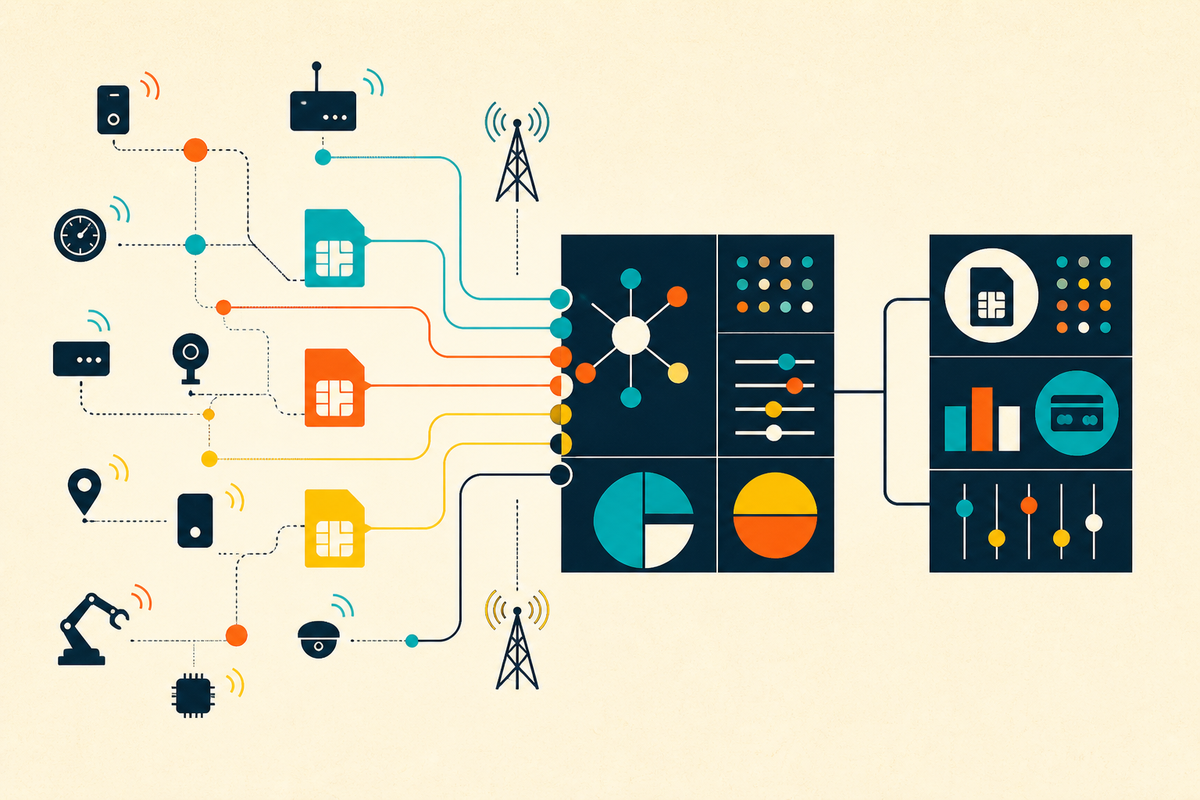
Today Zipit sells that accumulated knowledge to original equipment manufacturers. Its first layer is global connectivity: low- and high-usage plans across carrier networks including long-running relationships with AT&T, Verizon and Rogers. The second is the SIM itself, available in physical, multi-carrier and eSIM forms. The third is a connectivity-management platform where a customer can activate service, suspend a line, change a plan, watch data and compare devices across networks.
One connected-product stack
The fourth layer is where Zipit becomes less interchangeable with a SIM marketplace. Its subscription system can collect cards or ACH payments, issue invoices, run promotions, calculate taxes and let end users choose a service tier. The pages can carry the manufacturer’s branding, while support teams get their own view. APIs connect the system to an existing application or back office. An OEM may sell connectivity alone, charge separately for its software, or bundle everything into one monthly plan.
That arrangement solves an organizational problem as much as a technical one. Cellular IoT falls between departments. Engineers choose a modem. Procurement negotiates data. Finance worries about margins and tax. Product wants simple activation. Support needs to see whether a device is offline or merely out of data. A direct carrier account can address the radio connection while leaving the manufacturer to reconcile the rest. Zipit’s promise is one accountable operator across the seams.
A camera is worth more when it keeps working
Bushnell provides the cleanest view of the business model. A conventional trail camera required its owner to hike out and retrieve a memory card. A cellular version could send pictures home, but only if activation, coverage, data allowances and payments felt as dependable as the camera. Zipit helped Bushnell activate cameras across networks, sell photo and data packages, process transactions, run promotions, and power portals for customers and support staff.
Bushnell reported that the connected model produced roughly three times the lifetime profit per camera - a 200 percent increase - while activation could take less than five minutes. The figure is a customer case result, not a universal forecast. Still, it shows what Zipit is really selling: a way to move the economics of hardware past the checkout line. The data plan becomes a product feature and the invoice becomes part of the user experience.
The same pattern repeats in less photogenic settings. SignalFire Telemetry uses multiple carrier relationships through Zipit for industrial sensors that may sit where no single network is reliable. Device Solutions consolidated multi-carrier administration and invoicing. NuVision used one console for temporary trade-show connections. Other public examples include irrigation controllers, agricultural drones, RV internet, digital signs, access-control cameras, healthcare devices and point-of-sale systems. The objects differ; the operational nuisance is remarkably consistent.
“We were looking for a platform where we could bring coverage from multiple carriers onto a single solution.”Josh Schadel · SignalFire Telemetry
Where Zipit fits in a crowded market
A manufacturer can buy IoT service directly from a carrier, use a digital-first connectivity vendor such as 1NCE, Hologram or Soracom, or hire a broader provider such as KORE, Eseye, EMnify or FloLIVE. Price per megabyte is easy to compare. Total cost is not. A cheap plan can become expensive when a device roams badly, a fleet requires several carrier portals, usage surprises the finance team, or an international launch runs into local network rules.
Market position · illustrative
connectivity + billing
Zipit’s position is strongest when the commercial chain is layered: carrier to Zipit, Zipit to manufacturer, perhaps manufacturer to dealer, and finally dealer or manufacturer to an end user. Its white-label billing, tax support and customer portals matter more in that B2B2C maze than they would to a company that merely wants 500 telemetry SIMs and a usage dashboard. The trade-off is predictable. A high-touch managed partner is most valuable when the deployment is complicated enough to justify integration and shared operations.
The 2025 deal puts Zipit inside a much larger map. Wireless Logic says its wider network connects millions of devices across scores of countries and works directly with dozens of mobile and satellite operators. Zipit brings North American carrier knowledge, a Canadian subsidiary serving point-of-sale connectivity, and unusually developed downstream billing. The parent brings reach, buying power and more network options. In 2026, Zipit also announced a partnership with Smartcom for connected consumer devices and published guidance on SGP.32 eSIMs, hybrid cellular-satellite links and VoLTE. Those updates suggest the Greenville operation is being extended, not simply absorbed.
The practical steal
Zipit’s story offers a plain lesson for hardware founders: recurring revenue is not a pricing slide. It is an operating system. The device must connect in the places it is sold. Activation must be obvious. Data usage needs guardrails. Payments fail, taxes change and customers need a place to see what they bought. Each awkward detail can live in a separate vendor portal, or the business can design the chain as one product from the beginning.
There is another lesson in the company’s pivot. Zipit did not discard the hard-won knowledge inside its failed category. It changed who paid for that knowledge. Teenagers no longer needed a dedicated box for instant messages, but manufacturers still needed remote provisioning, wireless expertise and a way to support connected objects after sale. The clamshell vanished. The operational tail became the company. What once kept a chat session alive now keeps a camera, sensor, drone or sign earning its keep in the field.
Keep the signal going
Explore the platform, customer stories, company channels, and a few useful demonstrations.