For twenty years, Yadhu Gopalan kept a box of machines that the market had forgotten. There were handheld computers, early mobile devices and the assorted electronic fossils of a long Microsoft career. They were not handsome enough for a museum. They had styluses, gray plastic and the cheerful thickness of objects designed before pockets became a branch of industrial engineering. Yet each carried a piece of the same argument: computers were going to escape the desk.
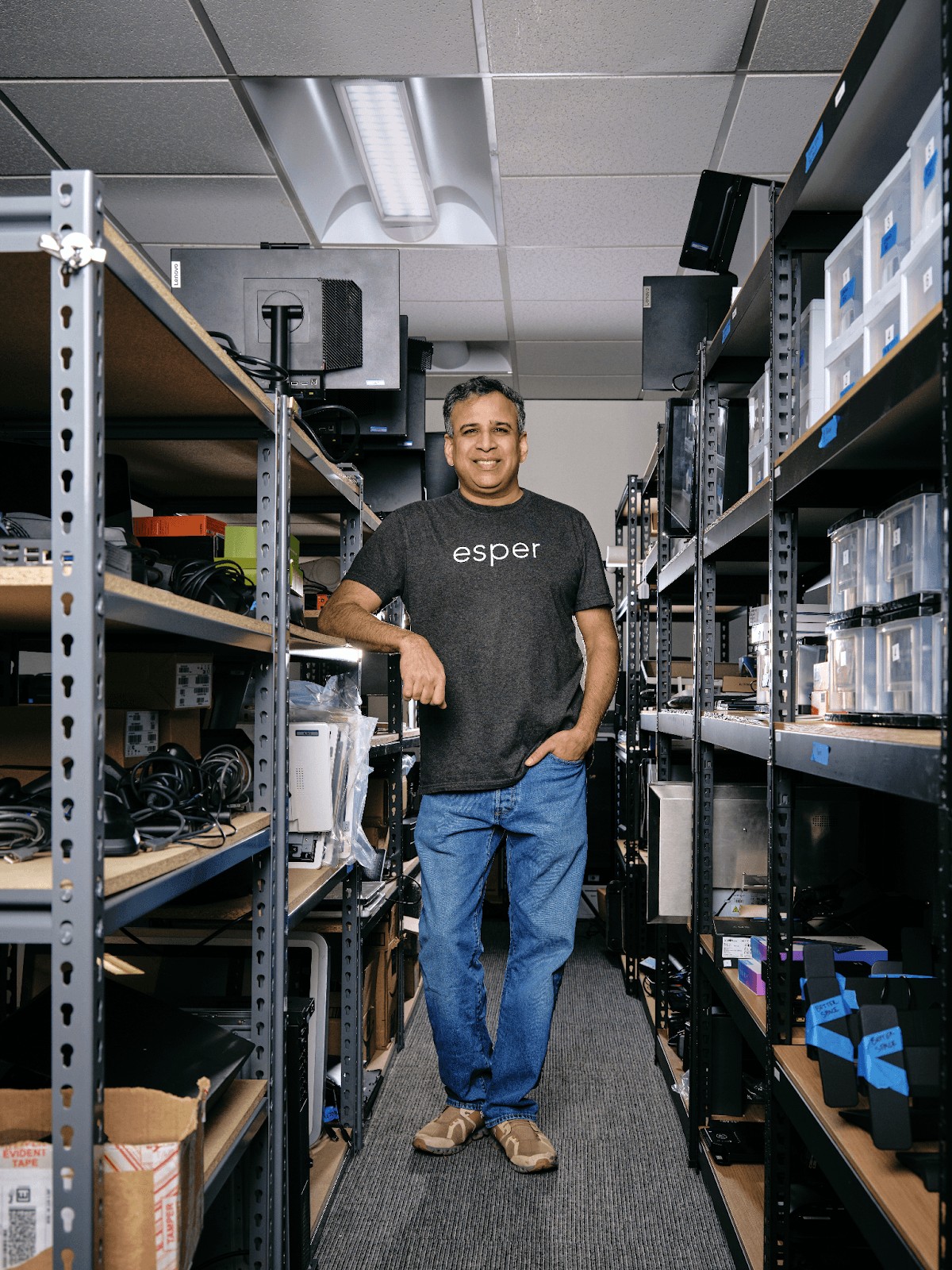
The box followed him from Microsoft to Amazon and, eventually, to Esper, the company he co-founded in 2018. When he opened it on a conference table in Bellevue years later, the devices formed a crooked timeline. Windows CE sat near one end. Esper’s hardware lab, crowded with the current generation of screens, terminals and dedicated machines, sat at the other. Between them lay almost three decades of learning how software behaves once it has to live inside an object, far from the engineer who wrote it.
Gopalan’s story is often told with familiar technology landmarks: Windows CE, Windows Phone, Fire OS, Amazon Go. The more revealing story lives underneath the product names. Again and again, he encountered teams with an ambitious idea and no shared infrastructure for deploying it, updating it, observing it or repairing it remotely. Before the clever experience came the plumbing. The plumbing was rebuilt each time.
“I wanted to solve a problem that I kept solving at these big companies.”
Yadhu Gopalan, on the premise behind EsperThe boy who preferred systems
He was born in Tamil Nadu and moved to the United States at eight. Maine became home. By around fifth grade, he was coding. Later came electrical engineering at the University of Maine and graduate study in computer engineering at Auburn. As a doctoral student in 1994, he imagined a future at NASA. Microsoft offered a livelier velocity, and he left the program for Redmond.
The Microsoft position was, by his telling, the only job for which he ever formally applied. He joined a project called Pegasus, then watched it become Windows CE. The software aimed to carry a Windows-like environment into handheld computers, cars, industrial equipment and other places where a desktop tower would have been absurd. The devices were modest by modern standards, but the problem was immense: make a general computing platform behave across an unruly world of hardware.
Gopalan stayed for roughly two decades. He moved from low-level work on kernels and file systems into architecture and engineering leadership across Windows CE and Windows Phone. More than 35 patents bear his name or contribution, spanning embedded systems, storage, operating systems and security. His career was becoming a tour of everything users rarely notice until it breaks.
In 2013, Amazon recruited him into its own device experiments. He worked on back-end systems for Fire OS and AWS, then owned systems engineering for Amazon Go. The cashierless store was an unusually physical education in DevOps. A cloud service can be replaced in a data center; a failed device in a shop has a location, a cable, a customer standing nearby and perhaps a lunch queue developing around it. Thousands of pieces of hardware had to act as one dependable system.
One problem, four eras
The products changed. Deployment, observability and remote control kept returning to the workbench.
A co-founder unlike himself
Starting a company required Gopalan to revisit an old bruise. A first startup, attempted after graduate school, had failed. The lesson he kept was interpersonal rather than technical: next time, his co-founder could not merely be another engineer with the same instincts. A good partnership needed difference.
Shiv Sundar supplied it. The two knew each other from Windows Phone, where Sundar worked on device commercialization and partner relationships. He understood manufacturers and the complicated business choreography around hardware. Gopalan understood the systems beneath it. When Sundar called about starting a company, the match made practical sense before it made mythology.
Esper began with secure management for Android devices. Customer conversations widened the brief. Companies also needed reliable application and operating-system deployment, the sort of machinery Gopalan had watched internal teams construct at Microsoft and Amazon. His proposition was economical: build that foundation once, make it mature, and let many companies use it.
The founder had to change with the proposition. Gopalan has described himself as “introvert by design.” Put him among people who knew the domain and he was at ease. Fundraising, sales and marketing demanded a different fluency. The childhood coder learned the public work of a CEO because the system needed a storyteller as much as it needed an architect.
The division between software and the physical world has always been slightly impolite. A kiosk freezes during dinner service. A menu board loses contact with the network. A tablet in a distant location drifts away from its approved configuration. Each incident asks the same question in a different costume: can the people responsible see what happened and restore the intended state without dispatching someone with a screwdriver?
Esper’s answer became a platform for provisioning, policy, software deployment, telemetry and remote control. Gopalan once reduced its desired effect to three words: “Esper is invisible.” It is a peculiar sales pitch and an honest infrastructure ambition. The best result is a device that does its job so consistently that the management layer attracts no attention at all.
Infrastructure wins its applause backstage, while the kiosk simply takes the order.
The quiet bargain of device operationsThe Android company outgrows the label
Capital arrived as the thesis found customers. A $7.6 million Series A was announced in 2020. Esper closed a $30 million Series B in May 2021, followed by a $60 million Series C that October. More than 200 enterprises and 2,000 developers were using the platform by the time of the Series C announcement. The company’s disclosed funding had approached $100 million.
Money also invited the familiar hazards of speed. Gopalan later acknowledged that Esper grew too quickly after its second fundraise and had to temper its plans. His language about startups is notably free of spa music. There are hard decisions, a grind and the hope of reaching escape velocity. The engineer who spent years designing controlled systems discovered that companies preserve a healthy amount of chaos.
The product kept broadening. Esper added iOS, then Linux, and in January 2026 introduced Windows management in beta. The sequence returned Gopalan, with a pleasing bit of symmetry, to the operating system where his professional life began. Esper could now address Android, iOS, Linux and Windows fleets through one interface. A company born from deep Android knowledge had become deliberately agnostic.
That expansion follows the devices themselves. A retailer may run Windows point-of-sale terminals, Android handhelds, Linux appliances and iPads without considering the arrangement philosophically interesting. The fleet is simply what history, vendors and budgets produced. Uniformity is rare; responsibility for uptime is not. Gopalan’s current pitch is therefore less about choosing an operating system than making variety operable.
In 2025 he turned the argument into a book, DevOps for Devices: The Innovator’s Guide to Enterprise Fleet Transformation. The title sounds like a category proposal because it is one. Software teams learned to ship, observe and improve cloud services continuously. Dedicated devices have often retained slower release cycles and fragmented tools. Gopalan wants the operational habits of the cloud to travel all the way to the edge, with allowances for the stubborn fact that hardware occupies space.
The useful clutter
There is a temptation to treat old hardware as comedy. The bezels are enormous; the processors are quaint; the ports resemble archaeological evidence. Gopalan’s box suggests a more generous reading. Each object was once an attempt to place computing somewhere new. Some attempts flourished, some disappeared, and all produced lessons about how devices survive beyond a launch event.
His own house has been described as full of electronics and hobby components, including thousands of resistors and capacitors awaiting projects. He introduced his son to Lego robots and building desktop computers. The habit is consistent: understand the whole system, touch the layers, admire the moment when separate parts become a working thing.
That habit also explains the particular modesty of the Esper idea. Its goal is not to make infrastructure glamorous. It is to make infrastructure reusable. Every hour spared from rebuilding deployment machinery can be spent on the experience a customer actually encounters. Every remote fix avoids a journey to a stubborn screen. Every useful alert replaces a mystery.
The old devices remain in the story because the future rarely arrives without baggage. Windows CE vanished, yet its central question - how to manage computers scattered through the physical world - became more relevant as computers slipped into counters, vehicles, signs and tools. Gopalan stayed with the question long enough for the world to catch up.
The box, then, is neither shrine nor junk drawer. It is a founder’s notebook written in plastic. Its pages say that operating systems come and go, infrastructure remembers, and an unfinished engineering problem can be patient. Sometimes it waits twenty years for somebody to stop solving it privately.