At Phoenix Contact, the embarrassing discovery came late. The test team learned what had actually been implemented in a software version too far into the process. Some original requirements had gone unbuilt; requests arriving later had made it in. The company’s published account describes a development operation spread across Office, IBM DOORS, revision-control systems, homegrown tools and Bugzilla. Each tool had a job. Together, they struggled to tell a coherent story.
- Polarion connects what a product must do with the work and tests used to deliver it.
- Its natural customers build complex products with formal evidence requirements.
- The useful buying question: can your team follow a changed requirement without opening a detective agency?
That is a fine little predicament for a software company to inherit. Nobody needs another place to type. They need to know which promise survived the journey from the meeting room to the finished product. Polarion, now part of Siemens, makes application lifecycle management software for precisely this journey. The phrase is cumbersome. The problem is wonderfully concrete.
01 / The trouble begins between the files
Phoenix Contact chose Polarion ALM and Polarion REQUIREMENTS for an environment of 400 users across three locations in Germany and the United States. It wanted departments to share visibility, control workflows and stop relying on emailed documents to move information between teams. The failure described in its case study was a coordination failure: the people responsible for verification could not reliably follow the decisions that shaped the implementation.
Think of a requirement as a promise with an address. A test is evidence about that promise. A change record explains why the promise or its implementation moved. Without dependable relationships between them, even accurate records can mislead. A passing result may answer yesterday’s question. A finished task may satisfy a request that nobody has formally approved.
A passing result may answer yesterday’s question.Why the links matter
Polarion’s answer is to make these relationships part of the working system. Teams can manage requirements and tests, route work through approvals and inspect change history. The software does not settle an engineering argument. It gives the argument a record, an owner and somewhere to go.
02 / The document gets an identity
The product family divides the work into recognizable jobs. Polarion REQUIREMENTS handles specifications and approvals. Polarion QA organizes testing. Polarion ALM brings development disciplines together. LiveDocs let teams work in structured specification documents while managing the requirements inside them as individual records. Permissions, configurable workflows and reuse support collaboration across projects.
There is an appealing bit of diplomacy here. People often like documents because documents have a beginning, a middle and an end. Engineering records need something less literary: distinct identities and relationships that remain useful when the surrounding pages change. The attraction of structured specifications is that reviewers can keep a readable document while the organization gets records it can manage.
The expertise behind this business concerns requirements, quality and configuration management. These are disciplines in which a small ambiguity can outlive the person who introduced it. Polarion’s public customer roster crosses aerospace, automotive, medical devices and industrial engineering. The fit is clearest wherever a team must explain both what it built and how it knows.
“Because we have everything in Polarion, everything is quite easily documented.”Lutz Dornbusch / Continuous Integration Engineer, Sonova
03 / A year to choose. A better way to count.
Spansion’s case study offers a useful purchasing lesson. Its teams had been working mainly in Word and Excel, with six or seven users generating 30 to 40 documents on a typical project. Linking the documents for traceability was difficult. The company took a year to select a replacement, moving from a market review to vendor evaluation and then a total-cost comparison.
The arithmetic included licences, setup, training and ongoing maintenance. Spansion chose Polarion for technical fit and its assessment of the price-quality balance. It tested critical aspects on a staging server before production rollout and used APIs to connect other engineering tools. The vendor-published account reports an 80 percent reduction in time spent managing traceability, in an environment of 120 users at three locations.
Less time on traceability management, reported in Spansion’s customer account.A specific historical result, not a forecast for another deployment.
The lesson travels better than the percentage. Before buying, count the effort required to keep your current system believable. Then count the effort required to replace it. A licence is an easy number to place in a spreadsheet; mapping old records, repairing links and teaching people a new routine are less obedient numbers. They belong in the same decision.
04 / NIO bought a rollout, too
At electric-vehicle maker NIO, the challenge included expanding R&D teams, traceability and adoption. Siemens partner Teamlive Works Technology implemented Polarion in five stages. Each stage included investigation, design, development, verification, acceptance and training. The deployment also incorporated NIO’s Jira project-management software. Siemens’ case study reports a 16 percent R&D productivity improvement over 380 days and achievement of ASPICE Level 2.

That account suggests a sensible implementation habit: make each increment usable before enlarging it. Training was inside the stages, rather than a ceremonial last item. A system intended to connect people depends on those people putting their work into it. The impressive diagram on the procurement slide cannot compensate for an empty record on Tuesday afternoon.
Readers can copy the approach without copying the vendor. Choose one troublesome handoff. Define who owns it, what evidence completes it and what a change should trigger. Try that workflow with the actual participants. Expand after they can use it. Buying a company-wide answer before agreeing on the local question is an expensive way to remain confused.
05 / The customer who bought the company
Polarion’s company materials date its founding to 2004. Historical profiles identify Robert Neher as a co-founder and sales leader. The commercial turn came in March 2014, when Siemens Venture Capital invested $10 million in Series A funding. Polarion described this as its first outside investment. Siemens was already a customer.
In November 2015, Siemens announced an agreement to acquire Polarion, with completion expected in the first quarter of 2016. Its explanation connected application lifecycle management with product lifecycle management. As physical products depend on software, their development records must cross the boundary between code and the mechanical and electronic systems around it.
That relationship gives Polarion a distinctive position in the market. Connections with Siemens’ Teamcenter product lifecycle software can matter to manufacturers already organizing product information there. But the market contains serious alternatives: IBM’s DOORS Next sits within Engineering Lifecycle Management, while PTC’s Codebeamer manages complex product-development lifecycles. A sensible comparison tests the buyer’s real workflows and integrations. Browser access alone is too common to settle the choice.
06 / Same question, different landlord
Polarion earns money through enterprise software licensing and maintenance, and through subscriptions to Polarion X, its managed cloud offering. Implementation and integration can involve specialist partners. Self-managed deployments put the operating work with the customer; the SaaS route moves more of that responsibility to Siemens. In November 2025, Siemens announced a Microsoft collaboration to make Polarion X available on Azure.
The deployment choice deserves its own conversation. Who will operate the service? Who approves an upgrade? Which existing systems need connections? Which people will maintain those connections when a process changes? These questions shape the practical cost and convenience of ownership more than a cheerful comparison of checkmarks.
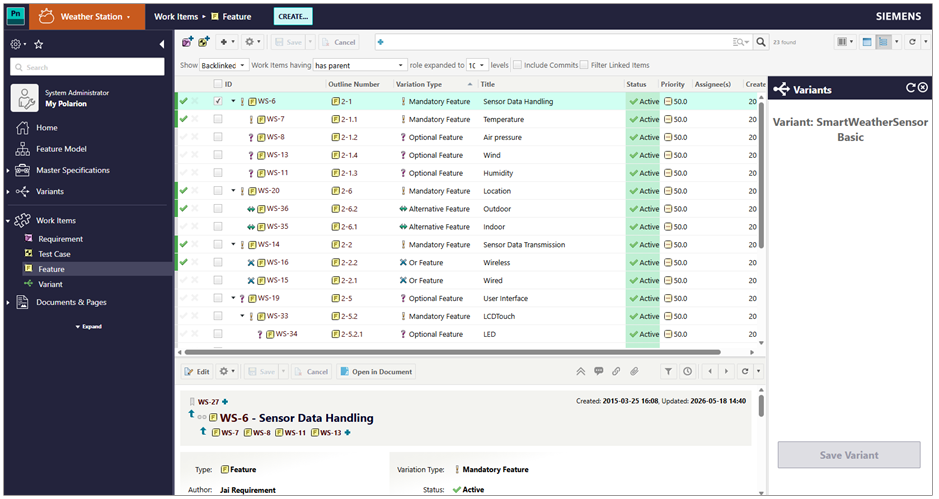
The September 2026 Polarion X 2606 release extends its Copilot API for customer customizations. Its bring-your-own-language-model approach requires the Copilot add-on and a connected model. The release also adds 13 interface languages, right-to-left support and group synchronization with Azure AD. These are useful clues about the audience: international organizations with engineering systems and identity policies already in place.
For buyers, the limit is equally practical. Traceability software needs meaningful requirements, maintained links and agreed responsibilities. Where those are absent, an elaborate platform can preserve confusion with admirable precision. A small team doing low-risk work may have little reason to accept the administration of a formal lifecycle system. The case for Polarion strengthens as coordination, reuse and evidence become consequential.
Return to the test team at Phoenix Contact. Its problem was knowing what had reached the product soon enough to verify it properly. That is the proposition worth examining in a Polarion demonstration: change one requirement, follow its consequences and ask who learns what. The demonstration gets interesting when the original promise has to survive a revision.