A kiosk is a wonderfully modest machine when it works. It accepts the order, prints the ticket and asks for no applause. Let it freeze at lunch, however, and it becomes the most important object in the restaurant. Shiv Sundar has built a career around this abrupt promotion from invisible to indispensable.
His work sits beneath the screens bolted to counters, mounted in hallways and carried across warehouse floors. These devices have one job, often a dull one, and very little permission to fail. Sundar’s company, Esper, helps businesses configure them, update them, watch their condition and repair many of their troubles from a distance. It is infrastructure with a peculiar ambition: to be noticed as rarely as possible.
Sundar now serves as Esper’s co-founder and Chief Business Operator. The title is accurate but incomplete. The company also calls him a hardware matchmaker, which is both more charming and more revealing. His skill is knowing which device will “just work” in an unusually specific setting. That instinct came from two decades spent where software meets the physical world, a border where elegant plans routinely encounter dust, weak networks, old processors and somebody’s sticky finger.
The phone years were an apprenticeship
Sundar arrived in the industry as an electrical engineer. After a bachelor’s degree in electronics engineering at Motilal Nehru National Institute of Technology and a master’s degree in electrical engineering at the University of Southern California, he worked in embedded systems. In 2005 he entered Microsoft’s Windows Mobile organization. He moved through hardware and software quality, product work and mobile partnerships, eventually helping commercialize Windows Phone devices.
This was a useful place to learn that a device is never merely a device. It is an agreement among a chip, an operating system, an original equipment manufacturer, a carrier, a developer, a retailer and a customer who has no interest in hearing which member of the ensemble missed a cue. Sundar worked near both the engineering and commercial sides of that arrangement.
He also met Yadhu Gopalan at Microsoft. Gopalan worked closer to the systems architecture; Sundar operated around commercialization and business development. Their duties crossed during the Windows Phone years, including around the Nokia relationship. The two learned how the other worked long before either needed a co-founder.
Embedded engineering gives way to Microsoft’s mobile organization.
Product and partnership roles at Samsung, Quixey, Cyanogen and Huawei widen his view of the Android ecosystem.
A one-way ticket to India turns a broad interest in devices into a specific deployment problem.
Sundar and Gopalan begin building Esper together.
A $60 million Series C follows rapid customer and revenue growth.
After Microsoft came Samsung Mobile, the search company Quixey, the Android software maker Cyanogen and Huawei. The job titles varied, but the education accumulated in one direction: how open-source software, device makers and commercial partnerships fit together. At Huawei, he ran Android partnerships. At Cyanogen, he managed OEM relationships. Those roles are less romantic than inventing a gadget in a garage, but they are how gadgets escape the garage.
A one-way ticket and a better question
In 2017, Sundar left his Silicon Valley job and took a one-way ticket to India. There he saw Android appearing everywhere beyond the personal phone. Businesses were adopting tablets, checkout screens and other dedicated machines, but the tools for managing those fleets had largely been designed for employee handsets. A phone in a pocket and a kiosk taking payments may share an operating system. Their obligations are quite different.
The opportunity was not simply to sell another management console. Companies needed to know whether a device was online, whether its application worked, whether a software release had failed and whether the machine could be repaired without sending a technician across town. They needed deployment, visibility, remote debugging, security and updates tied together over the device’s working life.
“Focus on creating a truly differentiated product offering that addresses the pain point of customers.”Shiv Sundar on Esper’s early product lesson
Sundar began laying the groundwork in India, then returned to Silicon Valley and widened the plan to include the United States. By 2018, Gopalan had left Amazon and the former Microsoft colleagues joined forces. Gopalan later explained the logic plainly: he wanted a partner who was not another version of himself. Sundar brought the manufacturers, partnerships and route to market; Gopalan brought deep operating-system and cloud infrastructure experience. Together, their earlier work had touched more than 100 million devices.
Esper launched around dedicated Android equipment in late 2018. Its proposition borrowed the cadence of modern software operations: automate configurations, stage application releases, monitor devices and roll back failed changes. The phrase “DevOps for devices” helped explain the idea. The machinery remained more literal. A restaurant could not simply hope that thousands of screens woke up in the right state each morning.
The operating-edge stack
The mistake that sharpened the company
The early team did what young companies are often advised to do and what customers rarely reward: it copied features from established competitors. Sundar later described those “me-too” features as his biggest entrepreneurial failure. They were familiar, defensible on a comparison table and not especially attractive to buyers.
The correction was not theatrical. Esper paid closer attention. Its early customers had often tried other products and failed to deploy their devices. They found Esper through technical content and through the company’s work validating many hardware shapes and Android versions. When Esper concentrated on the pain already sitting in those customers’ offices, Sundar said adoption rose.
It is a compact lesson in the difference between commitment and vanity. Sundar stayed committed to the problem while allowing the product thesis to change. By 2020, he was talking about customer empathy as the dividing line between imitation and a useful product. The company offered remote diagnosis, zero-touch provisioning, monitoring, kiosk controls and its own Android foundation. The list mattered because every item answered an inconvenience somebody had actually experienced.
Capital followed. Esper raised a $30 million Series B in May 2021, then a $60 million Series C led by Insight Partners that October. The company said it had attracted nearly $100 million since founding. At the Series C, it reported more than 200 paying customers and 2,000 developers using the platform. Revenue had grown fourfold during 2021. Sundar, overseeing broad operational and commercial responsibilities, said the India team then numbered 83 and was expected to expand.
Twenty years to Barcelona
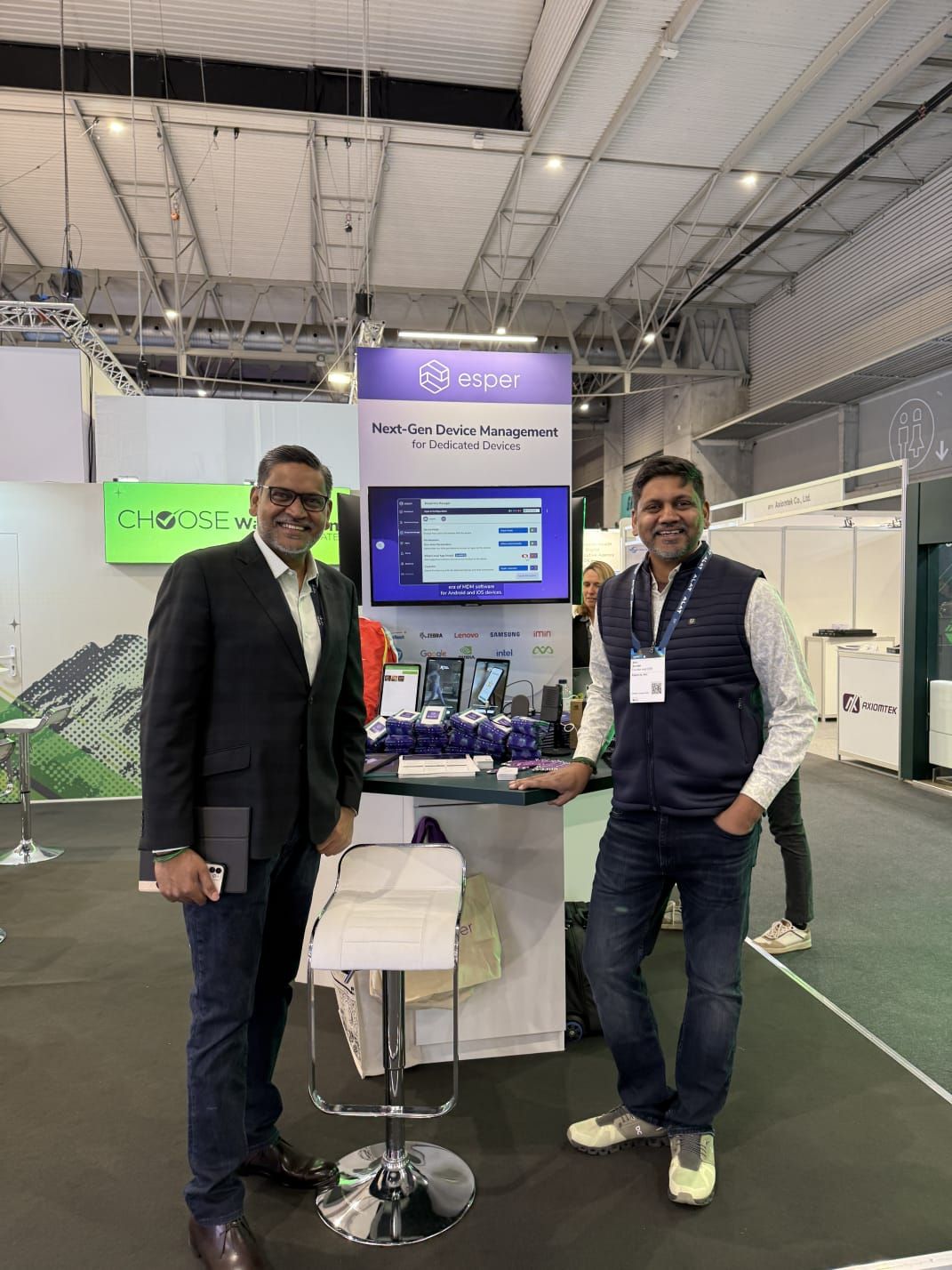
When Sundar joined Microsoft in 2005, one of his ambitions was to attend Mobile World Congress in Barcelona. He reached it twenty years later, representing Esper and the state of Washington. The industry around him had changed its clothes. Windows Mobile had receded. Android had moved far beyond the phone. Esper itself had expanded its management platform across Android, iOS, Windows and Linux.
The personal detail made the milestone land. His brother and role model, Sendhil Kumar, was there and brought colleagues to the Esper booth each evening. Sundar marked the anniversary with gratitude to managers, colleagues, investors, Gopalan and the company’s team. It was a founder’s post with none of the lonely-genius mythology. The cast list was long.
That preference for networks over lone heroes also appears in his current work with channel partners. Hardware does not create value because an invoice exists. A terminal may still be in its box, badly configured or underused. Sundar argues that manufacturers, distributors, resellers and software companies have to cover one another’s gaps so the device produces a result after it is sold. His practical unit of success is not the shipment. It is the working life that follows.
The next edge is intelligent, and still physical
Sundar’s recent focus has turned toward edge AI, especially in retail. The attraction is easy to see: models running closer to the customer can support recommendations, inventory decisions and faster service without sending every task to a distant cloud. The obstacle is equally concrete. Stores contain old checkout terminals, scanners, signs and kiosks, often split across different management systems. An algorithm may be ready while the plumbing is not.
His playbook begins with an inventory of those machines, then unified management, telemetry and automated deployment. It sounds almost stubbornly unglamorous beside the language of artificial intelligence. That is precisely why it is credible. Before a model can transform a shop, somebody has to know which processor sits behind the counter, which software version it runs and whether Tuesday’s update reached Toledo.
This is where Sundar’s career resolves into a coherent shape. The embedded engineer understands the board. The Microsoft veteran understands an operating system’s dependence on partners. The Android operator understands device variety. The founder understands that customers do not purchase architectures; they purchase fewer failures, faster rollouts and a machine that performs its one modest duty.
The edge is often presented as a futuristic place. In Sundar’s telling, it is already here, taking an order and scanning a box. Its machines are commonplace, stubborn and increasingly important. The better they work, the less anyone will think about them. For a hardware matchmaker, invisibility is a rather elegant form of success.