Forecasts are indoor creatures. They like clean columns, regular quarters, reliable connections and the soothing fiction that next Tuesday will behave roughly like last Tuesday. Kenny Hsu built a career making those forecasts more intelligent. Then he became chief business officer of a company whose machines are designed for the places where the tidy assumptions run out.
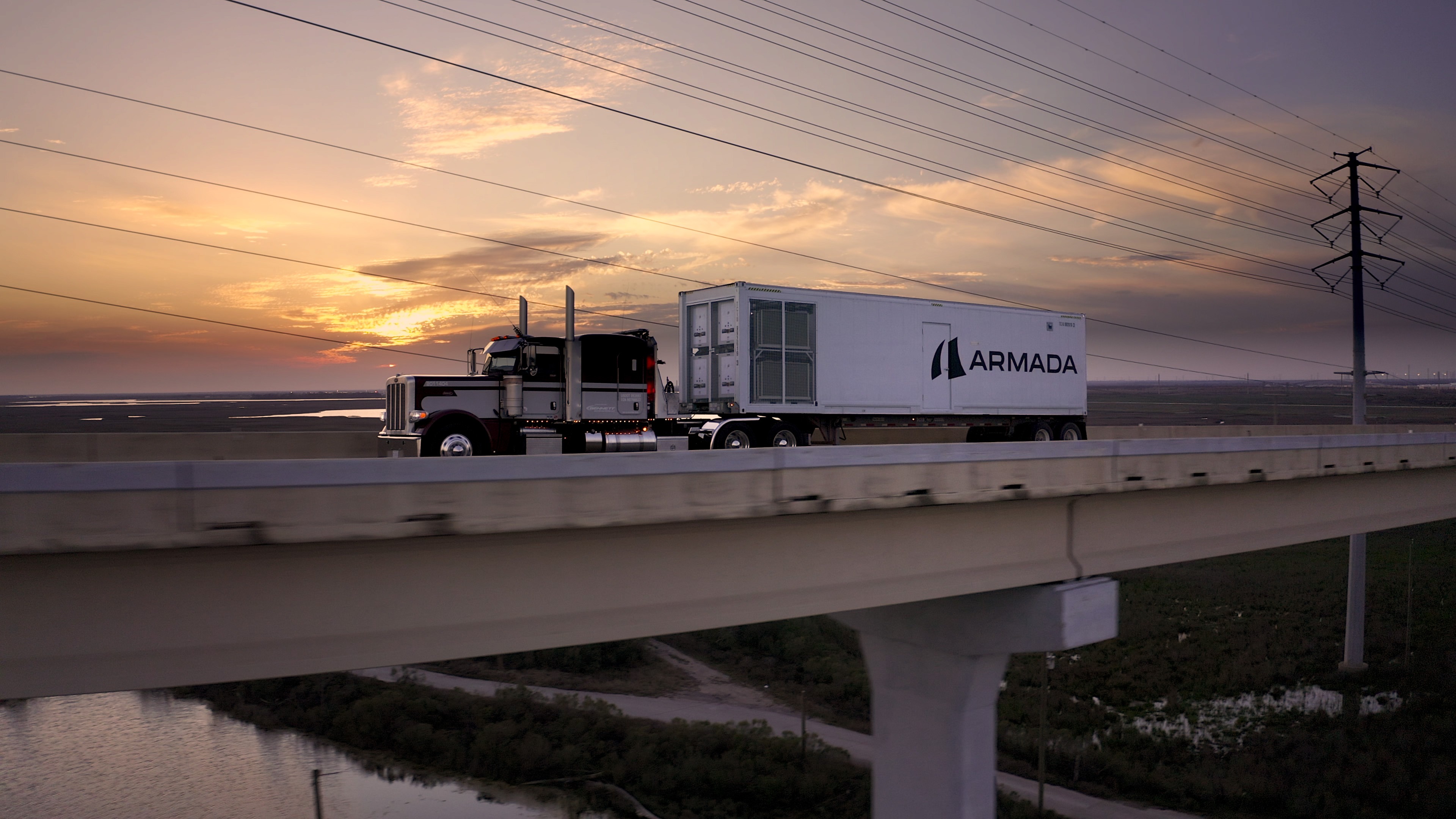
Armada's proposition begins at the edge of ordinary infrastructure: mines, oil fields, factories, emergency operations and defense sites where the cloud can be too distant, the connection too brittle or the data too sensitive to make a long round trip. Its Galleon systems are ruggedized, modular data centers. Its software manages connectivity, devices and workloads across distributed sites. In 2026 the company described a collaboration that combines its platform with Microsoft Azure Local and Foundry Local, allowing some AI work to stay on site even when the public cloud is unavailable.
Hsu's job is to help turn that engineering proposition into a repeatable business. It is an intriguing assignment for an executive whose public record is full of less cinematic nouns: quota, pricing, territories, forecast, margin. Yet those nouns are the load-bearing beams. A portable data center may arrive by truck; a durable company still arrives by operating discipline.
A life in the connective tissue
Long before edge AI became a boardroom phrase, Hsu was learning how organizations decide what a number means. His career has included Deloitte & Touche, Colliers International, Evans & Evans, McKinsey & Company, Symphony Commerce and Medallia. The list moves through accounting, property, advisory work and software, but the common territory is the space between analysis and action. It is the connective tissue of a business, rarely glamorous and painfully obvious when it fails.
The academic clues are equally numerical. Hsu received a full-tuition merit scholarship at the University of British Columbia. He earned the Chartered Financial Analyst credential in 2005. At Columbia Business School he ranked near the top of his class, graduated in the top 10 percent and joined Beta Gamma Sigma. His profile says he was selected as a Career Fellow, mentoring classmates through the MBA job search. It also records a social-enterprise project devising a tourism-promotion strategy for Kumasi, Ghana.
There was an early field trip, too. In 2008, Columbia published his study-tour paper on affordable housing in Mexico. The paper, a runner-up in the school's competition, examined what visits to housing developments could reveal about making home ownership attainable. Even the title, The Mexican Dream, points toward a recurring interest: take an ambitious proposition, inspect the system beneath it, and ask what would allow it to work in practice.
The operating route
The number needs a story
At Anaplan, Hsu became Global Head of Sales Planning and Analytics. A 2020 industry profile described his remit: lead the global organization and its sales analytics, use AI-driven account scoring to segment the operating model, and overhaul territories and quotas. Anaplan also put him in front of its practitioner community to discuss sales planning and execution. The work was mathematical, but never merely mathematical. Assigning a territory is a calculation with a human consequence attached.
That year, The Software Report placed him at number 16 on its list of 25 software sales executives. The recognition captured the visible half of operations: better models, sharper segmentation, cleaner allocation. Hsu's later comments reveal the other half. In a 2021 conversation after joining AuditBoard as vice president of revenue operations, he discussed a familiar benchmark: perhaps 50 to 70 percent of sales representatives should hit quota. He immediately complicated it. A percentage without context cannot tell leadership what kind of help the team needs.
“They've put at my fingertips the intelligence I need to call the right number accurately.”Kenny Hsu, on forecasting software while at AuditBoard
This is the useful paradox of Hsu's operating philosophy. He likes measurement because he distrusts the lazy conclusions measurements invite. Forecasts matter, provided the indicators fit the business. Quotas matter, provided leaders understand the conditions around them. Pricing matters, provided the company knows where its value comes from. For a smaller software company, he argued, pricing can help express a product's evolving position. As a brand matures, confidence in that value changes the negotiation.
He was equally direct about organizational politics. Revenue operations cannot float serenely above sales, marketing, customer success, finance and human resources. It has to build working relationships among them. If an operations leader wants more people or tools, Hsu's advice was to earn the investment: show results already achieved, or present a credible plan for return. Charm may open the meeting. Evidence gets a budget.
The Hsu operating test
Does the metric carry enough context to guide a decision? Do the people affected trust the model? Can the proposed investment show a return? Three plain questions, and an alarming amount of corporate fog disappears.
From recurring revenue to remote reality
AuditBoard supplied a demanding laboratory. When Hsu spoke publicly in 2021, the governance, risk and compliance software company was nearing a $100 million revenue year. Its North American sales force numbered about 40, while his revenue-operations team had four people and plans to grow. Reliable forecasting was not an administrative nicety. It was the difference between controlled expansion and an expensive surprise.
By the time Hg agreed to acquire AuditBoard for more than $3 billion in 2024, Hsu had helped run revenue operations through a consequential stretch of the company's growth. Public tributes from colleagues placed him among the leaders behind the sales organization. The outcome belonged to a large cast, a fact sensible operators tend to remember. Growth is a relay, except everyone is carrying a baton and the course keeps changing.
Armada changed the course rather dramatically. Software still matters, but now it has to meet hardware, power, cooling, manufacturing, connectivity, compliance and field deployment. In May 2026 the company announced a $230 million Series B at a $2 billion pre-money valuation, along with a Johnson Controls framework agreement for modular data center production. It said a planned Arizona facility could span up to 400,000 square feet and support more than 500 jobs. The abstractions had acquired loading docks.
GeekWire reported that Armada's Bellevue operation had reached roughly 120 people by May 2026, with more than 20 openings across engineering, infrastructure, security and product. Hsu and Chief AI Officer Prag Mishra lead the office. The pairing is telling: commercial judgment and AI leadership sit beside the engineers building the products. Armada's headquarters may be in San Francisco, but the Seattle-area hub draws on a region practiced at shipping cloud systems at scale.
For Hsu, the move from AuditBoard to Armada looks less like reinvention than escalation. Revenue operations asked whether a company could forecast a deal. Edge infrastructure asks whether it can manufacture, deliver and support the physical system promised by that deal, often in a place with poor connectivity and unforgiving conditions. The spreadsheet has left the building. It is bouncing down a road on a flatbed.
The empathy inside the model
Operational executives are easily caricatured as people who see employees as rows and customers as probabilities. One public recommendation of Hsu resists that picture. Former colleague Juval Lerner described a mentor who pushed people toward larger challenges, kept the bigger goal in view and showed empathy toward employees, customers and investors. Those three groups rarely want the same thing on the same schedule. Considering all of them is less a personality ornament than a daily management problem.
Hsu's public comments on Armada's collaboration with UnityCloud offer another glimpse of motive. The partnership is intended to deliver sovereign AI infrastructure with tribal nations. He wrote that its mission deepened Armada's commitment to innovation and to bridging the digital divide. The language matters because infrastructure is never simply machinery. It determines who can compute, who controls the data and who must wait for someone else's network to return.
That is also where his old insistence on context becomes unexpectedly useful. A remote site is all context: weather, distance, power, regulation, bandwidth, skills and urgency. A solution that ignores any one of them can be impressive in a demonstration and useless by Thursday. The edge punishes generic thinking.
At the edge, every clean business model eventually meets dust, distance and a deadline.
Hsu's contribution is unlikely to be the loudest object in Armada's story. Galleons have steel, scale and the natural charisma of heavy equipment. Business operations work through quieter instruments: a partner aligned, a price made defensible, a forecast made credible, a deployment converted into a pattern that can be repeated. It is the work of translating possibility into an organization capable of keeping its promises.
The title chief business officer can mean almost anything. In Hsu's case, the career beneath it supplies a more exact definition. He is an operator trained to ask whether the numbers describe reality, whether the teams can act together and whether growth has an architecture. Armada is betting that computing can go almost anywhere. Hsu's job is to make the arithmetic travel with it.