Michael Schultz has a habit of arriving just before the vocabulary settles. Web meetings were still a product category when he worked at PlaceWare. Electronic signatures still needed an explanation when he moved through product marketing and alliances at DocuSign. Ethical hackers needed corporate permission slips at Bugcrowd. Predictive selling had to prove it was more than a clever score at Enlyft. Now, at LogicGate, the word in need of careful handling is “agentic.”
This is a peculiar specialty, because it rarely appears on a job description. Schultz is a marketing executive by title. In practice, his work has repeatedly involved taking a technical possibility, finding the decision it improves, and explaining the connection without frightening the procurement committee. His résumé is less a climb through one industry than a tour of enterprise software at the moment each category asks to be taken seriously.
In November 2025, LogicGate named him chief marketing officer. The remit is broad: digital, brand and communications, product marketing, demand generation, and analyst relations. The company sells governance, risk, and compliance software, commonly compressed into GRC, a category whose acronym has the warmth of a filing cabinet. Yet its promise is plain enough. Help companies see risk sooner, organize evidence, automate repeatable work, and explain decisions when someone important asks.
Seven verbs and a career
Schultz’s career can be read through seven verbs: meet, sign, engage, secure, automate, predict, govern. PlaceWare made web meetings practical. DocuSign moved agreements out of printers and fax machines. ClearSlide measured how buyers engaged with sales material. Bugcrowd recruited ethical hackers into structured security programs. Nintex automated processes. Enlyft predicted which accounts deserved attention. LogicGate organizes how enterprises govern risk, including the risks created by AI itself.
The changing enterprise software verb
The verbs reveal how software changed. Early SaaS digitized recognizable office behavior. Later products measured that behavior, orchestrated it, and began recommending what people should do next. Agentic software goes another step. It can carry out parts of the work. That makes a marketer’s choice of language unusually consequential. “Assistant” suggests a tool. “Agent” suggests delegated authority. Enterprise buyers will quite reasonably ask who remains responsible when the agent is wrong.
Schultz’s current message does not wave away that question. His writing about third-party risk argues for connected records, traceable decisions, and named human approval before AI-generated findings become official. The underlying pitch is not autonomy at any price. It is speed inside a system that can still defend its own output.
“It’s about bringing data in that allows the right questions to be asked.”Michael Schultz, discussing sales forecasting at ClearSlide
The English major in the machine room
Schultz studied English at Tufts University, then earned an MBA from Dartmouth’s Tuck School of Business. It is a useful pairing for enterprise technology. One degree trains attention to language and structure; the other supplies the spreadsheets and incentives. A category marketer needs both. The feature list may be accurate, but the buyer is listening for a plot: What changes, for whom, under what constraints, and why now?
His early career included strategy consulting at Andersen Consulting, now Accenture, followed by roles at Voxeo, AOL, and PlaceWare. Microsoft acquired PlaceWare in 2003, and Schultz spent nearly eight years at Microsoft in SaaS product management and marketing. He then held product marketing and strategic-alliance leadership roles at DocuSign. These were formative categories. Web conferencing had to escape the special-event calendar. Cloud productivity had to win trust. An electronic signature had to feel as ordinary as ink while being far more useful.
At ClearSlide, where he led marketing and business development, the product sat between sales behavior and management judgment. Schultz described a shift toward guided selling and argued that better engagement data could remove emotion from forecasting. In one example, personalized video emails produced engagement rates of 60 percent or higher. The broader point was managerial: a forecast should be more than a roomful of optimism.
The recurring Schultz test: Does the technology improve a decision, and can the person responsible explain how? At ClearSlide the decision was where a sales leader should intervene. At Enlyft it was which account to pursue. At LogicGate it is what risk to accept, escalate, or remediate.
ClearSlide also joined a pattern that continues through his later work: isolated tools becoming integrated platforms. He described 2016 as the year the company brought its capabilities together. The platform would connect meetings, content, email, mobile access, and engagement analytics. A decade later, his argument against improvised third-party risk tools sounds like a more regulated cousin of the same idea. Scattered activities are hard to understand. Connected data creates the view from above.
From the crowd to the workflow
In 2018, Schultz joined Bugcrowd as vice president of marketing. Crowdsourced security asked companies to reconsider a loaded word: hacker. The service brought independent security researchers into authorized programs for finding vulnerabilities. Schultz’s public writing from the period covered managed bug bounties, the Internet of Things threat landscape, and Bugcrowd’s annual hacker research. The marketing task was partly commercial and partly cultural. A stranger probing your software could be an adversary, or the person who saves you from one.
Nintex hired him in 2019 as vice president of product, channel, and field marketing. He later served as senior vice president of marketing. The company was expanding beyond workflow into robotic process automation and e-signatures, and Schultz framed the opportunity around process excellence. The move reunited several strands of his career: documents, signatures, cloud services, partners, and the stubborn little gaps between systems where employees still copy and paste.
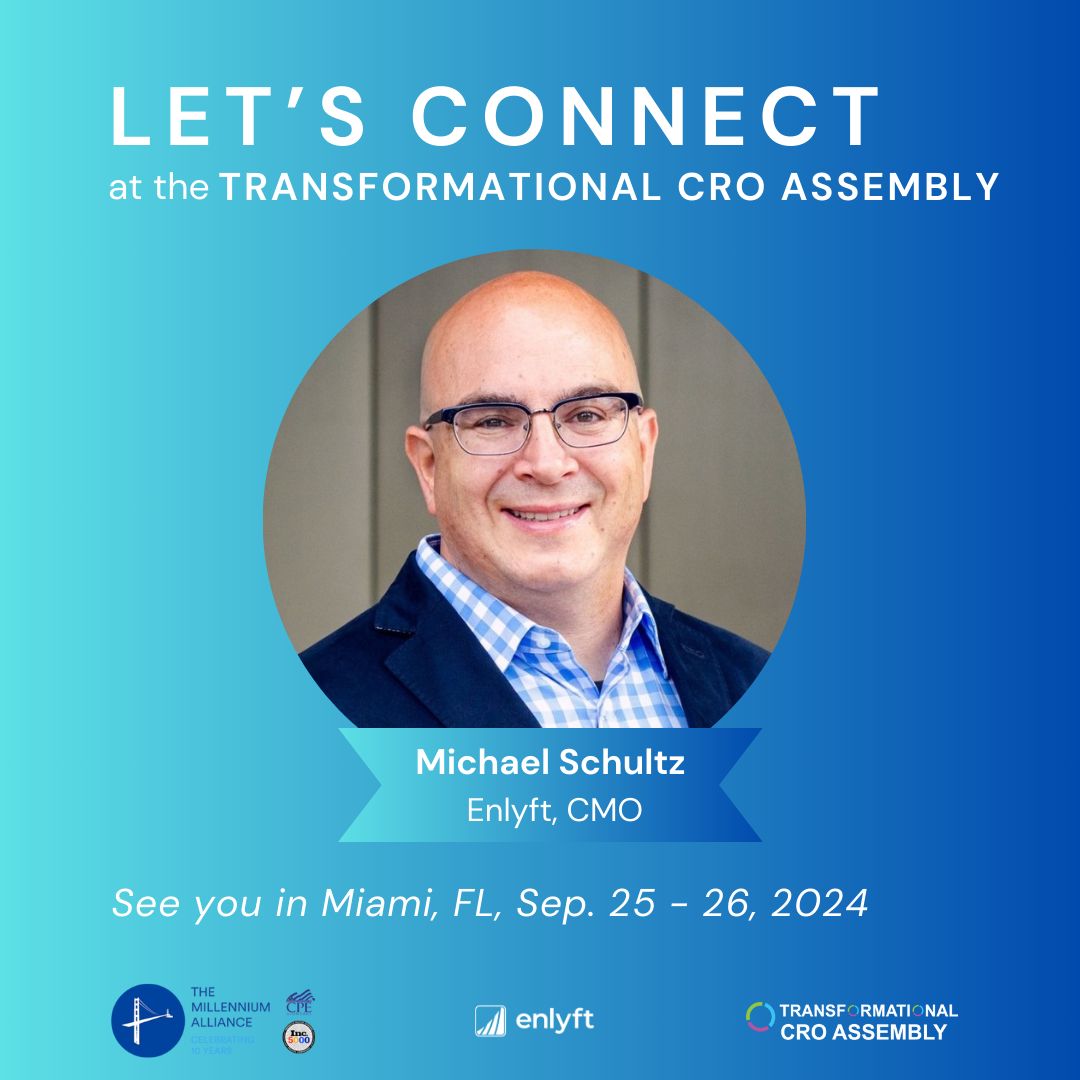
By 2023, as CMO of Enlyft, his focus had shifted from automating work to improving whom a go-to-market team chose to contact. He also carried the title “ICP evangelist,” referring to the ideal customer profile. At the 2024 Forrester B2B Summit, he and Enlyft chief executive Lokesh Dave presented on radically transforming account fit. The company’s pitch combined a graph of companies and technologies with buying signals, predictive models, and generative AI.
“Our primary goals in using AI are to shorten the time to close deals and be very clear and crisp about who are the right companies to target and why.”Michael Schultz, while CMO of Enlyft
The quote is revealing because the objective is concrete. AI is not there to sprinkle prose over a campaign. It should improve selection and speed, with scores that give the team evidence for the choice. Schultz also spoke about using engagement and intent signals to understand where buyers move forward and where they fall away. The old ClearSlide concern had evolved. First measure engagement inside a deal; then predict which companies are most likely to produce one.
Now the software makes a move
Schultz worked with Responsive on product-led growth, pricing, and AI-powered solutions before arriving at LogicGate. In announcing the move, he thanked the Responsive team and described LogicGate as a rare opportunity in a mission-critical category. He also named the leadership group welcoming him and praised his new marketing team. The post had the brisk, team-forward energy of a person already turning an org chart into a cast.
The assignment grew more interesting in 2026. LogicGate introduced Config Newton, which it describes as an agentic GRC engineer. Schultz framed the launch as a category moving from AI that assists toward AI that executes. The company says the agent can configure workflows from natural-language prompts while presenting reasoning for human review. The important word here may be “review.” GRC exists because organizations need more than an answer. They need a record of how the answer became a decision.
That distinction runs through Schultz’s August essay on why companies cannot “vibe code” a third-party risk program. A quick AI-built questionnaire or vendor score may look productive. Without a persistent model connecting vendors, contracts, assessments, controls, and approvals, it does not survive personnel changes or an auditor’s questions. The essay makes the case in operational terms: automation is welcome, provided its work lands inside a durable system with a named human in the loop.
There is an almost comic reversal in the career arc. Marketing is often accused of adding feeling to facts. Schultz has repeatedly argued for bringing facts into feelings: engagement data into the hopeful forecast, account signals into the ambitious campaign, approval records into the confident AI result. The goal is not to drain judgment from work. It is to give judgment something sturdier than enthusiasm.
The category after the category
LogicGate is based in Chicago, while Schultz remains part of the Greater Seattle technology community. The company has been building a Bellevue presence, placing him near another chapter of his professional geography. PlaceWare, Microsoft, Enlyft, and now LogicGate’s regional expansion all connect to the same ecosystem, one unusually practiced at turning business software into infrastructure.
His public career offers no grand founder myth and no single product with his name on it. Its interest lies elsewhere. Schultz has worked beside multiple transitions that now look inevitable only because their vocabulary became ordinary. Meet online. Sign digitally. Invite the ethical hacker. Automate the workflow. Score the account. Govern the agent. Each sentence once required a longer meeting.
The next part of his work is to make agentic risk management understandable without making it sound harmless. That requires a useful balance: enough imagination to show what changes, enough precision to say who remains accountable. Enterprise software can sell speed in a demo. Trust takes longer. Schultz’s career suggests he knows the second sale is the one that makes the first endure.