You have probably used OneTrust without knowing its name. It is the software behind that small, stubborn referendum at the bottom of a website: accept all cookies, reject the optional ones, or disappear into a preference center with the tonal warmth of a tax form.
The pop-up is easy to mock. The machinery behind it is not. A global company has to know which trackers fire on which page, what each one does, which law applies to which visitor, where that person's preferences must travel, and how to prove the whole sequence later. Multiply that across apps, televisions, brands, languages and hundreds of vendors. OneTrust sells the system that keeps the answer from living in six spreadsheets and one employee's head.
That is the compact version of a much larger business. OneTrust now packages consent, privacy operations, regulatory research, data discovery, technology compliance, third-party risk and AI governance into an enterprise platform. More than 14,000 organizations use it, including over half of the Fortune 500. The customers shown publicly range from Samsung and Adobe to Air Canada, Pfizer, Maersk and BT Group. Its users are the people who get called when data goes somewhere it should not: privacy lawyers, security teams, procurement managers, marketers, data stewards and, increasingly, AI-governance councils.
The deadline was the distribution strategy
Kabir Barday founded OneTrust in Atlanta in 2016, after working in product at mobile-security company AirWatch. The timing was almost suspiciously good. Europe's General Data Protection Regulation had been approved and would become enforceable in May 2018. Companies suddenly needed records of processing, impact assessments, consent logs and machinery for access or deletion requests. The work was legal in origin but operational in practice. Lawyers could interpret the rule; they could not manually inspect every database, vendor and web page forever.

OneTrust did three things precisely. It built before the enforcement date, treated education as distribution, and encoded the work of scarce specialists into reusable forms and workflows. In 2019 Barday told Axios, “You can't just throw 500 bodies at the problem.” By then the company had already acquired DataGuidance, a regulatory-intelligence service that now contains more than 25,000 articles and guidance notes backed by a network of roughly 1,700 expert contributors. That library matters because a workflow engine without current rules is just a very organized way to be wrong.
The numbers ran hot. OneTrust said it reached 3,000 customers and 1,000 employees before announcing its first institutional financing: a $200 million Series A in July 2019 at a $1.3 billion valuation. A $210 million Series B followed in February 2020. In December came a $300 million Series C, then a $210 million extension in April 2021. The valuation reached $5.3 billion. Inc. put OneTrust first on its 2020 list of America's fastest-growing private companies after measuring more than 48,000 percent revenue growth over three years.
Valuation climbed faster than the product menu
The 2023 round was not a collapse. It was a correction - and a public reminder that private-company marks move in both directions.
Then “trust” became too much company
Flush with capital, OneTrust expanded the noun it claimed to own. Privacy became “trust intelligence,” a category wide enough to include security certification, ethics hotlines, ESG reporting, third-party diligence, consent and data governance. Acquisitions supplied the pieces: Integris for data discovery, Convercent for ethics and compliance, Tugboat Logic for security assurance, Planetly for carbon accounting, and DocuVision technology for redaction.
The ambition made sense on a slide. All these teams collect evidence, assess risk and prove that a company followed a rule. But adjacent workflows do not automatically make a coherent product. Each new domain brings different buyers, budgets, data and specialists. An enterprise suite can reduce tool sprawl; it can also become the tool sprawl, neatly invoiced by one vendor.

The first thing to fail was the hypergrowth math. In June 2022, as technology valuations fell and investors began rewarding cash efficiency, OneTrust eliminated 950 jobs, about a quarter of its workforce. Barday said the capital markets had shifted away from financing fast-growing companies. A year later, OneTrust raised $150 million led by Generation Investment Management, with Sands Capital participating. The round took total funding above $1 billion but valued the company at $4.5 billion, below the 2021 peak. OneTrust said annual recurring revenue had doubled to $400 million since 2021 and that it had reached free-cash-flow milestones.
The product map now says what strategy decks rarely do: breadth has a carrying cost.The visible lesson from OneTrust's reset
What changed its mind is visible in actions, even if no executive has narrated a tidy conversion. In late 2024, OneTrust sold the ethics-and-compliance business, including Convercent, to EQS Group. A company that once argued every trust function belonged together was pruning the suite. Then, in 2026, it introduced a new identity around “AI-ready governance,” while promising existing product functionality would remain. The word “trust” did not disappear; it got a more specific job.
The second act: make policy executable
Traditional governance produces documents: an inventory, an assessment, a control list, an approval. AI systems make decisions continuously. Models change, agents call tools, vendors add features, and data travels through pipelines no committee sees in real time. OneTrust's new pitch is that governance must move from periodic proof to continuous control.
Find data, models, agents, vendors and their owners.
Map purpose and risk to laws, policies and frameworks.
Put approvals and controls inside operating systems.
Watch signals, changes and evidence after launch.
The AI Governance product inventories models, agents, datasets, projects and third-party systems. It applies templates for the EU AI Act, NIST's AI Risk Management Framework and ISO 42001; routes reviews; generates documentation; and ingests telemetry for drift, quality, safety and performance. Integrations with Azure OpenAI, Amazon SageMaker, Google Vertex AI and Databricks pull technical facts into the same record used by privacy, security and legal teams. A Privacy Breach Response Agent built with Microsoft Security Copilot applies regulatory context to incident triage and notification work.
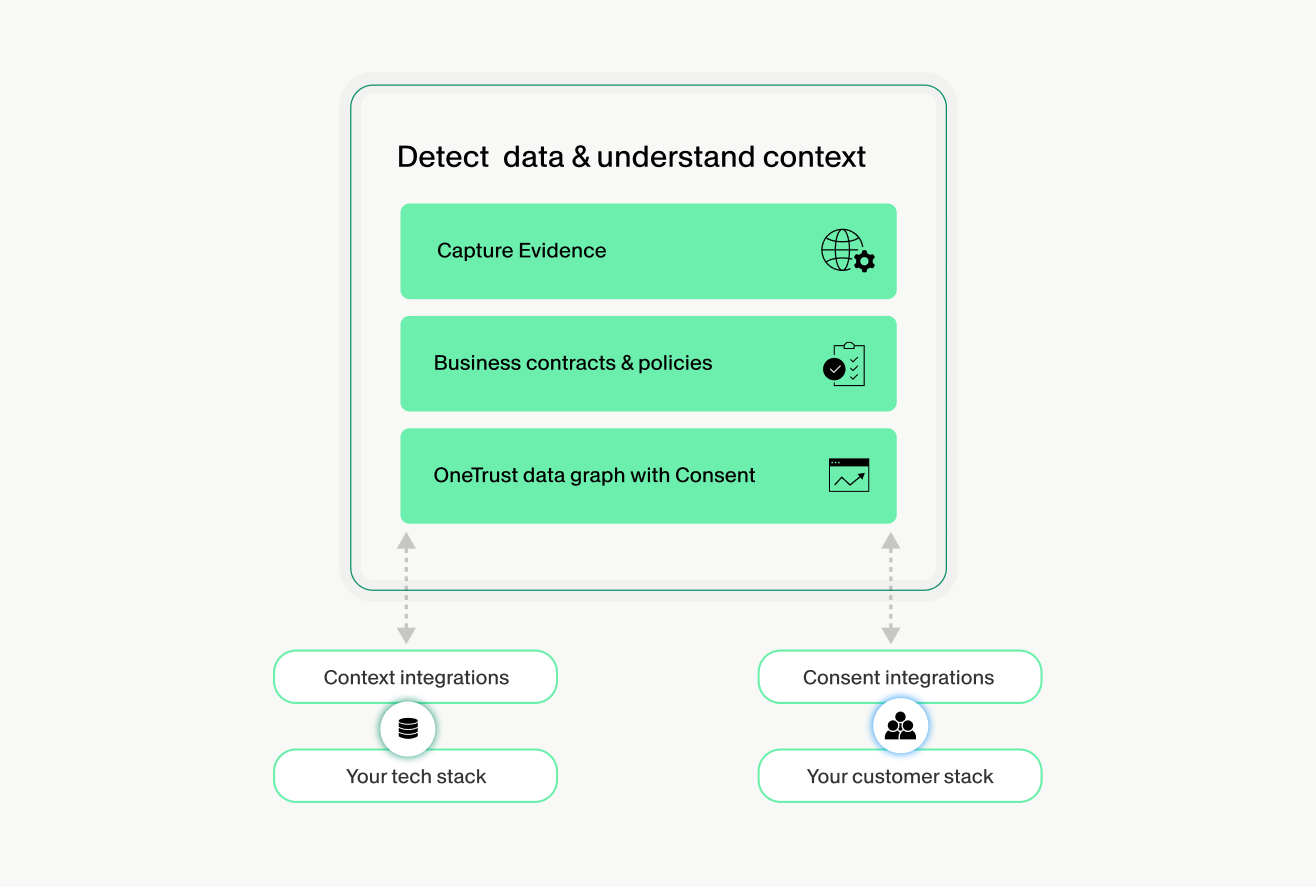
This is how OneTrust differs from narrower alternatives. A consent specialist may be easier to deploy for a few websites. A data-security platform may scan sensitive data more deeply. An AI-governance pure play may move faster on model evaluation. OneTrust's advantage is organizational coverage: it already has relationships with the privacy, legal, risk and security teams that must agree on the answer. Its disadvantage is the same breadth. Configuration, integrations, administrators and training are real parts of the purchase.
OneTrust does not publish a rate card. It sells annual enterprise subscriptions in configurable packages, with price shaped by modules, properties, users, data scope and services. That makes a crisp cost comparison impossible without a quote. A 2024 Forrester study commissioned by OneTrust modeled a composite customer at 227 percent return over three years, with payback within seven months, a 75 percent lift in privacy-team productivity and $195,000 in annual technology and services savings. Useful numbers, but buyers should treat a commissioned composite as a hypothesis to test against their own process map.
What to copy - and what to leave alone
The transferable OneTrust playbook has little to do with privacy. Find a deadline that turns expert advice into recurring operations. Build before the enforcement date. Teach the market while customers are still confused. Convert the specialist's checklist into a shared workflow, then connect it to the systems where evidence already lives. Expansion works best when the next product serves the same committee and reuses the same data.
A regulation is a distribution event only if the product exists while buyers are learning the problem.
The defensible asset is not the form. It is current interpretation linked to repeatable decisions and evidence.
Expansion becomes credible when one inventory can power privacy, vendor, data and AI reviews.
A platform saves tools only when administration, implementation and ownership cost less than the sprawl.
The approach is a poor fit for a small company with one site, a simple data estate and no dedicated privacy or risk operator. Those buyers may get more value from a focused consent product, a managed service or the tools already bundled with their cloud stack. It also struggles when no executive owns governance across departments. Software can route an approval; it cannot make legal, security and product agree on risk appetite.
For a multinational with dozens of brands, hundreds of vendors and AI appearing in every business unit, the calculation changes. The alternative is not a cheaper banner. It is a web of tickets, consultants, spreadsheets and institutional memory. OneTrust is betting that the company that organized privacy's paperwork can become the place where machines are given permission to act.
That bet is plausible, not settled. OneTrust has distribution, regulatory depth and a decade of enterprise workflow experience. It also carries the scar tissue of a category that grew too wide and a platform that asks customers to do real implementation work. The cookie banner made OneTrust visible. The next decade depends on whether the software behind the box can govern what nobody can see.