The internet's most familiar privacy ritual is also its strangest. A visitor meets a rectangle full of tiny switches, makes a choice and disappears into the site. Somewhere, a consent platform records the click. Then the rest of the machinery - ad pixels, email tools, data warehouses, analytics scripts and now AI models - carries on. The interface looked official. The hard question is whether anything downstream listened.
Ketch has built its company around that gap. The San Francisco software maker captures consent and privacy preferences, connects them to a person's identity, and pushes those decisions into the systems that collect or use data. It also automates access and deletion requests, maps data, scans websites for questionable transfers, and applies policy to AI workflows. Its term for the whole arrangement is “data permissioning.” The plain-English version is better: make a person's choice travel with their data.
That is a more ambitious job than drawing a prettier banner. It makes Ketch part consent-management platform, part workflow engine and part control plane. Privacy and legal teams get rules and evidence. Engineers get APIs and integrations. Marketers get a pool of data they can use with a cleaner conscience and, ideally, fewer angry emails from counsel.
The first failure happens after “no”
Ketch's origin story begins with people who knew the data business from the inside. CEO Tom Chavez and CTO Vivek Vaidya previously co-founded Krux, a data-management platform Salesforce acquired in 2016. At Ketch's public debut, Vaidya described the founding question as: “What kind of infrastructure can we build that will make our former selves better?” It is a compact confession from two ad-tech veterans. The industry had become very good at identifying people and moving information. Permission had not become equally portable.
The company started in 2020 as Switchbit, then became Ketch. Chavez, Vaidya, product chief Maxwell Anderson and infrastructure chief Anton Winter built a platform meant to turn jurisdiction, purpose and consent into machine-readable instructions. A European visitor, a Californian teenager and an Illinois shopper can trigger different rules. The useful trick is not merely showing each one the right notice. It is carrying the resulting choice into every connected destination.
What fails first in a typical setup is the handoff. A tag is misclassified. A vendor strips a consent signal. The website honors an opt-out but the marketing database does not. Ketch says its own research found 40 percent of trackers ignoring consumer opt-outs. That figure is a company claim, but the product response is concrete: Data Sentry watches live browser traffic and shows what information leaves, where it goes and whether the transfer matches the policy. It is closer to a privacy smoke alarm than another policy binder.
A platform with a very visible front door
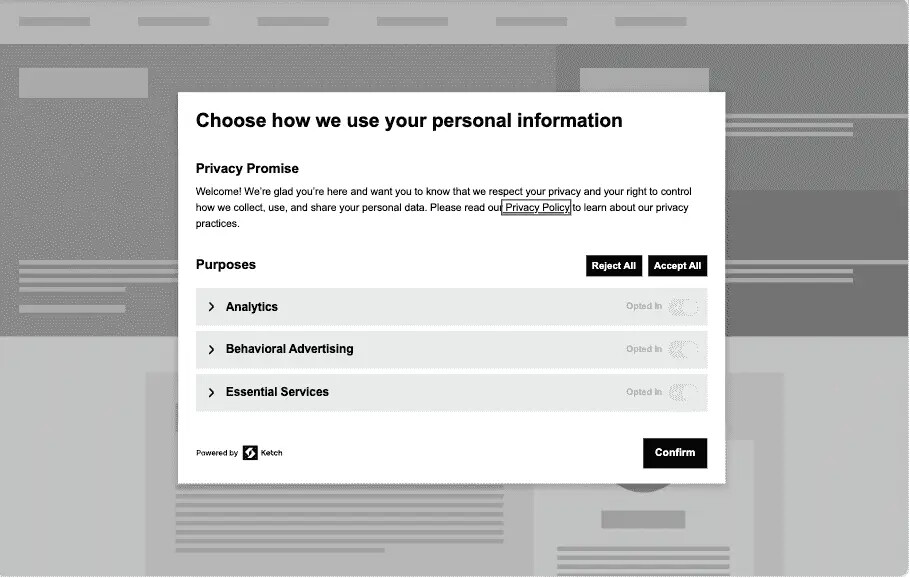
The product begins where most buyers expect. Ketch Consent Management supplies jurisdiction-aware notices, preference centers, consent records and tracker controls. Privacy Experiences lets nontechnical teams style those interfaces without code. Progressive Consent moves the request into a moment of value - a discount, a virtual try-on, a useful personalization - instead of demanding a lifetime data treaty from someone who has been on the site for six seconds.
Behind the interface sit the less photogenic products. DSR Automation routes requests for access, deletion and opt-out through connected systems. Data Mapping and Discovery builds an inventory of where sensitive information lives. Identity Sync tries to make a preference survive across browsers, devices and identifiers. The Permission Vault stores the decision, and a component called Transponder carries it into the stack.
In 2025, Ketch added Data Sentry and Progressive Consent. In 2026, the pitch moved decisively toward AI. The Ketch Agent Network gathers context from laws, contracts, repositories and configurations; drafts assessments; and proposes changes for human approval. AI Sentry sits nearer the model call, where Ketch says it can detect personal information and block or redact data that policy does not permit. This is a logical expansion, but also a demanding one. A cookie banner can be judged with a browser. Runtime AI governance must survive messy identity, ambiguous purpose and rapidly changing internal tools.
“A policy that cannot reach the system using the data is etiquette, not control.”YesPress analysis
The price is public until the work gets complicated
Ketch sells B2B software on a ladder. The free plan covers a full consent-management product for sites below 5,000 monthly unique users. Starter costs $150 a month for up to 30,000. Plus begins at $499 a month, billed annually, for up to 100,000. Pro is custom-priced for larger footprints and includes the broad platform. DSR automation, mapping, risk assessments and marketing preference management are separately scoped.
The openness is strategic. A small operator can install a credible banner without speaking to sales. A larger buyer can click through ungated product tours before booking a call. Then the platform expands as privacy work becomes operationally entangled. Ketch reported more than 300 percent customer growth in the six months after its March 2021 funding announcement. Today it says it supports 3,500-plus brands and 1.2 billion people, processing 67.2 billion consent transactions a month.
Named customers give that scale some shape: Paramount, TIME, One Medical, Calendly, LendingTree, OLLY, The RealReal, Purple, SingleStore and AccuWeather. TIME selected Ketch to modernize privacy-request workflows. SingleStore used it as a foundation for a customer journey tied to product-led growth. On Ketch's comparison page, an unnamed Fortune 500 retailer says it reached go-live in three weeks. These are vendor-published cases, so buyers should treat the outcomes as promising references, not universal laws.
The competitive argument is about the unit of work
OneTrust is the incumbent Ketch names most often. Transcend, DataGrail, Osano, TrustArc, Usercentrics, BigID and Sourcepoint occupy overlapping territory. Feature comparisons can become numbing: banners, requests, mapping, assessments, integrations. Ketch's more interesting distinction is philosophical. Legacy privacy software often treats a compliance task as the unit of work. Ketch wants the unit to be a permission signal that can be evaluated each time data moves.
That position explains the company's partnerships and claimed 1,000-plus connectors. Snowflake links rights workflows to warehouse data. Braze can receive marketing preferences. Salesforce, Databricks, BigQuery, ad platforms and internal databases become destinations for the same decision. Services partners including Bounteous, Boltive and VeraSafe help with the implementation that a product page can make look suspiciously easy.
Where the promise meets the wiring closet
Ketch works best when a company has meaningful personal-data flows, clear owners, resolvable identities and the appetite to connect production systems. It works poorly as a decorative banner installed by a team that will not map vendors, fix tags or wire downstream enforcement. No platform can propagate a choice into a system it cannot identify or reach.
What an operator can copy on Monday
The useful lessons are not limited to privacy teams. Ketch packages a technical control around a simple narrative: the click should have consequences. Its free tier makes that story testable. Its product tours reduce the mystery that enterprise software vendors often cultivate. And Progressive Consent reframes permission as part of a value exchange, not an obstacle placed in front of one.
- Trace one decision end to end. Pick “do not sell,” deletion or email opt-out and follow it through every system. The first broken handoff is your real roadmap.
- Ask later, with context. Request a specific permission when the customer can see the benefit. Blanket consent at arrival is easy to deploy and hard to make meaningful.
- Publish the entry price. Ketch makes the first three tiers legible. That earns attention before an enterprise buyer is ready for a scoped proposal.
- Show the product before the meeting. Four-minute interactive tours let prospects understand the workflow without surrendering an afternoon to calendar tennis.
Ketch has raised $68 million according to the company. The publicly detailed rounds include $23 million in March 2021 and a $20 million A1 six months later; Ketch also says it raised a Series B in 2024 without publishing the amount on its timeline. Funding bought the company time to broaden its claim from compliance automation to permissioning infrastructure. The bet now is that AI makes that layer more necessary, not merely more fashionable.
The risk is scope. Consent, identity, data discovery, enforcement and AI governance are each difficult markets with specialists of their own. Ketch must prove that one coordinated layer is stronger than a collection of best-of-breed tools, and that its integrations are deep enough to enforce rather than merely report. For a tiny site with simple data use, the answer may be no. For a company that cannot resolve identities across channels, the promise will fray. For a team unwilling to let privacy rules touch production, it will never get started.
But the core observation is hard to dismiss. The internet has spent years perfecting the moment when a person expresses a privacy choice, then treated the execution as somebody else's problem. Ketch wants the click to become a command. If it can keep that command intact all the way to the ad audience, warehouse row and AI prompt, the cookie banner may finally do something interesting.