The most interesting object in TrustArc’s history is small enough to sit at the bottom of a website. A privacy seal asks a visitor to believe that somebody has checked what happens to their information. Click, shop, subscribe. There is an organization behind the promise. But the seal cannot tell you when the checking happened, who did it, or what happens when the business changes.
- Started with a seal. TRUSTe began in 1997; the company became TrustArc in 2017.
- Moved into operations. Its software connects data records, risk assessments, consent and individual rights requests.
- Kept the expertise. Legal research, consulting and assurance sit alongside the software.
- Added AI assistance. Arc drafts from evidence, with review and approval still in human hands.
That distance between a promise and its upkeep is where TrustArc’s business now lives. The company sells cloud software and services to the people responsible for making privacy work inside an organization. A visitor may encounter its cookie banner. A privacy officer is more likely to encounter a queue of assessments, a data inventory and a collection of evidence that needs to survive the next question.
A badge with a maintenance schedule
TRUSTe began as a nonprofit in 1997, co-founded by Lori Fena, then associated with the Electronic Frontier Foundation, and software entrepreneur Charles Jennings. The early proposition suited an internet trying to persuade people to transact online: establish privacy expectations and give businesses a recognizable way to demonstrate them. A seal made an abstract promise visible.
The organization became a for-profit business in 2008. Then came an episode that makes a purely celebratory company biography impossible. In 2014, the Federal Trade Commission alleged more than 1,000 instances of missed annual recertifications between 2006 and January 2013, despite representations that seal holders were checked annually. It also challenged representations about nonprofit status. TRUSTe agreed to a settlement that included a $200,000 payment and additional reporting requirements.
“TRUSTe promised to hold companies accountable for protecting consumer privacy, but it fell short of that pledge.”Edith Ramirez, then FTC Chairwoman, 2014
The lesson is rather specific. In that episode, the checking fell short of the advertised schedule. Certification is a recurring obligation; a badge is merely its visible receipt. The modern company’s interest in evidence and revalidation reads differently against that history. It does not erase the settlement, and the settlement alone does not establish how today’s products perform.
The spreadsheet stops being enough
Consider a global food brand in a TrustArc-published case study. Its privacy team had been working through email and spreadsheets: manual, reactive, and increasingly difficult to manage as regulations multiplied and the volume of personal data grew. The chief privacy officer wanted a more systematic approach. TrustArc supplied tools and processes to organize that work.
This is a useful account of what changed the buyer’s mind. The existing method could record a fact, but the growing organization needed a way to keep facts, responsibilities and actions connected. An inventory becomes much less useful when it describes last year’s business. A questionnaire becomes much less reassuring when nobody owns the unanswered questions.
TrustArc’s Data Mapping & Risk Manager links systems, vendors, business processes and data flows. Higher-risk activities can lead into follow-up assessments. Assessment Manager supports configurable questionnaires, risk flags, remediation tasks and reports. The practical ambition is a route from “we use this data” to “this person must review what we do with it.”
Nymity, acquired in November 2019, supplies another part of the machinery: regulatory research. Its summaries, comparisons, alerts and operational templates help translate changing obligations into work a privacy team can assign. PrivacyCentral brings a controls-based approach to compliance, allowing shared requirements to be addressed through common evidence. The attraction is reducing repeated work when several frameworks ask related questions.
The product is the handoff
TrustArc’s range makes more sense as a sequence than as a shopping list. Privacy Studio handles outward-facing jobs such as consent, preferences and individual rights requests. The Governance Suite organizes internal records, assessments and regulatory work. Assurance Services includes TRUSTe certifications, verification and dispute resolution. Consulting adds people who can help design and operate the program.
- 01 / MapRecord the data, systems and vendors.
- 02 / AssessReview risk and assign follow-up work.
- 03 / ActHandle consent and rights requests.
- 04 / ProveMaintain evidence and revisit it.
The New England Journal of Medicine offers a revealing buying detail. In an account published by TrustArc, its data protection officer, Sean McInnis, attributes the move from OneTrust to problems with support and getting the previous cookie tool working. His praise singles out the technical account manager. This is one customer’s account, carried by the winning vendor, but its emphasis is instructive: implementation assistance can determine whether purchased capability becomes useful capability.
“Our Technical Account Manager has been a big part of our success.”Sean McInnis, Data Protection Officer, NEJM, quoted by TrustArc
Google’s own TrustArc setup instructions underline the point. A consent banner requires configuration, mapping between preference categories and consent types, and testing before publication. The interface is the visible part. Correct behavior depends on what the connected tags actually receive. The prettiest banner in the world cannot compensate for careless wiring.
What the numbers can tell you
TrustArc publishes an anonymous Fortune 100 technology customer’s results: more than 8,000 assessment users, a 60% increase in users and a 300% increase in annual assessments. The previous assessment solution was manual and hardcoded. The replacement supported more than 100 customer-specific privacy mandates. This is evidence of a reported expansion in capacity, rather than proof that every assessment produced a better decision.
At one anonymous Fortune 100 technology customer, according to TrustArc’s case study.
A separate consumer-products case reports a 15% reduction in time to compliance, operating-expense reductions of up to 30%, and automation of 75% of privacy processes. A medium-sized consumer-services case reports different results: 50% reductions in both compliance time and operating expenses, with 25% of processes automated. Those differences are worth preserving. Different starting points produce different economics.
The cases support a sensible hypothesis: organizing repeated privacy work can save effort. They do not supply a universal savings rate or a price for the reader’s organization. An anonymous case also limits outside checking. Treat the figures as questions for a demonstration: which steps disappeared, which still needed staff, and what did the customer count as an automated process?
AI, with someone still holding the pen
In October 2025, TrustArc announced Arc, an AI-powered privacy workspace. CEO Jason Wesbecher presented it as an answer to the growing workload of privacy professionals. The more revealing details arrived in the Q3 2026 product update: evidence-based draft answers with confidence indicators, cited material and reasoning; draft business-process records whose fields users can accept or edit; and assessment responses grounded in uploaded documentation.
That design places the decision at a useful point. A team can ask software to prepare an answer while retaining the obligation to inspect it. Program Builder addresses a quieter problem through prioritized plans, owners, deadlines and revalidation reminders. The two ideas belong together: producing a response faster matters less if nobody remembers to revisit it.
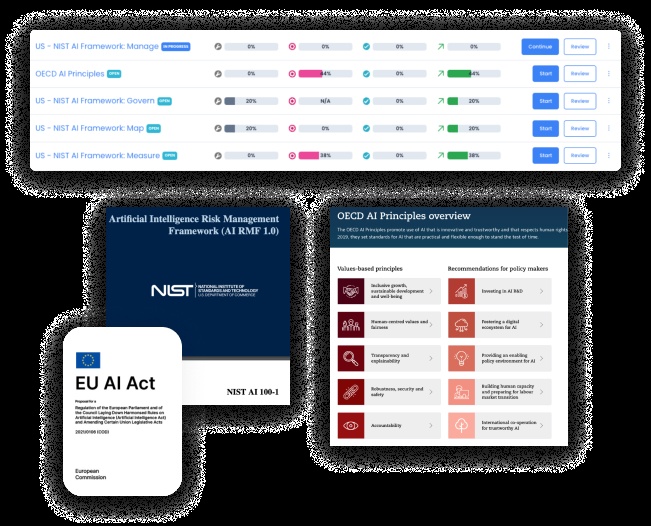
AI governance is a natural adjacent market for a company already organizing data risks, legal requirements and assessments. Its governance offering includes risk workflows and responsible AI certification. That does not make a certification a blanket verdict on every model output. Buyers still need to understand the scope of the review and the evidence behind it.
Buy the workflow, budget for the work
TrustArc occupies the enterprise privacy-management market alongside OneTrust and alternatives such as Ketch, Osano and Transcend. Its distinctive proposition is the combination of operational software, privacy research, expert services and assurance. That combination deserves consideration when a buyer needs both a system and help running it. A team seeking only a simple consent interface may have a narrower problem to solve.
The business model combines cloud software subscriptions with service and assurance engagements. Platform pricing goes through sales. A useful buying exercise is to request a scoped quote covering the modules, implementation, integrations and continuing support required for the actual workflow. Staff time belongs in that calculation, too. Software still needs accurate records, authorized access and people willing to close the tasks it creates.
Main Capital Partners announced its acquisition on October 14, 2025. At the time, the investor described more than 1,200 enterprise customers across over 25 countries. Wesbecher’s announcement set out priorities including expansion in Europe and India and more AI-driven experiences. These are stated plans, rather than completed results. The company’s public values emphasize collaboration and transparency; its CEO describes a customer-obsessed approach.
The part readers can copy requires no purchase: take one real data flow, name its owner, attach evidence, decide what triggers review, and follow one request through every handoff. If the organization cannot provide that information, automation has very little truth to organize. TrustArc’s long history returns us to the small seal at the bottom of the page. The promise is brief. Keeping it is a continuing job.
Follow the work
Explore TrustArc, its Arc product demo, video walkthrough, YouTube webinars, resource library, blog and company news.
Find the company on LinkedIn, X, Instagram, Facebook and GitHub.