Imagine a conversation that begins in email, drifts into Teams, continues on a phone and ends with someone asking an AI assistant to summarize the decision. Months later, a compliance officer needs to explain what happened. The messages may all exist. The conversation, as a usable record, is another matter. That gap is where Arctera has planted its flag.
- Preserve communications with their context, then use that record for oversight and investigations.
- A Veritas spinout in 2024, Arctera joined Cloud Software Group in December 2025.
- Its current focus is SaaS compliance, with AI working against governed enterprise information.
Enterprise software has an odd relationship with memory. Companies pay to create information, pay to store it, then pay again to work out what it means. Arctera sells tools for that third encounter: the audit, the investigation, the question nobody anticipated when the message was sent. Its audience includes legal, compliance, risk and IT teams, especially in regulated organizations.
A new company with old roots
Arctera completed its separation from Veritas on December 10, 2024. This was a corporate carve-out with established products: Data Compliance, InfoScale for availability, and Backup Exec for protection. Veritas’ enterprise data protection business combined with Cohesity; the businesses that became Arctera followed a separate path. The distinction matters when a familiar product suddenly acquires a new name.
Launch CEO Lawrence Wong described dedicated engineering, customer care and sales functions for the inherited portfolios. The original proposition was organizational focus. Software that had lived inside a larger company would receive teams and attention aligned with its own customers. At launch, Arctera reported tens of thousands of customers across those businesses, including 70% of the Fortune 100. That was an inherited footprint.
Cloud Software Group’s figure covered Arctera’s portfolio at the time, before its current SaaS focus.
Cloud Software Group announced its agreement to buy Arctera from Carlyle-affiliated funds in August 2025 and completed the acquisition that December. In May 2026, Arctera announced a focused SaaS operating model. Customers requiring on-premises support would be served through a dedicated Enterprise Vault organization. The business had moved from separation to consolidation of its cloud compliance effort in roughly eighteen months.
The record is the product
Consider the hypothetical conversation again. Saving an email gives you an email. Preserving a decision may require participants, attachments, meeting transcripts and the relationship between messages. Arctera’s Unified Platform connects capture, classification, archiving, surveillance and discovery around a shared record. Its argument is that information should arrive with context, rather than demand a reconstruction project when someone needs it.
What fails first in a fragmented setup? Arctera’s diagnosis points to the handoffs: captured material unavailable to surveillance, different classification across channels, and discovery results that vary with indexing. These are the vendor’s stated problems, rather than a documented failure at one named customer. They explain the appeal of connecting the workflow before an investigation begins.
Arctera now advertises integrations with more than 130 platforms, spanning collaboration, financial communications and AI tools. The commercial opportunity goes beyond email storage. A bank supervising conversations, a healthcare organization preserving sensitive communications and a government responding to records requests can share the need for traceable information, even when their rules and review procedures differ.
The competitive neighborhood is busy. Smarsh, Global Relay, Proofpoint, Mimecast and OpenText also serve information-archiving needs. Arctera’s particular pitch is continuity across the lifecycle, supported by its Veritas lineage. Buyers still need to compare actual channel coverage and workflows. A long integration list does little for a firm whose critical conversation happens in the one place its configuration misses.
The customer names give this abstract problem some weight. Lotte Card’s information security leadership publicly described the inherited solutions as strategic to its business at the separation. Republic Services supplied a customer voice for the first Insight release in January 2025. Those references span financial services and an operating business outside finance. The common thread is the responsibility to manage information through changing tools and requirements.
The archive meets the assistant
In July 2025, Arctera added capabilities to capture inputs and outputs from tools including ChatGPT and Microsoft Copilot. Its InsightBooks feature was designed to summarize information across messages, meeting transcripts and AI prompts. The problem had expanded: a company now needed to preserve what employees asked machines, alongside what they asked each other.
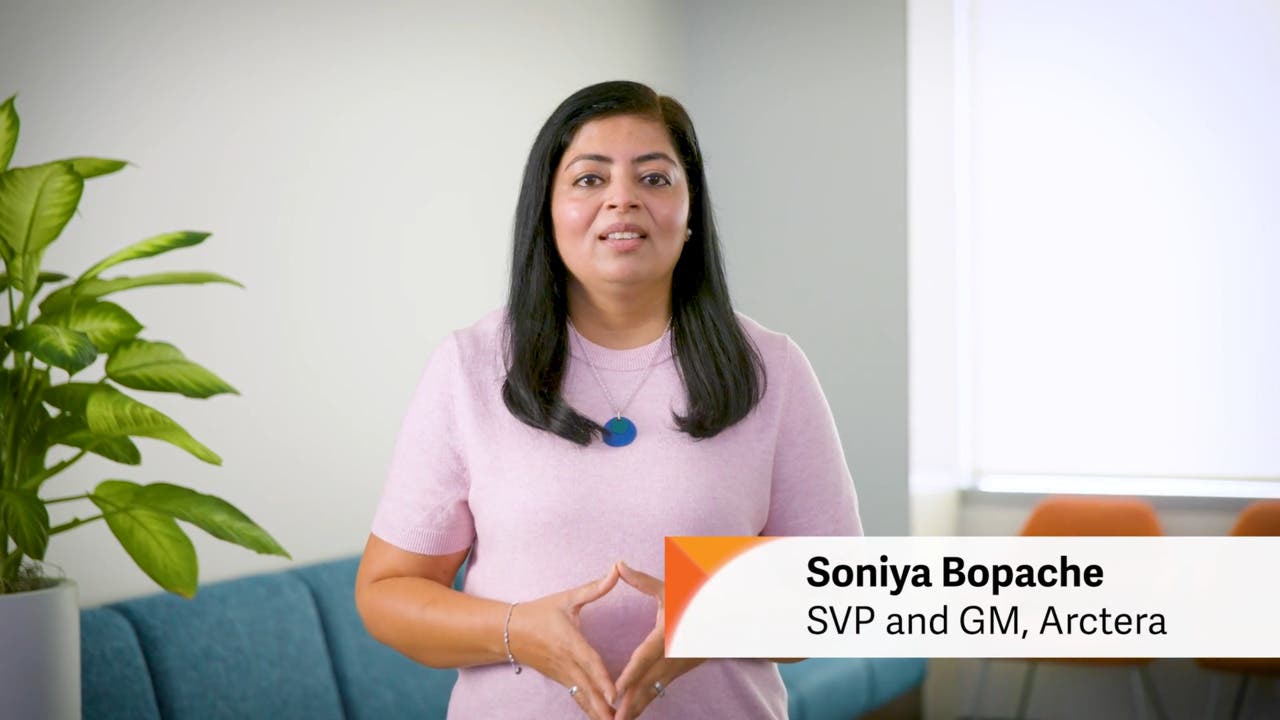
“Enterprise compliance is no longer system-specific, rather it has become a system-wide requirement.”
Soniya Bopache · SVP & GM · May 2026
AI Converge, introduced in May 2026, tackles the reverse journey: making governed enterprise records available within AI workflows. An August relationship with legal AI company Arca uses the Model Context Protocol to connect legal tools with those records while maintaining permissions, retention policies and oversight. For an investigator, the promise is less movement between repositories before analysis can begin.
What a buyer should test
The practical lesson is portable. Pick a real communication sequence and follow it from source to archive to review. Check attachments, participants, missing records and permissions. Arctera’s August 2026 release added source-to-platform reconciliation to identify missing or delayed data, plus legal-hold notifications and review improvements. Completeness itself needs a control.
Cost belongs in that exercise. For a useful comparison, ask for subscription, migration, connector, retention and implementation charges in writing, alongside the internal work needed to establish policies and review alerts. Test retrieval and export as carefully as ingestion. The sensible unit of value is a defensible record produced with less effort.
There is also a human side to deployment. Arctera’s August 2026 practitioner community offers product discussions and access to expertise; its new San Ramon briefing center gives customers a place to meet product and engineering teams. Training, escalation and feedback remain part of the work around the software.
The fit depends on the organization. A cloud-based approach requires acceptable deployment and data-control arrangements; Arctera explicitly directs on-premises requirements elsewhere. Automated classification also needs human review and workable policies. No archive can rescue a conversation it never captured. Arctera’s most useful idea is therefore simple enough to copy: preserve the context while the work is happening, before remembering becomes an investigation.