When a caregiver left 5280 Home Care and Attendant Services, a small part of the agency could leave with them. Patients had the caregiver’s personal mobile number. They kept calling it. The employee had moved on; the relationship had not received the memo.
For owner Jason Perez, the problem was practical before it was technical. His Colorado agency needed to reach people outside the office, keep customer contact inside the business and oversee sensitive conversations. Buying everyone a company phone looked expensive and awkward to manage. Movius offered another arrangement: agency-owned numbers on the phones staff already carried.
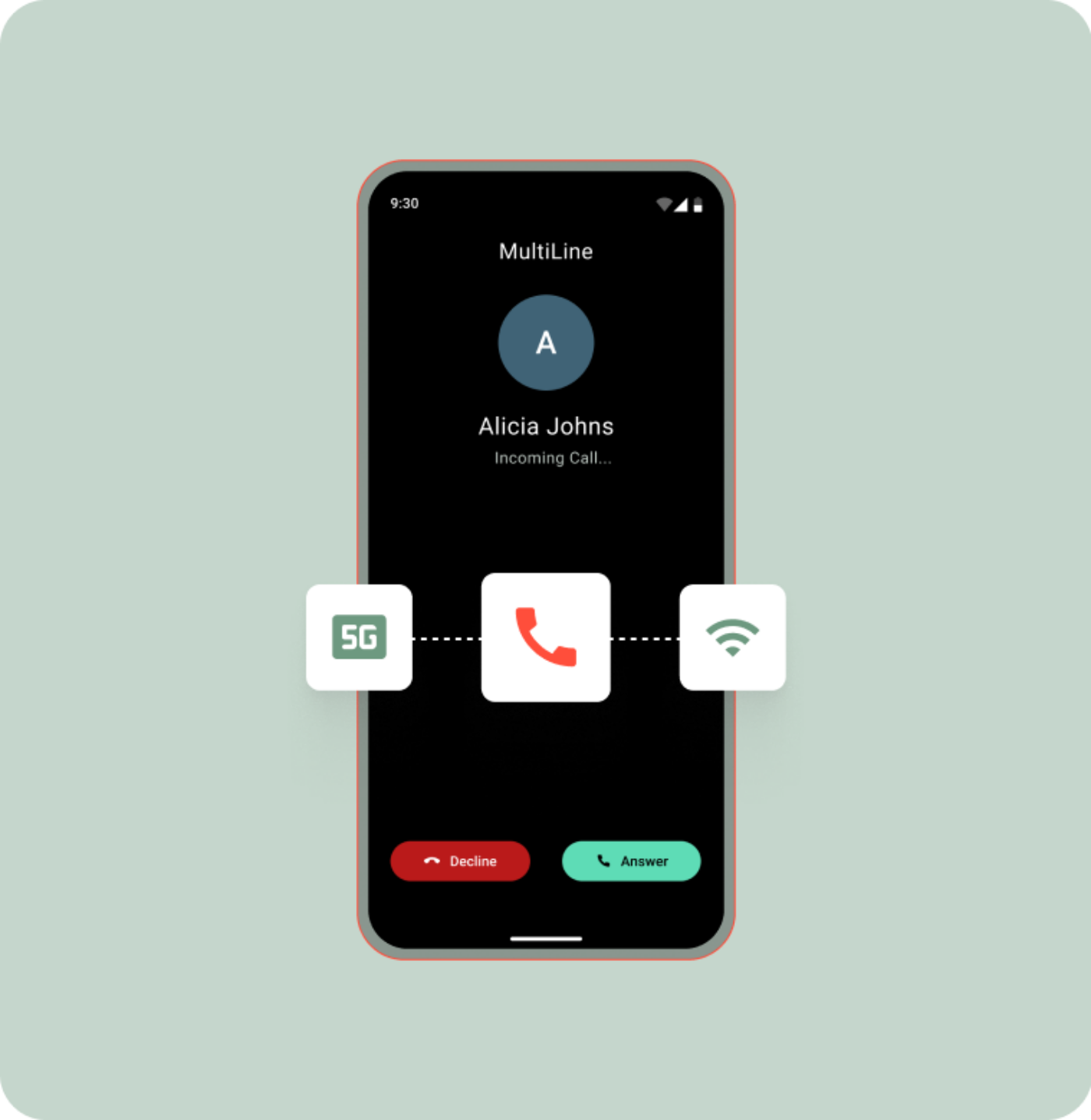
- One phone, separate identities. MultiLine adds a company-managed business number to a supported device.
- A conversation with a memory. Calls and messages can feed recording and archive workflows.
- The number stays. Departing employees need not take the client’s point of contact with them.
- Two deployment routes. MultiLine serves the app-based approach; CoreLine adds native capture on corporate SIM devices.
The employee leaves. The number doesn’t.
In Movius’s published customer story, Perez reports setting up his staff in 30 minutes. Calls could ring at the office and on mobile phones. Recording also gave management a way to review difficult exchanges. These are one customer’s reported results, rather than a deployment timetable for every buyer. The telling detail is the one Perez chose to emphasize: ownership.
“Those numbers belong to the agency.”
Jason Perez · Owner, 5280 Home Care and Attendant Services
A phone number looks like a string of digits. For a service business, it can function as a front door. Once a customer learns which door to knock on, persuading them to use another takes work. MultiLine makes that door something the organization administers. The handset can remain personal; the business identity can be reassigned.
This is the useful idea at the centre of Movius, a mobile communications software company serving enterprises and smaller organizations. It sells control over employee-to-client contact: who owns the number, where a conversation happens, which policies apply and what record survives. A second business line is the visible part. The administrative machinery makes it valuable.

The message that escaped the filing cabinet
The case becomes more expensive in finance. On August 14, 2024, the SEC announced $392.75 million in combined penalties against 26 firms for recordkeeping failures. Its investigations found business communications travelling through unapproved methods and required records going unpreserved. Supervisors and senior managers were involved too. The familiar habit of sending a quick message had acquired a rather unfriendly invoice.
Combined SEC penalties across 26 firms in one enforcement announcement. Industry context, not Movius revenue or a claim of savings.
Movius addresses the mismatch between how clients want to communicate and how institutions need to retain communications. MultiLine supports voice, SMS and social messaging channels including WhatsApp, WeChat and LINE. It connects with Microsoft Teams and Salesforce, and can transfer captured business communications into an organization’s existing archive.
Its administrative tools include consent collection, message filtering and redaction. For a relationship manager, that can mean calling or texting from a business identity within an established workflow. For a compliance team, it means a route from the interaction to a retained record. Those two groups care about different things; the product has to satisfy both.
A software line with a telecom past
Movius’s story reaches back through IP Unity and Glenayre. Public accounts date its predecessor roots to 1999 and the transaction that formed the later company to 2007. It worked in a world of telecom equipment and legacy communications before moving toward cloud business software. Fierce Network’s 2019 reporting places the SaaS pivot in 2014, as employers became more interested in letting staff use personal devices.
By March 2019, the company had raised a $45 million Series D led by JPMorgan Chase. Existing investors included PointGuard Ventures, New Enterprise Associates and Anschutz Investment Company. The money supported its product roadmap and expansion. The same period’s reporting described a move from small deployments toward enterprise customers, with the operational demands that come with much larger groups of users.
That history helps explain the market position. A general business calling service can give you a number. An archive can retain material it receives. Movius concentrates on the mobile client conversation between those functions, combining an identity, supported communication channels and capture. Its particular pitch matters most where staff work away from desks and records matter after the call ends.
Buyers can also consider enterprise calling suites, specialist mobile recording tools or company phones paired with archive software. The useful comparison is the complete workflow: supported countries and channels, staff behaviour, archive integration, administration and total cost. A feature labelled “recording” is the beginning of that comparison.
The carrier is also the sales channel
Movius delivers its software as Secure Communications as a Service. Its distribution includes telecommunications companies that already have relationships with business buyers. In February 2023, T-Mobile Ventures announced an equity investment supporting T-Mobile MultiLine, powered by Movius. The carrier’s own announcement did not disclose the investment amount.
TELUS announced its Canadian Unified MultiLine offering in January 2025. In October, Vodafone announced a German partnership with app-based and native recording variants, with availability planned for early 2026. These deals give the software a route through existing networks and enterprise sales relationships. Movius provides the communications layer; the partner can bring reach and a familiar buying relationship.
The cost argument starts with the second handset that a company may avoid buying, replacing and administering. But a sensible budget also counts software, connectivity, implementation, archive storage and support. Savings depend on the arrangement being replaced. The home-care example explains why one buyer preferred software; it does not establish a universal payback period.
Then the app became optional
CoreLine, announced in December 2025, adds another route. It embeds capture in the SIM-based corporate phone environment, allowing voice and SMS interactions without requiring employees to install an application. Movius says it launched with T-Mobile and TELUS. CoreLine and MultiLine can be administered side by side, with recordings transferred into existing archival systems.
There is a useful product lesson here. Some employees welcome using one personal phone. Others want, or must use, a company-issued device. A communications vendor can argue with that division or accommodate it. CoreLine broadens Movius’s answer so an organization can manage both groups. It also makes the company less dependent on persuading every user to open a particular app for every ordinary call.
Business identity through the app-based approach on supported devices.
Native SIM-based capture for the corporate-phone approach.
AI has a job description here
Movius also offers AI applications with fairly specific assignments. Arya monitors call quality. RepayAI uses speech bots in debt collection. CliniXAI delivers patient follow-up surveys through phone calls, addressing some of the barriers posed by paper or tablet questionnaires. Clare analyses communication content and sentiment, including clinician-patient exchanges.
These products extend a familiar capability: handling conversations at scale. Their usefulness depends on the task and on what an organization does with the output. A survey delivered by voice may make participation easier for someone who struggles with a written form. Sentiment analysis still requires judgment before a score becomes a decision about a patient or customer.
CEO Ananth Siva took the role in 2021. The company’s published values emphasize speaking up, equality and design thinking. In a 2023 account of its office reopening, Siva said an employee survey helped inform the decision; attendance was encouraged rather than required at that time. A business selling work-from-anywhere software still saw value in a room where colleagues could talk after the meeting ended.
The record still needs a responsible owner
Government has become another part of the story. Movius announced FedRAMP authorization in August 2025, describing an Air Force Authority to Operate, and GovRAMP authorization in March 2026. The latter announcement followed third-party assessment and programme review. MultiLine also received Gold for Messaging Innovation of the Year in Juniper Research’s 2026 awards.
Authorization and capture capabilities help a buyer assess the system. They do not replace the buyer’s work. An organization still needs to decide which channels staff may use, obtain appropriate consent, configure retention and supervise the records. If employees keep conducting business outside the managed route, the route cannot preserve what never entered it. Availability and integration also have to fit the places and systems in which the business operates.
The lesson a reader can copy is unusually plain: treat the business number like a company email account. Assign it deliberately, give employees a workable way to use it, and plan what happens when they leave. Movius has turned that administrative chore into a product. For the next patient calling a familiar number, the benefit is simpler still: someone at the agency can answer.