The report had already gone. Weeks later, the verdict arrived in a PDF. For one global asset manager, that was the rhythm of transaction-reporting quality assurance after five years with an incumbent provider: submit, wait, investigate. Meanwhile, false positives piled up and compliance staff spent time checking the checks. Novatus’s account of the engagement reads like a small office tragedy, complete with a recurring attachment.
The London company replaced those delayed reviews with live diagnostics through En>ACT, its reporting platform. Novatus says the work removed more than 20,000 false positives, identified five systemic problems and permanently resolved more than 80% of material issues through structural fixes. Those are results from a company-published, unnamed-client case study. They also explain its pitch more clearly than a page of regulatory acronyms: find the defect while somebody can still do something useful about it.
Five systemic issues identified and addressed. More than 80% of material issues resolved through structural fixes.
The business hiding behind “send”
Novatus sells software and specialist help to financial institutions dealing with regulatory reporting, risk, compliance and messy data. Its customers occupy the institutional end of finance: banks, asset managers, pension funds and wealth managers. The website reports 100 firms onboarded to En>ACT. Across its asset-management and pension-fund customers, it cites $18 trillion of combined assets under management. That measures the size of the customers, rather than money managed by Novatus.
The practical problem is deceptively ordinary. A firm records a trade in one system, enriches it with reference data, transforms it into the required format and sends it elsewhere. Every handoff creates opportunities for the wrong identifier, an incorrect field or a missing transaction. A file can pass through the machinery without faithfully representing the business that produced it.
En>ACT provides an independent check on that machinery. Novatus describes coverage across global reporting regimes, including European, British, Australian and North American requirements. Its name supplies the three-part test: accurate, complete and timely. Each adjective asks a different question. Are the details right? Is everything that should be reported present? Did it arrive when required?
Two founders, then a second engine
Andrew Hedley and Matthew Ranson founded Novatus in 2019 and now lead it as Co-CEOs. The company’s own timeline begins with a small office and a consulting client in March that year. It dates the birth of its technology platform to February 2021 and the first platform customer to June. The sequence matters: advisory work came first, then a repeatable software product.
By July 2022, Maven had committed £4 million for a minority stake. The contemporary announcement described both a consulting business and a technology division, whose flagship was then called the Transaction Reporting Analysis tool. Funding was earmarked for technical advisers, sales and marketing, and further product development. Software grew alongside the people who understood the reporting problem.
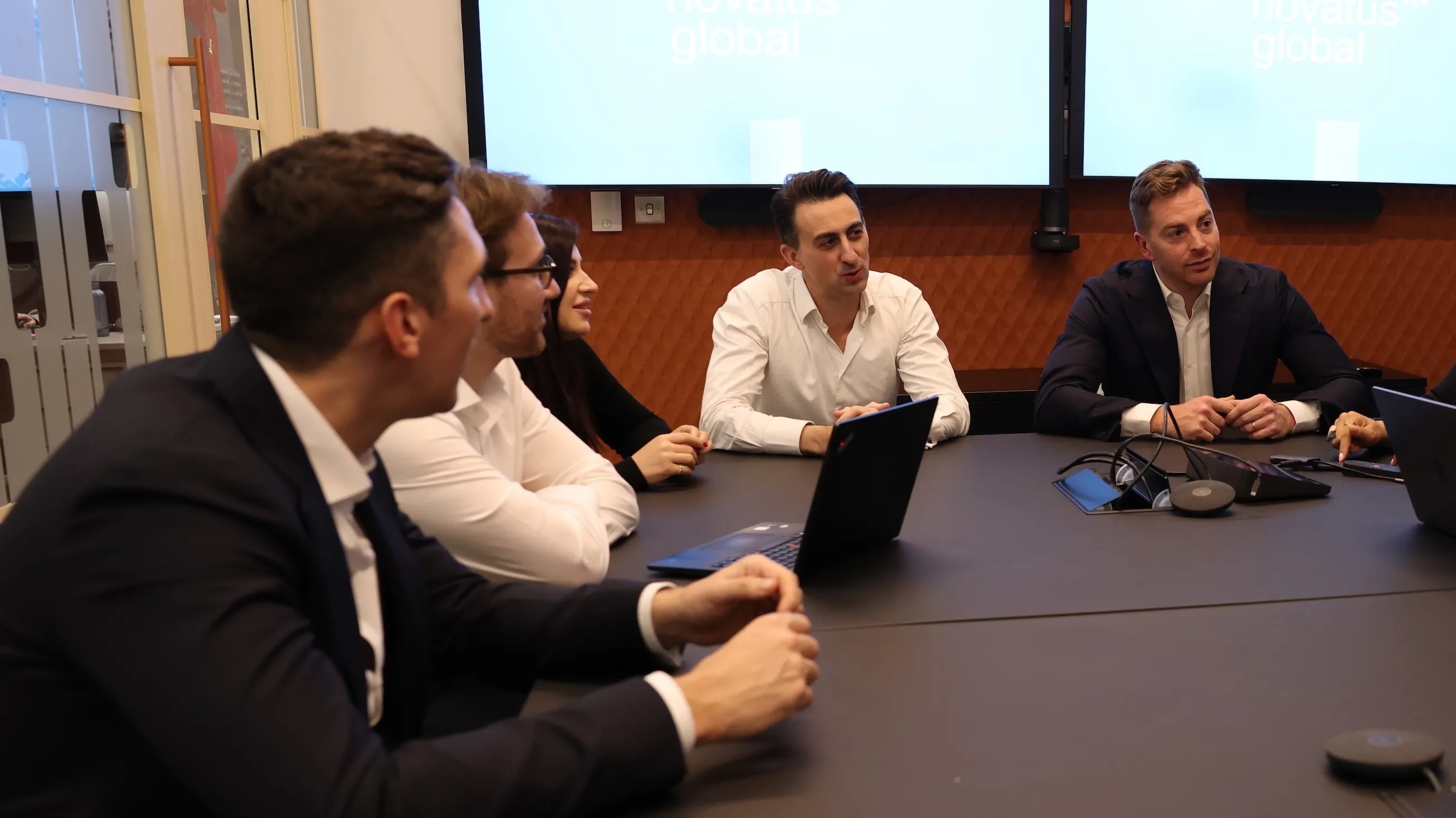
That arrangement still defines the company. Consulting spans strategy and operations, data and AI, risk and resilience, compliance, ESG and transaction reporting. A customer might need an assurance platform, a repaired data pipeline or temporary senior compliance leadership. Those are different purchases, even when they start with the same uncomfortable discovery.
Show the working, field by field
The platform’s assurance service checks submission files against a maintained rules library. Novatus says it tests every transaction and every field, linking an exception to the regulatory requirement behind it. Users can investigate by field, asset class or reporting entity. A red flag becomes more useful when it comes with an explanation.
Books-and-records reconciliation goes further. It takes underlying trade and reference data, determines what should be reportable, recreates an expected submission and compares it with what was actually submitted. That distinction is crucial: examining an outgoing file alone cannot establish that a trade missing from the file ever existed. The source records provide the other half of the story.
Novatus offers submission-file uploads through its platform, API or secure file transfer. Its deeper reconciliation service also needs internal trade and reference records. This creates a practical buying distinction: starting with file assurance can be relatively contained; understanding the full reporting chain requires access to the underlying business data and people who can explain it.
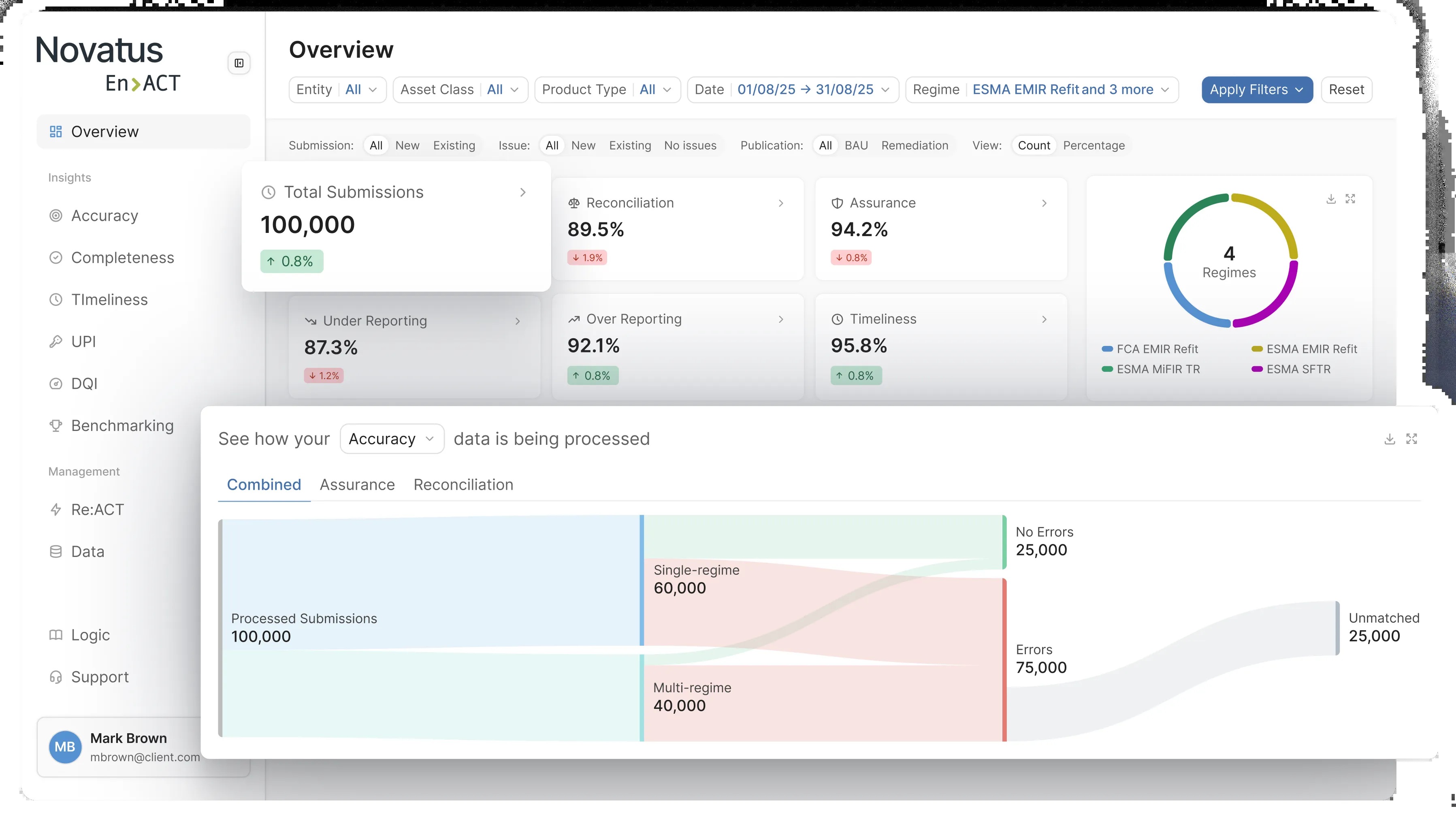
In January 2026, Novatus added benchmarking. Customers can compare performance with anonymised peers and the wider client population, including at individual-field level. That can help separate a firm’s own data weakness from a problem shared across the market. The sensible use is to prioritise investigation. An average score is a comparison point, not proof that a report is correct.
The company also markets remediation capabilities under Re>ACT: assigning issue owners, tracking age and progress, and passing suggested fixes to technology teams. Its ambition is to connect detection with the work required to remove recurring faults. For a buyer, the revealing demonstration would follow one exception all the way from discovery to a verified correction.
Thirty managers, one awkward question
A second Novatus case study concerns an Australian superannuation fund overseeing reporting delegated to 30 investment managers. The institutional headache is easy to understand: when other organisations do the reporting, their summaries may be all the asset owner sees. Comparing performance becomes difficult when each manager brings different systems, files and processes.
Novatus describes a common oversight layer that ingests the managers’ data and applies consistent validation. The fund can compare managers, drill down to a transaction or field, and identify the party responsible for a problem. The useful change is in the conversation: an asset owner can challenge a specific error with supporting evidence instead of exchanging broad reassurances.
The same principle appears in its managed reporting offer. Daily execution can be outsourced, while the client retains visibility into submissions, exceptions and remediation. Novatus explicitly describes responsibility as remaining with the reporting firm. Access to the data, clear ownership and continued oversight are therefore conditions of the model, rather than optional housekeeping.
The price of fixing the plumbing
Novatus’s business model combines SaaS contracts, consulting and managed services. Its careers material describes multi-year, multi-million-pound client contracts. These are institutional procurement decisions involving scope and delivery, with commercial conversations starting through a demo or consulting enquiry.
A separate reporting rebuild offers a more tangible view of the economics. An asset manager had legacy infrastructure, manual production and fragmented data ownership. Novatus mapped the data, redesigned pipelines, improved master data and introduced governance and quality controls. Its published account claims £2 million in annual savings through automation and vendor consolidation, alongside a move from quarterly to monthly reporting without extra headcount.
Annual savings from automation and vendor consolidation
4 cycles / yearMonthly
12 cycles / year
The mechanism is more useful than the headline number. Changing data ownership and production architecture allowed more frequent output without simply adding people. A reader can copy the sequence: map where the data originates, find repeated manual transformations, assign owners, then automate the parts that recur. Buying another dashboard before that work would leave much of the original problem intact.
Other assignments are explicitly labour-intensive. For a wealth-management platform facing regulatory scrutiny, Novatus describes a 24-month compliance transformation using up to 20 specialists and interim executive leadership. That is a reminder of why its consultancy persists: software can expose a weakness, but organisational repair may take people, authority and time.
$40 million meets the distribution problem
In September 2024, Novatus announced a $40 million growth investment from Silversmith Capital Partners. It said revenue had more than tripled over the preceding twelve months; Maven reported a thirteenfold increase in annual recurring revenue since its investment. These are different measures over different periods. The announced priorities were deeper technology investment and geographic expansion.
Partnerships offer another route into large institutions. Novatus announced a Snowflake partnership in July 2025. In July 2026, it announced that Northern Trust had selected LSEG and Novatus as a preferred partner for OTC trade repository reporting for middle-office clients. The combination uses LSEG’s G20 submission engine, En>ACT and data supplied by Northern Trust.
That arrangement gives Novatus a defined place in financial infrastructure. Its software supplies assurance within a wider reporting service. Competitors also pursue that territory: Kaizen offers independent reporting assurance, analytics and workflows. Full coverage and regulatory expertise are therefore competitive requirements. Novatus’s case rests on how its live diagnostics, source-data reconciliation, benchmarking and consulting work together for a particular client.
Growing without losing the explanation
By June 2026, Novatus reported more than 120 people across London, the United States, Australia and India. It had received a King’s Award for Enterprise in Innovation that May. Andrew Pinnington then joined from DTCC as Chief Customer Officer, taking responsibility for sales, client success and managed services.
The company presents its culture as flat and collaborative. An employer-published account from consulting executive Hugo Warner describes experimentation alongside career progression. Another employee describes entering its graduate programme after Classics and teaching. Both accounts suggest a business that recruits for judgement and learning as well as specialist experience.
“We’ve built things, broken things, and failed fast along the way”Hugo Warner / Executive Director
Company-published employee account
The late-PDF case captures the test ahead. The customer’s review process had become a task of its own, detached from repairing the reporting underneath. Novatus’s opportunity is to shorten that distance: from an error to its cause, from its cause to an owner, and from an owner to a fix. The attachment can finally stop coming back.