Every regulated company runs a quiet, expensive machine in the background. It is made of people - lawyers, risk analysts, compliance officers - and their job is to read new rules, figure out which ones apply, and prove that the company's own policies and controls match up. It is slow, it is manual, and it never stops, because the rules never stop. 4CRisk.ai was built on a simple observation about that machine: most of it should not be done by humans copying text into spreadsheets.
Founded in 2020 in Silicon Valley, 4CRisk.ai is a RegTech company that makes artificial intelligence for governance, risk, and compliance - the corner of the enterprise software world known as GRC. Its pitch is narrow and specific. It does not try to be a chatbot for everything. It reads regulations, tracks how they change, and maps a company's obligations, policies, and controls to the rules that govern them. In February 2026, the regulatory-intelligence firm CUBE acquired it. This is the story of what it built and why that acquisition made sense.
01 / The problemCompliance is a copy-paste job that scales badly
A bank or an insurer can be subject to thousands of regulations across dozens of jurisdictions, each written in dense legal language, each revised on its own schedule. When a rule changes, someone has to notice, read it, decide whether it applies, find the internal policy it touches, and check whether the controls still hold. Multiply that by every regulator and every internal document and you get the reason compliance departments are large, tired, and perpetually behind.
The founders knew this from the inside. CEO Venky Yerrapotu spent more than two decades in GRC and, by his own account, deployed more than 400 risk and compliance solutions before starting the company. Co-founder Supra Appikonda came from the same world. The team describes itself as carrying more than 100 years of collective GRC experience. In other words, the product is what happens when people who lived the pain decide to automate it.
"If we mapped 50 compliance documents to NIST CSF it would have been a six-month project. With 4CRisk these were mapped in four days." Guidewire
02 / The betSmall, private, specialized AI - not a bigger chatbot
Here is where 4CRisk.ai runs against the grain of the AI hype cycle. While much of the industry raced to point the biggest general-purpose model at every problem, 4CRisk.ai built its own smaller ones. It calls them Specialized Language Models, or SLMs: models trained only on carefully curated regulatory and GRC content, so they understand the nuance of regulatory language better than a general model that learned a little about everything.
The technical idea underneath is old-fashioned and elegant. Back in 2020 the team trained neural networks to encode the intent of a regulation into mathematical structures called vectors. Turn a rule into a vector and you can compare it, by machine, to a company policy or a control - the way an expert would, but in bulk. That is what lets the software say "this obligation is covered by that control, and this one is not."
The choice was not only about accuracy. It was about trust. Regulated firms are exactly the customers who cannot paste sensitive policy documents into a public model. 4CRisk.ai's SLMs are designed to run inside a company's own infrastructure or private cloud, with role-based access, audit trails, and security testing - keeping compliance data from ever flowing out to a public LLM. For a compliance buyer, that is not a nice-to-have. It is the whole ballgame.
03 / The productsFive tools for one workflow
Rather than sell one monolithic platform, 4CRisk.ai unbundled the compliance workflow into products a team can adopt one at a time - whichever part hurts most. They all sit on its cloud-based ARIA platform.
Regulatory Research
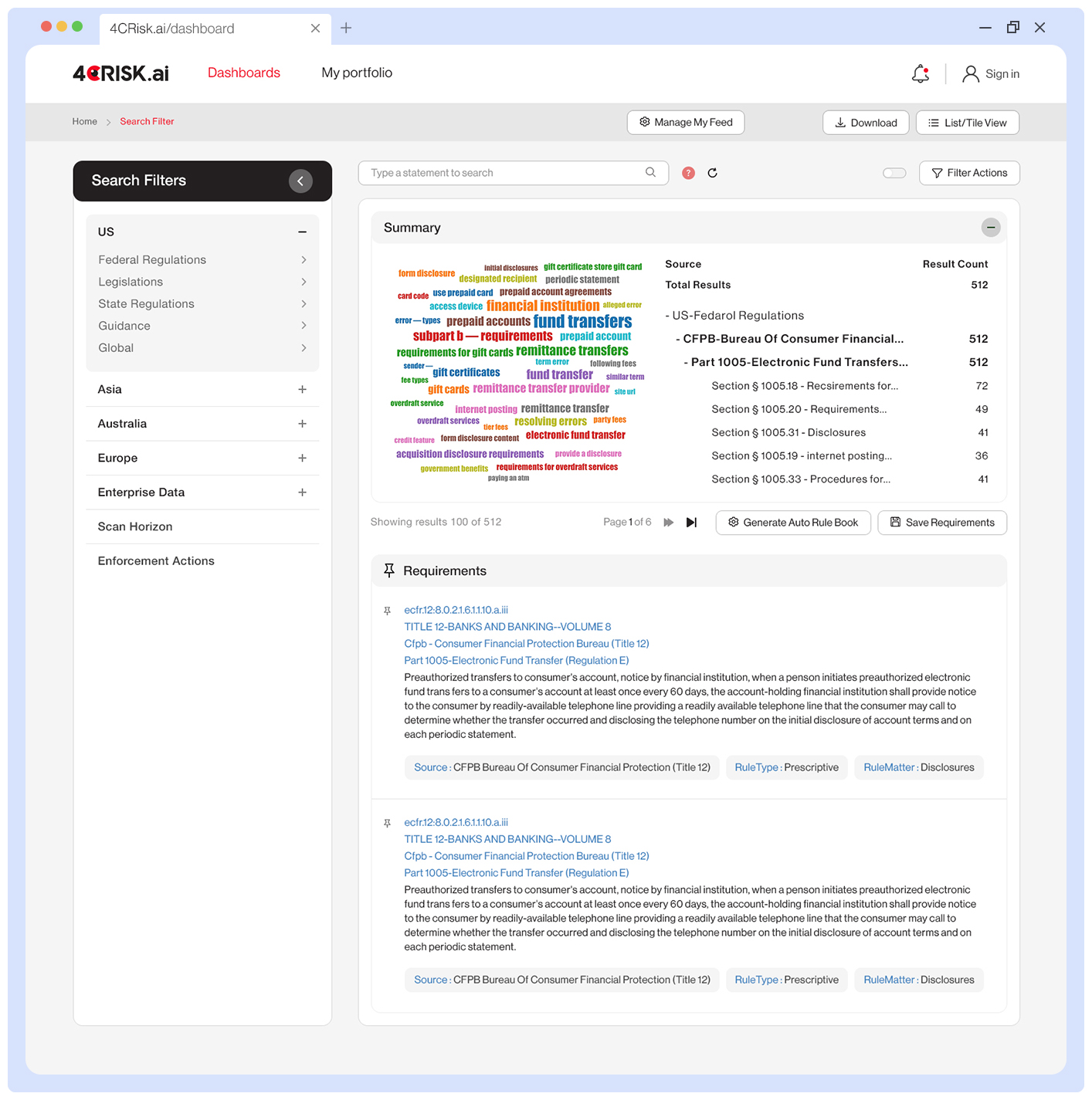
Navigates regulators, laws, and standards and builds a curated, company-specific regulatory library. Less searching, more acting.
HorizonScan
Continuously monitors regulatory change relevant to a specific business, so teams see it coming instead of reacting late.
Compliance Map
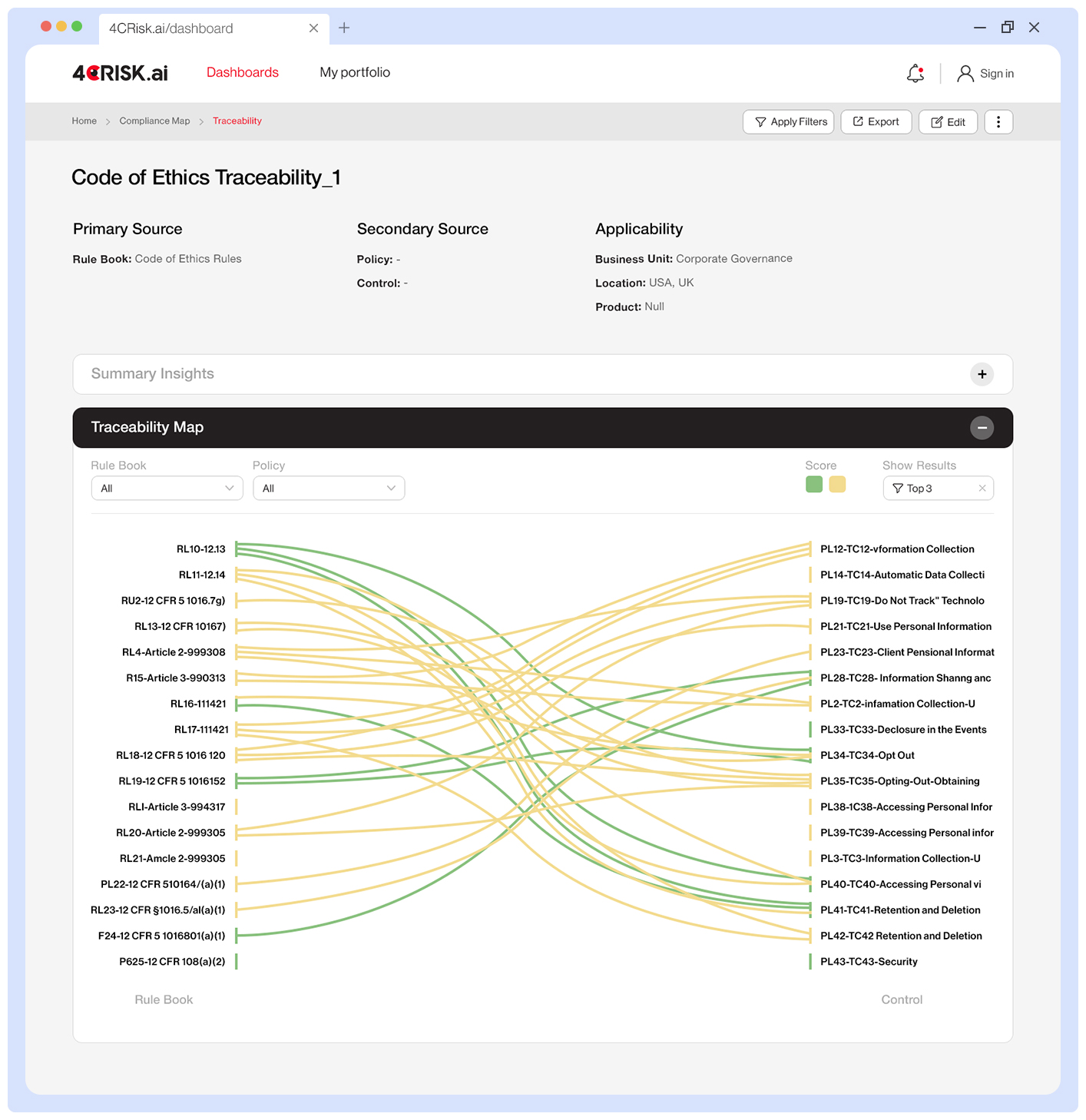
Maps policies, procedures, and controls to obligations and risks, with real-time traceability and automated gap assessment.
Regulatory Change Management
Automates tracking, assessing, and implementing regulatory updates - the busywork of staying current.
Ask ARIA Co-Pilot
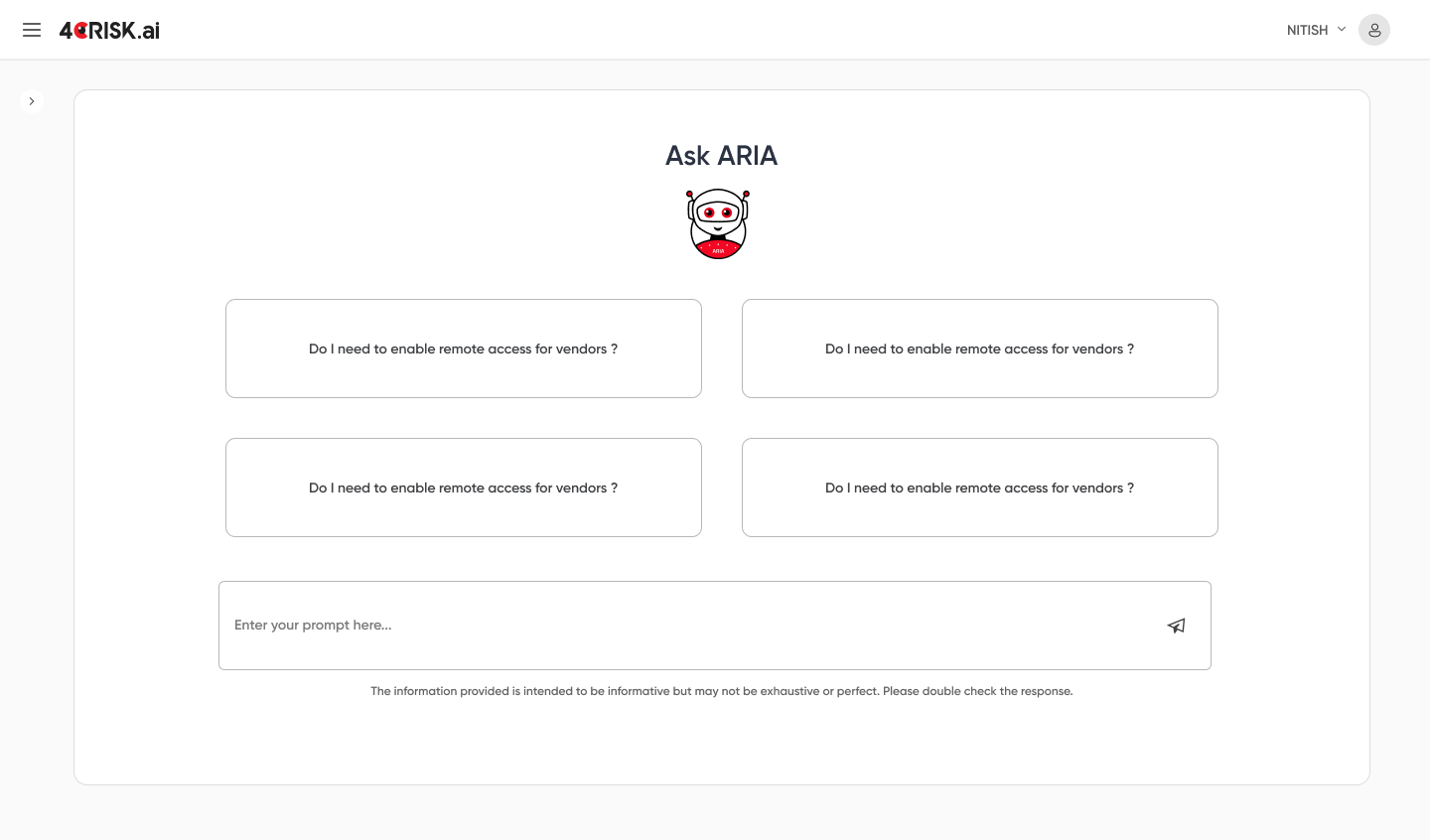
A conversational assistant that gives immediate, sourced answers to hard compliance questions, privately.
Specialized Language Models
The private, domain-trained models under the hood - smaller, cheaper to run, and built to hallucinate less.
The headline product is Compliance Map, and it is where the "50 times faster" claims come from. The company reports that its gap-assessment generation runs about 40x faster than a manual process, with human review roughly twice as fast because the AI pre-sorts the material. It frames the payoff in risk terms too: up to a 75% reduction in non-compliance risk through broader regulatory alignment, and an 85% improvement in the efficiency of designing internal controls.
Source: customer-reported benchmark (Guidewire). Bars scaled to elapsed time.
04 / The strategyComplement the system of record, don't fight it
One of the smarter decisions here is what 4CRisk.ai chose not to do. Big companies already run GRC platforms - Archer, ServiceNow, MetricStream - and they are not going to rip them out. So 4CRisk.ai positioned itself as the intelligence layer on top, feeding cleaned and mapped regulatory data into whatever system of record a customer already uses, over APIs. Be the layer everyone needs rather than the platform everyone has to replace.
That strategy shows up in its customers. The clearest public example is Guidewire, the property-and-casualty insurance software leader, which chose 4CRisk.ai to modernize IT regulatory compliance and produced the six-months-to-four-days benchmark that became the company's calling card. The broader customer base is regulated enterprise: banks, financial-services firms, insurers, and the compliance, risk, legal, and audit teams inside them.
What you can copy
Find a workflow that is expensive, repetitive, and trusted to humans only because nothing better existed. Build a narrow tool that does the boring 90% and hands people the exceptions. Keep the data private so regulated buyers can actually say yes. Then sit on top of the incumbent instead of trying to replace it.
05 / The marketA crowded lane, and an exit
4CRisk.ai competed in a busy RegTech field. Corlytics and Ascent work the regulatory-intelligence and change-management angle; Compliance.ai, an early mover, was absorbed by Archer in 2024; larger GRC players like MetricStream and Wolters Kluwer loom over the category. And CUBE - a global leader in automated regulatory intelligence - was a peer, right up until it became the buyer.
In February 2026, CUBE, which is backed by the investment firm Hg and says it serves more than 1,000 customers globally, acquired 4CRisk.ai. The logic was clean: CUBE was good at ingesting and interpreting regulation at scale; 4CRisk.ai was good at mapping that regulation to a company's own policies, controls, and risks using agentic, specialized AI. Financial terms were not disclosed. It was the kind of exit RegTech founders aim for - build a sharp wedge, then become the piece a bigger platform needs.
"We have seen a dramatic improvement in the time taken to align our policies with regulatory requirements. Importantly, the accuracy is very high." Compliance team, financial firm
06 / The peopleBuilt by operators, not tourists
The company stayed small - roughly 35 people - and leaned on domain depth over headcount. Yerrapotu, who holds engineering degrees from Osmania University and Montana State University, ran the company as founder and CEO; Appikonda served as COO. Their recognition stacked up along the way: repeat listings on the RegTech100 and AIFinTech100, and a Globee Golden Award for artificial intelligence. None of it changed the core message, which stayed remarkably consistent from the 2022 Series A to the 2026 acquisition: specialized, private AI beats a general model at a job where being wrong is expensive.
For anyone building in AI right now, 4CRisk.ai is a useful counter-example. The lesson is not that big models are bad. It is that the winning product in a regulated, trust-sensitive market can be the small, private, expert one - narrow enough to be right, contained enough to be trusted, and useful enough that a larger company eventually buys it. Where it would not work: a market with no compliance pain, buyers who happily use public models, or a problem too fuzzy to encode as obligations and controls. 4CRisk.ai picked none of those. That was the point.