The people who built the spreadsheets had left. The spreadsheets, with the touching loyalty of office furniture, had stayed. At Bankers’ Bank of Kansas, compliance staff were working with Excel calculations established in the 1990s. Few remaining employees understood the full process. The bank had retained its records and misplaced part of its memory.
- Ncontracts turns financial risk and compliance work into shared, documented workflows.
- Its customers include banks, credit unions, mortgage lenders, fintechs and wealth managers.
- It sells software alongside regulatory knowledge and specialist services.
- The useful test: can the next employee understand the decision and finish the work?
Enterprise Risk Manager Beth Seals wanted a process current staff could operate and future staff could understand. The bank moved to Ncomply, Ncontracts’ compliance management software. Regulatory tasks could be assigned to different people. Policies could be reviewed and approved in one place. The history of the work stayed with the work.
The bank reported that tasks taking close to 160 hours fell to approximately 30. A vendor-published customer account is a particular example, rather than a promise for every buyer. Still, the arithmetic is arresting. Some 130 hours had been hiding inside the way the institution organized itself.
Same obligation. Fewer hours.
The contract was only the beginning
Michael Berman founded Ncontracts in 2009 to help financial organizations manage vendor contracts and third-party risk. Before that, he had been general counsel at Goldleaf Financial Solutions, Tecniflex and Imagic. His route into software ran through legal and regulatory work, where an overlooked clause or an unexamined supplier could become everybody’s problem.
A contract is a remarkably compact inventory of future chores. Someone must notice the renewal date, understand the termination provision, check the supplier’s controls and decide whether the relationship still makes sense. Put the document in a folder and those obligations remain perfectly capable of arriving on schedule.

Ncontracts expanded from that starting point into enterprise risk, compliance, lending, audits and continuity. The connection is practical: the same vendor may matter to cybersecurity, recovery planning, contract management and a board discussion. Each department maintaining its own version creates ample employment for the person asked to reconcile them.
Give the obligation an owner
Nvendor handles the vendor lifecycle: onboarding, due diligence, contracts, monitoring and eventual exit. Risk assessments distinguish what a relationship exposes the institution to before controls and what remains afterward. Configurable tiers help determine the depth of review. The office stationery supplier and a critical technology provider should not automatically receive identical treatment.
The product combines document storage with assignments, reminders and reporting. Optional cyber monitoring adds external signals. Specialist services can review documents such as SOC reports, financial statements and business continuity plans. Buying a report and having someone competent interpret it are different purchases; Ncontracts offers help with both.
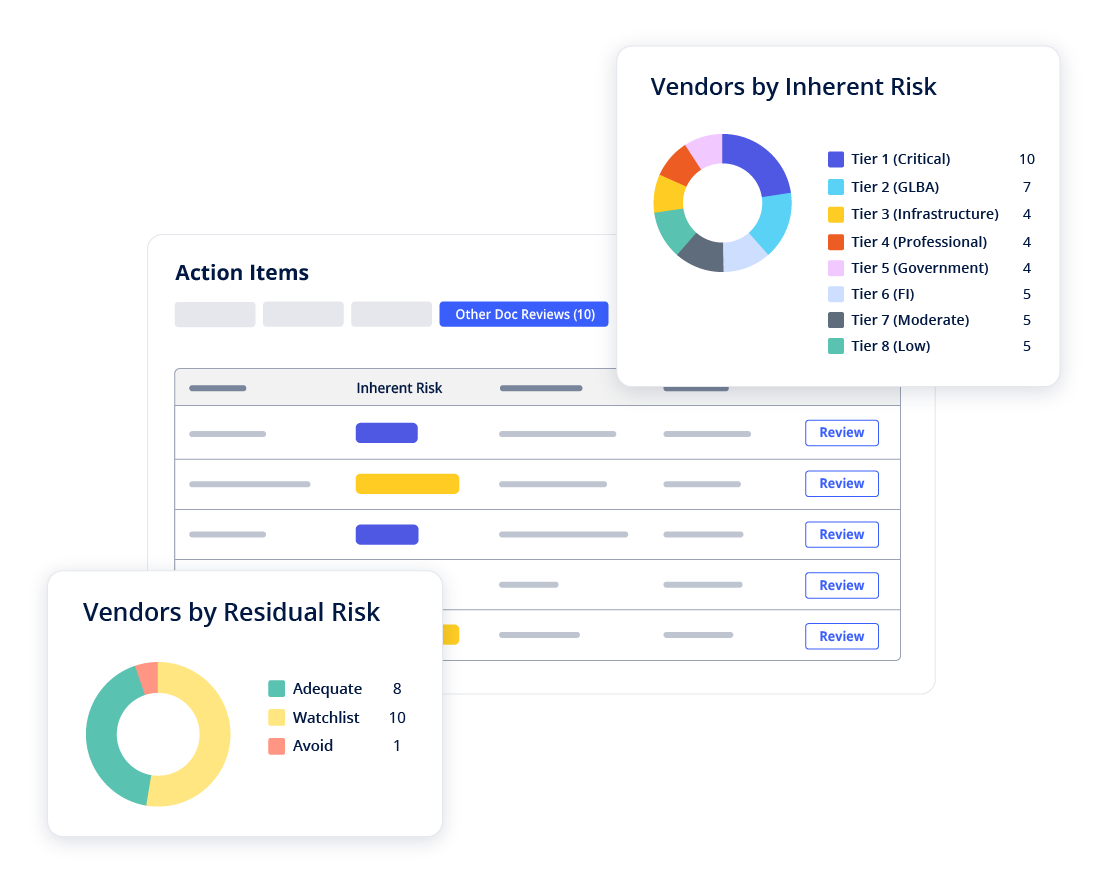
Fahey Bank’s Christine Woodard provides a useful illustration. Her responsibilities included security, continuity, enterprise risk and occasional IT work, as well as vendors. In Ncontracts’ account, she described automated due diligence reminders, review workflows based on criticality and easier board reporting. She estimated doing the same vendor work manually would take at least twice as long.
The interesting detail is participation. Relationship managers could contribute answers rather than leaving Woodard to judge everything herself. Software helped distribute knowledge to the people qualified to supply it. A risk questionnaire completed by the wrong person can be beautifully formatted and thoroughly unhelpful.
- 01 / IdentifyName the vendor and accountable owner.
- 02 / AssessSet the risk tier and required evidence.
- 03 / DecideRecord the review and approval.
- 04 / RevisitSchedule monitoring, renewal and exit.
The risk officer who kept his own language
At Montecito Bank & Trust, Chief Risk Officer James Jefferson had a different difficulty. His team had already developed risks, controls and a reporting vocabulary its board understood. A replacement system demanding a fresh start would discard work the bank wanted to preserve.
Its Access-and-Excel setup was becoming burdensome to maintain and awkward to share. Risk assessments involved scheduling meetings with business-unit owners. Nrisk let the bank retain its custom assessments and controls while assigning work online. Jefferson reported fewer meetings and the same risk staffing even as the bank doubled in size.
“For us, it was all about automation and customization.”James Jefferson, Montecito Bank & Trust
That distinction is a sensible purchasing test. An institution with an established method should demonstrate its actual assessments during evaluation. An institution still designing its program may value expert-built content more. The same platform can be useful for different reasons; the demo should expose which reason applies.
A suite, and several rooms with their own doors
Ncontracts’ integrated products divide the work into recognizable jobs. Ncomply manages regulatory change, policies and compliance tasks. Nrisk supports enterprise assessments and controls. Ncontinuity covers recovery planning and testing. Nverify organizes internal audits; Nfindings follows corrective actions. Ncyber supports cybersecurity assessment. Their appeal is the ability to connect related risk work rather than repeatedly reconstruct it.
The wider portfolio requires a little care. Nlending is a distinct lending compliance solution group, covering fair lending, CRA, HMDA and analytics. Quantivate, acquired in 2023, remains a distinct configurable GRC platform. Venminder, acquired in 2024, remains a distinct third-party risk platform. A common owner does not turn every product into one interface.
Growth has involved purchases as well as product development. TruPoint Partners joined in 2019, BancIntranets in 2020, and QuestSoft and OnSemble in 2021. In September 2024, Hg bought out Gryphon Investors as Ncontracts acquired Venminder. The transaction terms were undisclosed. Old comparison charts naming Venminder as an independent rival now need an editor.
The expert is part of the product
Ncontracts calls its embedded practitioner content Knowledge-as-a-Service. Former regulators, attorneys, risk officers and compliance specialists contribute to the assessments and guidance. The commercial idea is straightforward: a bank buys help structuring the decision alongside the mechanism for recording it.
That positions the company within financial-services GRC rather than general office productivity. LogicGate Risk Cloud offers another route to configurable financial-services risk workflows. Abrigo overlaps in bank risk and compliance, with a different emphasis on lending, financial crime and portfolio risk. Buyers need to compare the particular job, rather than award points for the longest list of modules.
Ncontracts uses custom quotations for its software; services extend the offering. A useful cost comparison includes modules, onboarding, data migration, specialist review and the internal time required to maintain the program. The attractive saving is work genuinely removed. Moving the same confusion into a subscription merely gives confusion a purchase order.
AI arrives carrying its homework
Nquiry launched on May 4, 2026. It answers financial regulatory questions with citations and an audit trail, with an escalation route to credentialed specialists through Compliance Concierge. Ncontracts also has AI features for contract review, complaint classification and lending regression analysis. These are tools attached to particular tasks.
On September 29, America’s Credit Unions announced its endorsement of Nquiry, extending its existing Ncomply relationship. The point worth examining is traceability: can a compliance officer inspect the basis of an answer and retain the evidence? Nquiry’s product page offers a 90-day money-back accuracy guarantee. Buyers should examine its applicable terms and test questions drawn from their own work.
The pressure is visible in Ncontracts’ March 2026 survey of 173 financial-services professionals. Sixty-three percent reported third-party risk programs with one or two dedicated full-time staff; 53% managed at least 300 vendors. Those respondents do not represent every institution. Their answers nevertheless describe an audience with a limited appetite for more administrative work.
By August 2026, Ncontracts reported more than 5,000 financial organization clients and an eighth consecutive Inc. 5000 appearance. Scale helps explain the breadth of its portfolio. The more revealing question remains small enough to ask in a meeting: who owns this obligation, and where is the evidence?
Start with the work that keeps disappearing
The lesson a reader can copy is to choose one recurring process, identify its owner, attach the evidence and define the next review. Time it before and after changing it. Preserve useful judgment already built into the organization. Check whether another employee can follow the record without calling its author.
The approach depends on people keeping records current, answering assessments honestly and acting on findings. It also depends on financial-sector requirements being the right fit for the software. An organization outside that market, or one expecting an AI answer to substitute for a formal legal opinion, has a different buying problem.
A bank can purchase software. It must still decide who does the work. Ncontracts becomes interesting where those two decisions meet: the moment an obligation stops living exclusively in somebody’s head.
Ncontracts website ↗ · Company news & blog ↗ · Nquiry product tour ↗ · YouTube videos ↗ · LinkedIn ↗ · X ↗ · Facebook ↗