The least glamorous minute in banking may be the one an analyst spends retyping a number that already exists somewhere else. Multiply that minute across loan files, suspicious-activity alerts, credit memos, allowance calculations, board packets and 2,400 financial institutions, and you have Abrigo’s market. The company sells software for work the public rarely sees but regulators, auditors and bank executives care about intensely. Its pitch is not that banking should become magical. It is that the same data should stop being handled like a paper baton in a relay race.
Abrigo serves mostly U.S. banks and credit unions. It covers commercial and small-business loan origination, credit analysis, anti-money laundering, fraud detection, CECL, stress testing, asset/liability management, investment accounting and analytics. Add advisory teams staffed by former bankers, examiners, auditors and BSA officers, and it begins to look less like one product than a specialist department available by subscription.
A company built like a bank’s back office
Abrigo was assembled, not dropped into the world by a single immaculate founding story. Sageworks began in Raleigh in 1998, turning financial statements into analysis and plain-English narratives. Banker’s Toolbox started in 2000 after founder Daniel Cho watched a BSA officer wrestle with manual cash-transaction reporting. MainStreet Technologies specialized in allowance calculations. Banker’s Toolbox bought MainStreet and Sageworks in 2018, and the trio took the Abrigo name in 2019.
That origin explains the product map. Each predecessor knew one unpleasant, mandatory workflow deeply. Abrigo’s later acquisitions added Farin’s asset/liability expertise, Valuant’s accounting and valuation tools, BankLabs’ construction-loan technology, DiCOM’s loan-review software, TPG’s investment accounting, Journey’s bank analytics and 360 View’s CRM and marketing automation. The strategy resembles a cabinet assembled from highly specific drawers. Abrigo’s job is to make the joins disappear.
What the software actually changes
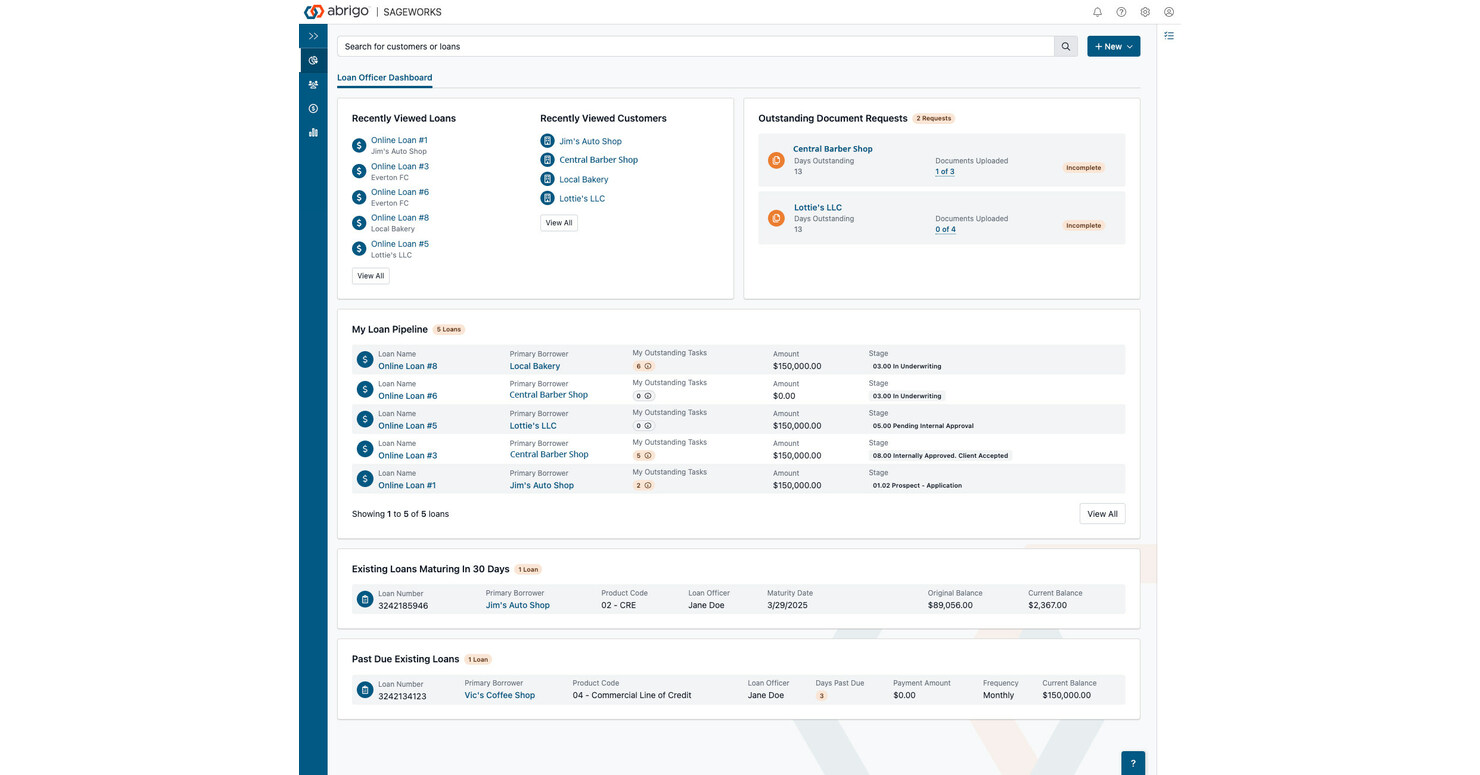
Take small-business lending. A borrower applies, documents arrive, identity and business checks run, an analyst spreads financials, policy rules are applied, a memo is written, approvals move and closing documents follow. In a fragmented bank, those steps can live in email, spreadsheets, a core system, a document repository and several vendor portals. Abrigo’s lending suite puts the application, decision rules, workflow, document requests, credit analysis and relationship view into a connected process. It also exposes APIs for systems such as Salesforce and Microsoft 365.
The repeatable operating loop
The proof is operational. Bankers Trust reported that a typical small-business loan moved from roughly two weeks to three-to-five days after adopting Abrigo’s product, with two days as its goal. The bank did not begin with full straight-through automation. It started with credit pulls, know-your-business checks and documents, then expanded as staff gained confidence. The copyable idea is almost embarrassingly sensible: automate the obvious chores first, preserve control over the scary decisions, and earn permission for the next step.
“We decided to kind of view this as baby steps.”Darcy Johnson, Bankers Trust, on staged automation
Financial-crime work has a different enemy: noise. A monitoring system that produces endless weak alerts is technically busy and practically useless. MidCountry Bank said its previous provider generated thousands of alerts a month. After moving to Abrigo’s BAM+, that fell to hundreds. Its alert-to-case ratio rose from less than 1 percent to roughly 6-to-8 percent, while most of those cases progressed to suspicious-activity reports. The first thing that failed was not detection. It was trust in the queue. Better tuning changed the bank’s mind because analysts could understand why an alert fired and spend their time on cases that deserved it.
The emergency that became a sales demo
In early 2021, Capital City Bank learned three days before the second Paycheck Protection Program round that its provider could not support the launch. The bank already used Abrigo for CECL, so it made the call. Abrigo had the replacement PPP system operating within 36 hours. The institution’s previous process still contained manual steps; the emergency implementation showed what an automated workflow could do under pressure. That experience pushed the bank toward a broader loan-origination rollout.
Main Street Bank offers the more chaotic cousin of the story. It implemented Abrigo’s PPP setup in three days and handled nearly 500 loans over the next five. The final government rule had arrived only hours before the program opened. The bank tested one application internally, walked a second borrower through by phone, then opened the doors. What changed its mind was not a grand technology thesis. It was watching the workflow survive reality.
There is a useful product lesson here. In regulated industries, credibility is often earned during the ugly exception, not the polished demo. A tool becomes strategic after it proves it can absorb a deadline, keep an audit trail and let humans see what is happening.
AI, with a seat belt
Abrigo has pushed AI into narrow banking jobs: extracting loan data, drafting credit narratives, validating documents, searching policy, preparing allowance language, prioritizing investigations and screening names. Abrigo Connect combines a data warehouse with dashboards, peer benchmarks, alerts and natural-language questions. A lender can ask about pipeline bottlenecks; an AML leader can examine alert-to-case ratios; an executive can inspect deposit movements without commissioning a new spreadsheet.
The important adjective is embedded. A generic chatbot knows language. A banking assistant also needs permissions, institution data, policy context, traceability and a reviewer. Abrigo says its AI approach emphasizes security, explainability and compliance because an answer that cannot survive examination is not much of an answer in banking. The company’s 2026 Intelligent Scan product applies that logic to sanctions, enforcement, politically exposed person and watchlist screening.
This is also how Abrigo differs from point solutions. Verafin or NICE Actimize may compete in financial crime; nCino and MeridianLink in origination; Wolters Kluwer, Moody’s and specialist firms in risk and accounting. Abrigo’s argument is breadth: data collected in one workflow can support another, while one provider can supply software, implementation and domain experts. The counterargument is the same word. Breadth creates integration work, a larger vendor relationship and more change to manage.
The hidden price is adoption
Abrigo sells through demos and negotiated enterprise contracts. There is no shelf price because the bill changes with institution size, modules, integrations, implementation and advisory help. That makes a simple “what did it cost?” answer less useful than the cost category: subscription plus migration, training, process design and staff attention. Buyers should insist on a baseline before signing - turnaround time, false positives, hours per allowance cycle, rework, or the number of systems touched - then price the proposal against that specific drag.
Frandsen Bank & Trust provides the adoption manual. It involved representatives from commercial and agricultural lending in selection, named a project owner who understood both analysis and lending, piloted at a few branches, created power users and began with loans of $300,000 or less. After feedback and adjustment, the bank trained all 36 branches and made the system mandatory. It reported 100 percent adoption. The software did not manufacture buy-in; the rollout did.
The most stealable feature is not a feature. It is a rollout: cross-functional selection, a named owner, pilot users, small cases first, feedback, then a clear cutover.
Where the bet works - and where it does not
Abrigo fits a bank or credit union with measurable back-office pain, too few specialists, scattered data and a leader willing to own the process. It is especially logical when an institution wants several adjacent capabilities and can reuse the same customer, loan or transaction data. Community institutions are the sweet spot because they face much of the same regulatory machinery as larger banks without the same staffing budget.
When this playbook breaks
It breaks when data is unreliable, nobody owns implementation, every department protects its old process, or leadership buys a platform before naming the metric it expects to move. It also weakens when a bank needs one lightweight point tool, demands instant self-service, or is unwilling to accept vendor concentration.
The company’s acquisition habit adds another condition. Products bought from different specialists do not become a unified platform merely because they share a logo. Customers should test identity, data definitions, permissions, reporting and support across modules, not just within each demo. “One provider” is valuable only when it produces fewer handoffs in practice.
Still, Abrigo has found a durable wedge. Banks cannot opt out of suspicious-activity monitoring, credit decisions, allowance calculations or board reporting. They can only decide how many humans, spreadsheets and disconnected systems will carry the load. Abrigo’s bet is that the winning platform will not replace judgment. It will give judgment cleaner inputs, fewer repetitive chores and a trail that another human can follow.
That is not cinematic fintech. No metal card drops from the ceiling. No consumer gets confetti for opening an account. But when a loan arrives nine days sooner, an investigator sees hundreds of alerts instead of thousands, or a small finance team closes its quarter without rebuilding the same report, the machinery has done something useful. Abrigo is selling leverage to institutions that cannot win by adding headcount. The lesson is available to any enterprise founder: find the mandatory work, remove the duplicate motion, and measure the quiet before-and-after.