Consider a hundred people who want to open a bank account. They have chosen a bank. They have found its website. They have begun the application. At Frost Bank, only about fifty used to finish. There is something wonderfully perverse about this: the customer has volunteered to become a customer, and the machinery has talked them out of it.
In August 2026, Frost and Blend reported that the completion rate had reached eighty percent. Thirty more people, out of every hundred starters, were getting through. The bank also reported that applications needing manual review fell from fifteen percent to three percent. These are the sort of numbers that make a software demonstration considerably more interesting.
- Blend sells the journey: applications, verified data, lender workflows, and digital closing.
- Its buyers are financial institutions: banks, credit unions, mortgage lenders, and servicers.
- Its costly lesson was expansion: buying title services increased exposure to a mortgage downturn.
- Its next wager is AI: fewer clerical tasks, with early savings measured by Blend itself.
The thirty people who came back
Frost’s relationship with Blend began on the lending side in 2020. After using the software across home equity, mortgage, and consumer lending, the bank extended it to deposit accounts. That sequence matters. A familiar partner had already earned enough confidence to be invited into another part of the business. The sale followed an operating relationship.
The reported deposit-account results give that decision a concrete shape: accounts opening in as little as six or seven minutes, fewer applications requiring intervention, and more people finishing what they started. The improvement from fifty to eighty percent is thirty percentage points, or sixty percent relative growth. Those two expressions describe the same result. One sounds like a press release. The other lets you picture the people.
“Customer growth is our number one metric for success”Brad Bremer, Frost Bank · August 2026

Dark = before · Yellow = after. Percentages refer to different measures, not a single funnel.
A mortgage is a relay race
Blend occupies the space between wanting a financial product and actually receiving one. A borrower answers questions, shares documents, authorizes information checks, and waits for a lender to decide what else is required. An employee reviews the file. Another system needs the data. A closing requires signatures. Every exchange is an opportunity to repeat a question, misplace a document, or leave someone wondering what happens next.
The company, founded in 2012 by Nima Ghamsari, Eugene Marinelli, Erin Collard, and Rosco Hill, supplies cloud software for those exchanges. Its customer is the institution. A consumer can encounter Blend inside a lender’s branded application without having chosen Blend at all. The lender supplies the financial product and makes the credit decision.
The Home Lending Suite covers mortgages, home equity, refinance, verification, loan officer tools, and closing. The Consumer Banking Suite handles deposit accounts and consumer loans. Blend Builder lets institutions configure workflows using reusable components. The connecting platform brings applications, staff workspaces, data providers, and existing banking systems into the same process.
- 01ApplyQuestions adapt to the applicant.
- 02VerifyConnect data and collect evidence.
- 03ResolveFollow up and review exceptions.
- 04FinishOpen the account or close the loan.
Products and lender configuration determine which steps are available.
That makes integrations central to the proposition. In June 2026, Blend announced expanded connections with MeridianLink Mortgage, Consumer, and DecisionLender. In August, Blend and identity provider Prove reported lower application drop-off through a pre-fill integration. Software that can obtain information already held elsewhere has a chance to spare the applicant another small ordeal.
The customer roster includes Wells Fargo, U.S. Bank, Navy Federal Credit Union, and BMO. Blend says it processed $1.2 trillion in loan applications in 2024. Applications are not funded loans, and that figure is not Blend’s revenue. It does, however, describe the scale of the paperwork passing through its software.
The expensive detour
There was a moment when owning more of the relay looked irresistible. In January 2021, Blend raised $300 million at a $3.3 billion private valuation. It went public that July. Between those events it acquired a controlling stake in Title365, moving into title and settlement services. Reported cash consideration was roughly $422 million, with a $225 million term loan helping finance the transaction.
The ambition had a sensible customer logic: connect more of the homebuying process and reduce the awkward exchanges among its participants. The acquisition announcement put it neatly: “no one wants a mortgage - they want to buy a home.” Unfortunately, a good description of the customer’s desire cannot determine the direction of interest rates.
As rates rose, refinancing contracted. In the fourth quarter of 2022, Title365 revenue fell seventy percent from a year earlier. Blend’s mortgage banking revenue also declined. The company’s cost structure had to follow the market down. Its annual filing records approximately 440 positions eliminated during 2022, followed by further reductions. The price of the adjustment included people as well as accounting charges.

In 2024, Haveli invested $150 million in convertible preferred stock. Blend said approximately $145 million would repay credit obligations. In early 2025 it decided to leave title operations; its annual filing says the sale to Covius closed on March 1, 2026. Connecting the process remained attractive. Owning the title business had become an expensive way to do it.
The bill behind the button
Blend’s business is institutional software, priced through contracts rather than a consumer subscription. Its arrangements include minimum commitments for completed transactions, fees for usage above those commitments, and other usage-based pricing. Professional services add implementation and support revenue. A lender assessing the purchase has to price the modules and the work of making them useful inside its existing operation.
The distinction between software and services is visible in the accounts. For 2025, continuing operations generated $123.585 million in revenue: $114.446 million from the software platform and $9.139 million from professional services. The recovery was real but qualified. Blend reported $15.1 million in non-GAAP operating income alongside a $21.8 million GAAP operating loss.
Different accounting measures. Adjusted operating income does not mean GAAP operating profitability.
The second quarter of 2026 brought $33.8 million in revenue, up seven percent year over year, and a smaller GAAP operating loss. This is the measured version of a comeback: a narrower company, improving economics, and considerable work still to do.
Its alternatives include nCino’s mortgage software, specialist platforms such as Floify and Maxwell, and the institution’s own development team. Blend’s argument rests on the breadth of its banking workflows and the connections among them. A lender seeking one mortgage function may evaluate that breadth differently from a bank trying to coordinate deposits, home equity, and mortgages. The relevant comparison is the work each system will absorb.
Fifteen seconds, with a human still in charge
Autopilot pushes further into that work. Announced in March 2026 and commercially available from July 1, the AI system reviews application data and documents and supports pre-underwriting tasks. Blend describes reviews typically taking about fifteen seconds. That is a document-and-application review claim, not a promise that a mortgage can be funded in fifteen seconds.
In August, Blend reported early production results from more than 50,000 loans processed with its pre-underwriting agent. Its analysis compared twenty-four lender and loan-type cohorts with their own earlier performance. It reported two to four fewer days in the loan cycle, 4.5 hours of fulfillment tasks automated per loan, and an estimated $600 lower fulfillment cost per funded loan.
These are company findings from before-and-after comparisons. They are encouraging evidence about a workflow, with room for changes in loan mix, staffing, and other circumstances to affect the result. The estimated saving is neither the software’s price nor a guaranteed reduction in every lender’s expenses.
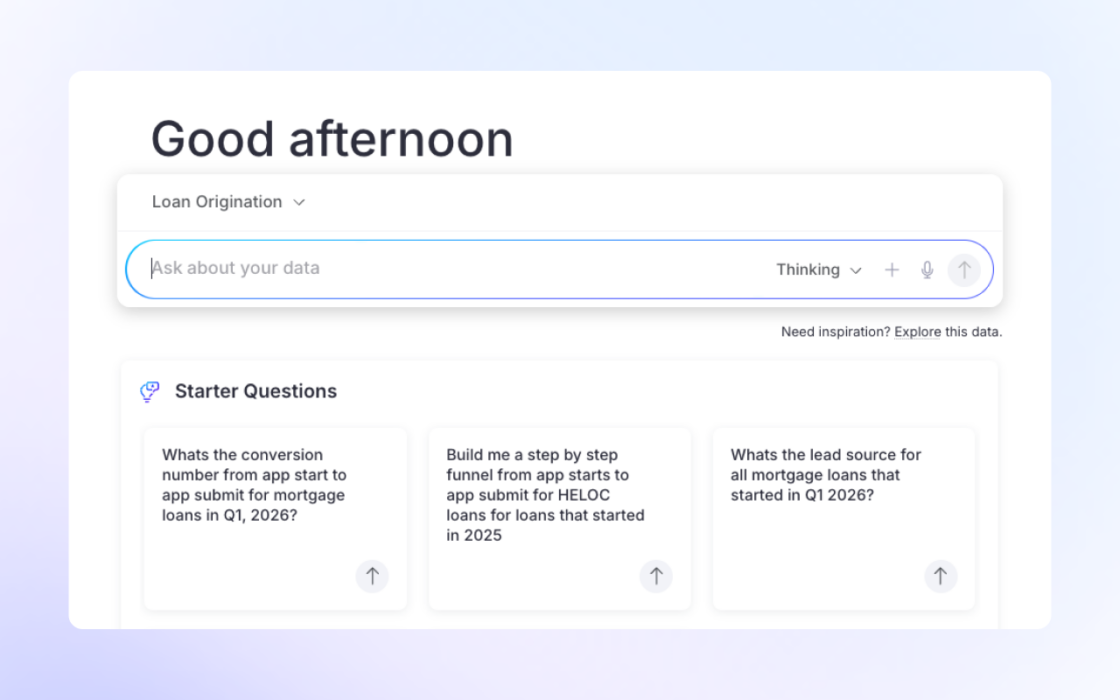
The documented initial activation is opt-in: an administrator accepts terms and chooses which loan officers receive AI-assisted processing. Blend’s existing intelligence tools also distinguish automatic follow-ups from suggestions that staff accept or reject. Those controls belong in the product demonstration. A bank must decide which routine work it will delegate and which exceptions require judgment.
Steal the denominator
The useful lesson is available even to someone who will never buy Blend. Count the people who begin, the people who finish, and the applications employees must rescue. Then inspect the handoffs. Frost’s thirty additional finishers make a better starting point for improvement than a vague ambition to become more digital.
For a potential buyer, the same discipline means checking data coverage, testing integrations with real files, and following an application past submission. Savings depend on configuration, staff adoption, and the lender’s policies. A clean demo with no exceptions tells you surprisingly little about an untidy Tuesday.
Blend’s September 2026 expansion with Alliant Credit Union places its mortgage application software inside Alliant’s broader Journey Home experience. The attraction is familiar: a customer wants somewhere to live, while the institution needs a complete, usable file. Blend’s opportunity sits between those desires. Its own history supplies the caution. There is money in shortening the journey, and considerable expense in deciding how much of the road to own.