The first version of nCino did not arrive from a futurist's sketchbook. It came from bankers who were fed up. Inside Live Oak Bank in Wilmington, North Carolina, loan work moved through the familiar obstacle course: spreadsheets, email chains, paper checklists and systems that guarded their data like suspicious neighbors. A team of bankers and entrepreneurs began building one cloud workspace in late 2011. The internal tool became an independent company the next year.
That origin explains nearly everything about nCino, including the odd name. It is a play on encino, Spanish for live oak. More important, the company began with a live customer, a regulated environment and a process painful enough to justify change. Its founding group included Live Oak chief James “Chip” Mahan, Neil Underwood, Pierre Naudé, Nathan Snell and Pullen Daniel. Naudé led the business from inception until February 2025, when product chief Sean Desmond became CEO and Naudé moved to executive chairman.
One workbench for a very crowded job
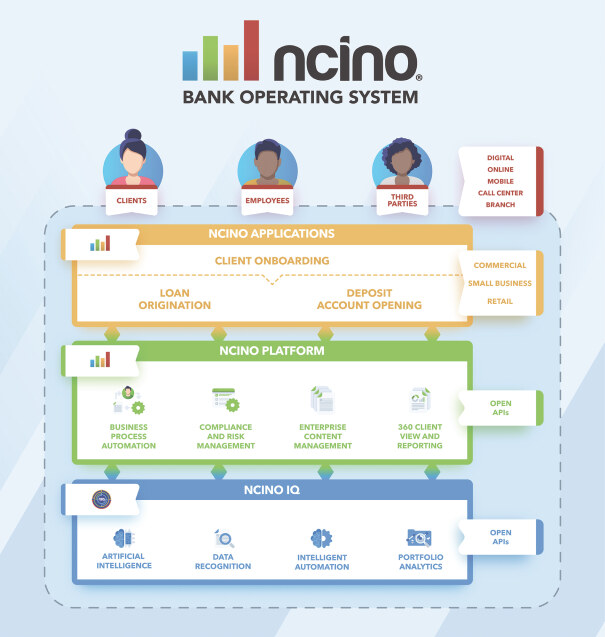
nCino is sometimes called a core banking provider, but that is not quite the job. A core system keeps the ledger and runs the bank's essential transaction machinery. nCino usually sits above it, connecting the people and processes around onboarding, account opening, loan origination, underwriting, documents, pricing, approvals and portfolio monitoring. Think less engine room, more shared cockpit.
The commercial banking product is the center of gravity. A relationship manager can start a customer record; credit teams can spread financials and assess risk; approvers can see the same file; compliance staff get an audit trail; portfolio managers can watch covenants and exposures after the loan closes. Consumer banking adds omnichannel applications, deposit opening and automated decisioning. The mortgage suite follows borrowers from mobile application through closing and analytics. Identity, KYC and integration products connect outside data and bank cores.
The buyer is rarely a person looking for a cute productivity app. It is a bank, credit union or mortgage lender making a multi-year operating decision. nCino reports more than 2,700 financial-institution customers, from community banks to global enterprises. Named adopters include U.S. Bank, TD Bank, Santander UK, WaFd Bank and Busey Bank. The company charges subscription fees, then earns a smaller services stream from configuration, implementation and training. Customers often start with one line of business and expand. That land-and-expand motion is why a commercial-lending win can become an onboarding, deposit, analytics or mortgage account later.
What it cost - and where the bill hides
nCino does not publish a menu price, and a clean sticker number would be misleading anyway. The subscription is only one line. A bank may also pay for systems integrators, core and data connections, migration, workflow design, testing, training, security review and permanent platform administrators. Santander UK's commercial-lending program used a 20-person internal team across workstreams, with Accenture leading configuration and implementation. That is a transformation program, not a weekend install.
The corporate cost is easier to see. nCino raised successive rounds from investors including Wellington Management, Insight Partners, Salesforce Ventures and T. Rowe Price, then went public in July 2020. Its IPO produced about $268.4 million in net proceeds and an opening valuation near $3 billion. Expansion also came by acquisition: the 2022 SimpleNexus mortgage deal combined roughly $240 million in cash with 13.2 million nCino shares, a package worth about $1.2 billion when announced. Later purchases added DocFox, FullCircl and Sandbox Banking.
Fiscal 2026 revenue
+10% year over year
Annual contract value
at Jan. 31, 2026
GAAP net income
after a FY2025 loss
By fiscal 2026, that investment had built a business with $594.8 million in revenue, $523.1 million of it subscription revenue. Annual contract value reached $602.4 million, up 17 percent. The company also posted $5.2 million in GAAP net income after a $37.9 million loss the previous year. Those numbers are not evidence that bank software became easy. They show that a difficult, sticky workflow can support a large recurring-revenue business.
What fails first is usually not the software
A revealing independent case involved a $1.4 billion community bank that had already installed nCino but had not achieved the expected efficiencies. The diagnosis was not “buy another platform.” It was to review how the system had been configured and how the bank's process operated. That is the recurring hazard in enterprise transformation: organizations can reproduce yesterday's bureaucracy inside tomorrow's interface.
The first failure point is often ownership. Lending, credit, compliance, operations and technology may each assume someone else will settle the new workflow. Then custom exceptions multiply, data quality becomes political and training arrives after decisions have hardened. A powerful platform can make a confused process run faster, which is not the same as making it good.
Works when
An executive owns the outcome; front-line bankers design with the implementation team; processes are simplified before configuration; data and integrations have named owners; adoption is measured after launch.
Breaks when
The bank treats the project as an IT handoff; recreates every legacy exception; underfunds training; lacks clean source data; or expects software to settle unresolved policy arguments.
U.S. Bank offers the more productive pattern. It began with small-business lending in 2019, then expanded nCino into commercial and wholesale areas. Its transformation group put change management, training and adoption together and created a center of excellence that gave leaders and users visibility. The institution changed its mind about the platform's reach after seeing its scalability in use. WaFd Bank's turning point was starker: the low-cost systems that once made it lean had become a competitive constraint after the financial crisis. “If we wanted a long-term franchise, we needed to invest,” CEO Brent Beardall said.
The measurable results are customer-specific, not universal promises. Busey Bank moved treasury work away from manual, email-heavy processes and reported exceeding a treasury product implementation goal by 83.3 percent. Santander UK replaced 13 disparate legacy systems with one loan-origination platform. nCino says commercial customers have originated loans 54 percent faster in studied cases. Useful numbers, with an important footnote: outcomes depend on process, scope and baseline.
The AI pitch has finally found a grown-up problem
Every software company now has an AI paragraph. nCino has a more plausible claim than most because it controls structured work where context, permissions and auditability matter. Its nCino IQ effort began in 2019 with analytics and machine learning. The current “agentic banking” pitch puts software agents alongside employees to review documents, prepare work, surface risks and handle administrative steps inside governed workflows.
The distinction is guardrails. A general assistant can draft a memo. A banking agent must know which documents it may touch, which policy applies, who can approve the decision and what evidence an auditor will demand later. nCino is also opening interfaces for outside agents: Mortgage MCP is designed to connect compatible AI tools with mortgage administration and loan-officer workflows while retaining platform permissions and audit logging.
This advantage is conditional. nCino remains deeply tied to Salesforce, the platform on which its original system was built. Large incumbents such as FIS, Fiserv, Finastra and Temenos sell overlapping suites; specialists compete in mortgage, onboarding and digital experience; banks can assemble their own Salesforce stack or keep patching point solutions together. AI may make custom software cheaper. nCino's defense is that 14 years of banking data models, integrations and regulatory workflow are harder to improvise than a screen.
The part worth copying
Founders can copy the sequence, not the bank. Start where practitioners are already losing hours. Build beside them. Make one workflow coherent before declaring a platform. Use the first customer as a laboratory, but keep asking whether its pain repeats elsewhere. nCino moved from commercial and small-business lending at community banks to enterprise institutions, international markets, consumer banking and mortgage because the underlying complaint - disconnected work around a financial relationship - traveled well.
Banks can copy a different lesson: begin with a line of business that has a visible owner and baseline metrics. Simplify policy before translating it into clicks. Give adoption, training and data governance the same status as configuration. Expand after users trust the first workflow. That is slower than buying the “operating system” slogan and faster than rescuing a sprawling deployment.
It will not work everywhere. A small institution seeking one narrow tool may not need the platform, cost or Salesforce dependency. A bank unwilling to retire exceptions will create an expensive digital museum of its old habits. And an organization without integration talent, clean data or executive patience may discover that the shared cockpit still has no pilot.
nCino's story is entertaining because its founding frustration remains current. Banks still have old systems. Employees still chase documents. Customers still wonder why an institution that can move millions of dollars needs the same information three times. The company built a sizable business by making those mundane irritations legible. Now it must prove an AI agent can remove more of the chase without loosening the controls. In banking, that is the whole trick: move faster, leave a trail.