John Lynch’s team had a problem that a new screen could not solve. Amount had automated much of the work of verifying its bank partners’ loan applicants. Yet specialists were still examining the documents people supplied to establish their income and address. A suspicious file could go to fraud operations for further investigation. The application was digital; the scrutiny remained painstakingly human.
- Amount sells financial institutions the software behind account opening, lending and credit decisions.
- Its proposition brings applications, risk checks and decisions into a shared platform.
- After the Avant spinout, a small business acquisition and a funding boom, FIS bought Amount in September 2025.
The paperwork that refused to disappear
The awkward detail is instructive. A business can automate an impressive number of steps and still leave a queue at the one step that demands judgment. In Amount’s case, increasingly convincing forged documents made that remaining task harder. Looking modern and working quickly had become separate achievements.
“Manually reviewing supplied documents was a major part of our specialists’ workflow.”John Lynch, then Senior Director of Fraud and Verification Services, Amount
Amount tried Inscribe’s fraud investigation tool to support its existing investigations. It began with the standalone tool, with a deeper API integration described as a later ambition. The practical lesson is modest and useful: test whether a specialist tool helps the people doing the work before turning it into a larger engineering project.
That episode also explains the company’s appeal. Banks want an application that feels effortless to the person submitting it. Behind that application, somebody must decide whether the person, the documents and the proposed loan belong together. Amount sells software for that less photogenic part of banking.
A lender discovers a second customer
Amount’s beginnings make the emphasis on credit less mysterious. The technology grew inside Avant, the consumer lender co-founded by Al Goldstein. In September 2018, Avant announced the Amount brand for its bank partnership business. Regions Bank and Eloan, Banco Popular’s national lending platform, were already using it.
This was a product with experience behind it. A lender needs application handling, fraud controls, verification and decisions for its own operations. Selling those capabilities to another institution means turning internal machinery into something configurable. The institution brings its customers and commercial priorities; the supplier brings a system it has learned to operate.
Avant announced the completed separation in February 2020. Adam Hughes became Amount’s CEO, while Goldstein became executive chairman of both businesses. The argument for separation was focus: lending to consumers and supplying technology to financial institutions had grown into businesses with different strategies. Keeping both under one roof was no longer the obvious answer.
There is an appealing economy in the idea. Rather than asking an established bank to become a software startup, Amount could give it the parts of a digital lender that it wanted. The bank could put its own name on the experience. Amount’s name could remain backstage, where enterprise software often does its most profitable work.
Three doors into the same bank
Today, Amount’s website leads to FIS Origination Suite. The current proposition spans deposits, lending and cards for consumers and small businesses. On the deposit side, FIS describes mobile applications, prefilled information for existing customers and identity and fraud checks within the onboarding flow. Lending adds automated workflows and predictive analytics for credit and fraud decisions.
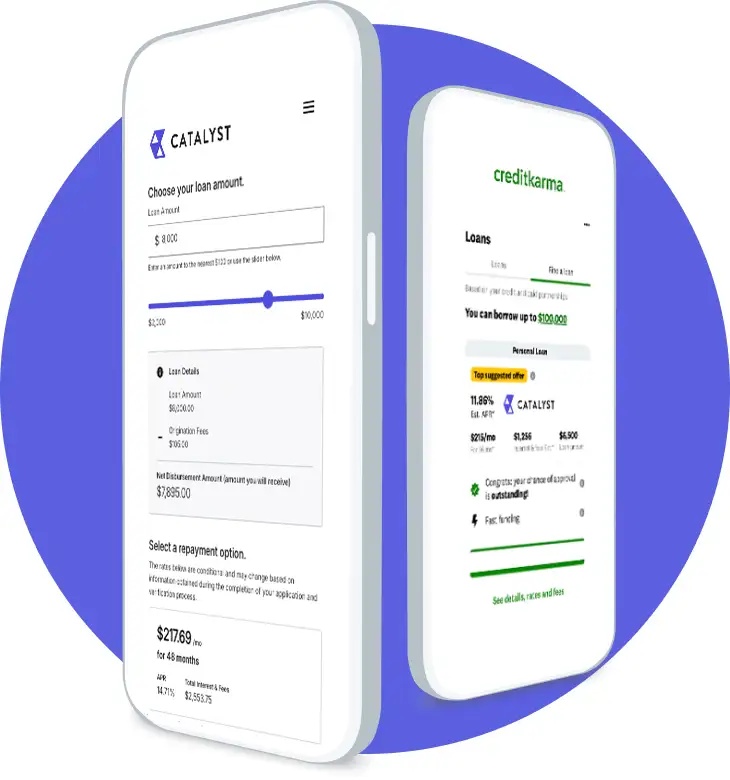
The underlying sales argument is consolidation. Separate deposit, loan and card systems can require separate integrations and operating routines. A shared platform offers the prospect of reducing that duplication. This is an architectural proposition, not proof that every institution should buy the same package.
Amount has also supplied risk analytics, performance assessments and customer acquisition support. Those services matter because an application system is only useful if the institution understands what happens inside it. A completed form, an approved application and a funded loan are different events. Confusing them can make a dashboard look healthier than the business.
Historical customers and partners include TD Bank, Regions and Barclays US Consumer Bank. The model is enterprise software sold to institutions. A borrower encounters the bank’s product and brand. Amount’s job is to help the institution process that encounter.
The competitive field overlaps with MeridianLink, nCino, Q2 and account-opening specialist MANTL, now an Alkami solution team. Institutions can also use tools from their core banking provider or build internally. Amount’s distinguishing pitch is the combination of lending experience, decisioning and multiple origination products. Buyers still have to compare actual product scope, integration effort and operating fit.
The price of getting bigger
The expansion required money. In May 2021, Amount announced nearly $100 million of Series D capital and a post-money valuation above $1 billion. Its legal adviser, Cooley, said the proceeds would support hiring across product, technology and sales, as well as acquisitions that could add capabilities.
The following February, Amount bought Linear Financial Technologies for $175 million in cash and stock. Linear brought small and midsize business loan and account origination technology. Its reported customers included American Express, Citizens and PNC. The deal gave Amount a broader answer when a bank wanted consumer and business banking tools from fewer suppliers.
Historical post-money valuation
May 2021 financing
Cash-and-stock purchase price
Linear acquisition, 2022
Then the pace changed. In June 2022, Amount cut 18% of its workforce. Hughes attributed the decision to the macroeconomic environment. The public record documents a staffing reset; it does not establish a single failed product as its cause. Growth had acquired a cost that a unicorn label could not pay by itself.
In August 2024, a $30 million equity round made the credit union market a more explicit priority. Curql, a collective of credit unions investing in fintech, joined existing investors. Amount said the funding would support its technology, credit union expansion and AI and machine learning capabilities. Distribution was becoming part of the product strategy.
The distribution deal hiding in the acquisition
On September 24, 2025, FIS announced it had completed the Amount acquisition. The announcement described more than 150 million new account applications processed. That is an application count, not a count of unique customers or approved loans. The distinction matters almost as much as the number.
FIS said it intended to integrate the platform into its digital, core banking and card systems. For Amount, the combination offered the parent company’s reach, infrastructure and regulatory expertise. For FIS, it added cloud-first origination capabilities to an existing banking business.
The early commercial signal is concrete, if still limited. In its 2025 annual report, FIS says it had won nearly 30 new client deals since acquiring the capability. That supports the case for wider distribution. It does not tell us those deals’ value, implementation results or contribution to profit.
Copy the experiment, then check the economics
What should a bank operator borrow from this story? Start with the point where an application stops moving. Count the work that people repeat, the cases they escalate and the customers who leave. Amount’s document-review episode suggests that a targeted experiment can teach more than a sweeping promise to automate everything.
For an institution considering the platform, the useful questions concern completion, review time, fraud losses and integration with existing systems. A shared workflow is attractive when several products repeat the same work. An institution with a narrow product range, effective existing tools or difficult integrations may reach a different buying decision. These are practical inferences from the product’s proposition.
FIS directs prospective customers to sales for pricing. The purchase therefore needs a comparison of implementation effort, ongoing charges and measurable operating benefits. Faster applications are worth paying for when they produce a better business outcome. A faster queue that still ends at the same unresolved decision is merely a queue with better manners.
Keep following the story
Amount website · Explore Origination Suite · LinkedIn · X · Facebook
The acquisition announcement · Marqeta’s partnership blog · Amount video from its 2021 press release