A bank customer can open an app at midnight, photograph a driver's license and choose a checking account before the kettle boils. Then the application reaches the bank, where modernity occasionally ends. A relationship manager emails operations. Compliance asks for another document. Someone retypes a legal name. Treasury services wait in a different queue. The customer who enjoyed three minutes of sleek software now enters a week of polite uncertainty.
Vikar Technologies was built for that awkward second act. Founded in New Jersey in 2017, the company sells hosted software to community and regional banks, credit unions and wealth managers. Its One Vikar platform connects account opening, KYC and KYB checks, commercial lending, treasury enrollment, wealth onboarding and periodic reviews. The promise is not merely a nicer application. It is that the customer's information and the bank's work should keep moving after the application lands.
The first thing that failed was the space between systems
Vikar's four founders - Glenn Bolstad, Adam Bieser, Amruta Dongre and Nancy Schneier - had spent years in financial services, consulting and fintech. Before Vikar, the group helped build the North American market for a wealth-management onboarding startup. Across institution after institution, they saw the same structural gap. Large platforms were designed for giant banks and arrived with weight, complexity and expense. Smaller tools handled one attractive slice of the journey but left employees stitching the rest together.
What changed their minds from operators to founders was repetition. The problem was not one badly designed screen or one stubborn bank. Smaller institutions were routinely forced to overbuy a suite, underbuy a point solution, or assemble their own nervous system from PDFs, spreadsheets, email and a core banking platform. The team concluded there was room for software that adapted to a bank's established process while giving every department a common interface.
The relay race Vikar wants to turn into one track
One platform, four doors
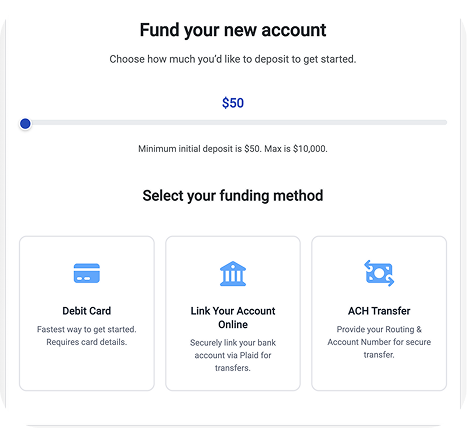
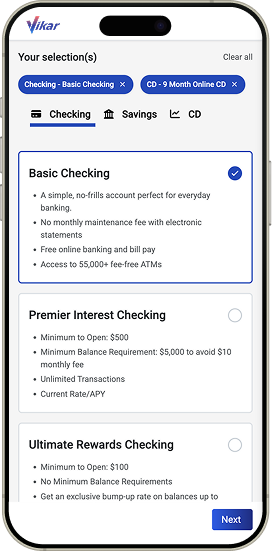
The platform now presents four main doors: deposits, lending, treasury and wealth management. For deposits, customers can apply online, in a branch or with a banker directing the process. Verification, document collection and account funding can sit in the same journey. Commercial account opening supports the messier reality of businesses - multiple owners, complex entities, international structures and the need to verify both people and organizations.
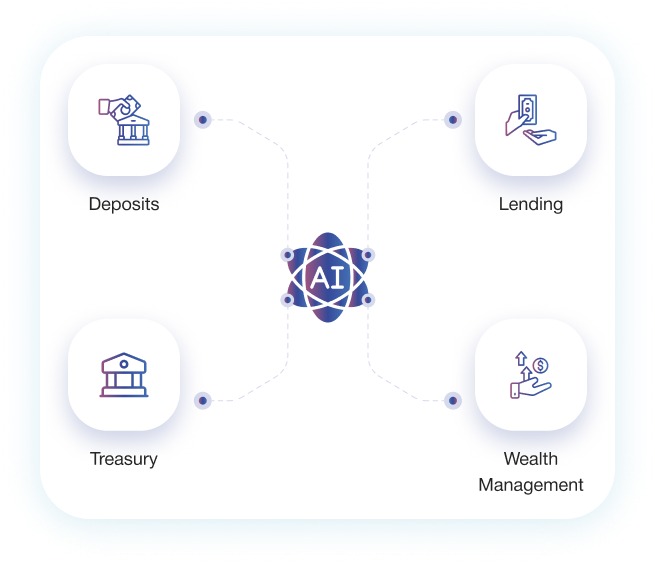
Lending runs beyond origination into underwriting, closing, onboarding, renewals, modifications, covenant tracking, loan reviews and portfolio management. In 2024 Vikar added dedicated SMB origination, specialty lending and international account opening. Treasury connects service selection with agreements, risk controls and activation for products such as ACH, wires, positive pay and lockbox. Wealth workflows coordinate advisors, compliance, risk and operations around brokerage, advisory and trust accounts.
The connective tissue is configurability and integration. Vikar says a bank can deploy modules alongside existing software or replace point solutions, while connecting to its core. That is a shrewd position in a market where rip-and-replace projects can consume years and careers. The bank does not have to pretend its commercial lending process resembles another institution's retail account opening. Vikar's software is supposed to bend around each workflow.

Who buys it, and what they are really buying
Vikar's named customers include Peapack Private Bank & Trust, Firstrust Bank, Northfield Bank, Valley Bank, Salem Five Bank, First Commerce Bank, Machias Savings Bank and BCB Bank. These are institutions that compete partly on relationships. Their problem is not a lack of capable bankers. It is that capable bankers lose hours moving information between systems built by different vendors in different eras.
The business model is enterprise SaaS: request a demo, configure modules, connect systems, implement and support. Vikar does not publish list prices or implementation fees. So the honest cost equation is broader than a subscription. A buyer has to count integration, migration, security review, training and internal process decisions. The potential return also lives outside the license line: less rekeying, fewer abandoned applications, quicker decisions and earlier account activation. None of those benefits should be accepted on a slide alone. A bank should test them against one real workflow.
That test can be pleasantly concrete. Give the vendor an application from a complicated local business, not a fictional customer named Jane Doe. Include beneficial owners, a missing document, an identity exception, two deposit products, treasury services and a lending request. Time every pause. Count every field an employee enters twice. Ask which system owns the final record, who can change a rule and what appears in the audit trail. Then repeat the exercise with a banker starting the application in a branch and the customer finishing at home. Vikar's omnichannel claim matters only if the context survives that trip. This is also where a community institution can discover whether “configurable” means its operations team can safely adjust a workflow or whether every change becomes a services ticket. The winning demo should look a little untidy because real bank customers are untidy.
The company reported a 60 percent increase in both clients and software revenue during 2024, followed by 30 percent client growth and 80 percent team growth in 2025. Those are company-reported percentages, not audited totals. Still, the sequence matters. Vikar doubled headcount, expanded sales beyond the East Coast and then broadened the product. Its January 2025 Series A, led by Btech Consortium Fund and Verde Technology Ventures, was earmarked for hiring, national expansion and product development. The amount was not announced.
The moat is becoming a map of everybody else
A banking workflow company lives or dies by what it can connect. Vikar joined Jack Henry's Vendor Integration Program in 2023. In 2026 it entered Q2's Innovation Studio, partnered with Onsetto on business-banking activation and added Plaid for external-account authentication, funding and identity verification. Each partnership makes the platform more useful without asking Vikar to become a core, a payments network and an identity database at once.
That also reveals where Vikar fits in a crowded market. A bank could consider nCino, Abrigo, Baker Hill, MeridianLink, Finastra, Numerated or a core vendor's own modules. It could buy account-opening software separately from a loan-origination system and keep treasury onboarding in email. Vikar's differentiation is the attempt to span the client relationship while remaining modular: one common workflow across products, without insisting every institution adopt the same process.
AI is now part of the pitch, through document intelligence and assisted insights across onboarding and lending. The useful question is not whether an icon sparkles. It is whether the system can extract information, show its work, route exceptions and preserve human accountability under a bank's policies. In regulated software, “faster” is a feature only when the audit trail comes along.
What another founder can copy
- Pick a customer segment incumbents serve awkwardly, not a problem nobody has noticed.
- Map every departmental handoff before designing the customer-facing screen.
- Let the first product coexist with the old stack; earn the right to consolidate it later.
- Make configuration a repeatable system, not an invitation to become a custom-development shop.
- Build distribution through the ecosystem your buyer already trusts.
Where the playbook breaks
Vikar's approach works best when a financial institution has real workflow fragmentation, enough transaction volume to justify integration and leaders willing to standardize decisions across departments. It is less convincing for a buyer that needs one narrow utility, demands self-serve pricing, cannot assign internal owners to implementation, or refuses to change a single approval step. Configurable software still requires choices. If every exception becomes sacred, flexibility turns into expensive customization.
The likely fit
A community or regional institution with fragmented onboarding or lending, multiple departments in the journey and a clear owner for process redesign.
The likely miss
A tiny team seeking one plug-and-play feature, or an institution without integration capacity, implementation leadership or appetite for workflow change.
There is another risk in breadth. Deposits, commercial lending, treasury and wealth each contain enough edge cases to occupy a company. Vikar must prove that a unified platform does not flatten the expertise each line requires. Its public customer announcements show traction, but procurement teams should ask for live references that resemble their asset size, core, products and complexity. The right proof is not a generic demo. It is a messy business customer with several owners, several accounts and a loan attached.
Vikar's idea is appealing because it is rooted in observation rather than theater. Community banks do not need to imitate megabanks. They need modern tools that preserve their relationship advantage while retiring the scavenger hunt behind it. If One Vikar can make the customer's second act feel as deliberate as the first three minutes, the least glamorous part of banking software may become the most valuable.