During the banking turmoil of 2023, Joshua Summers and Scott Weller were helping startup founders move their accounts. Then they encountered a complication: some borrowers’ loan covenants restricted where they could keep their cash. A clause designed to protect a lender had become an obstacle to moving quickly. The paperwork was doing precisely what it was written to do. The circumstances had changed.
- AI agents handle borrower documents, financial spreads, credit memos and ongoing monitoring.
- The buyers are lenders; credit professionals review the work and retain approval.
- $22.5 million raised. The much-mentioned 150+ banks belong to investors’ networks.
The pair began asking lenders questions. Summers later described roughly four dozen conversations across institutional and private lending. They found slow underwriting and limited capacity to watch loans after origination. In his Blue Dun interview, he offered an unusually plain lesson about that discovery process: “With every company I’ve started over the years, I wish I had done this.”

A loan is also a pile of documents
EnFi emerged from those conversations. Founded in 2023 with CFO Michelle Breitman Hipwood alongside CEO Summers and CTO Weller, it builds AI agents for commercial credit. Its work begins where an analyst’s patience often ends: financial statements, tax returns, debt schedules and agreements arriving in different formats, with important facts scattered among them.
Document intake checks whether a package is complete and whether its contents agree. A mismatched name or amount becomes an exception for someone to resolve. Financial spreading then turns statements and returns into comparable figures across accounting periods. Analysts can inspect, edit and approve the spread before it feeds subsequent work. The promise is quite literal: fewer hours carrying numbers from one place to another.
The number needs a paper trail
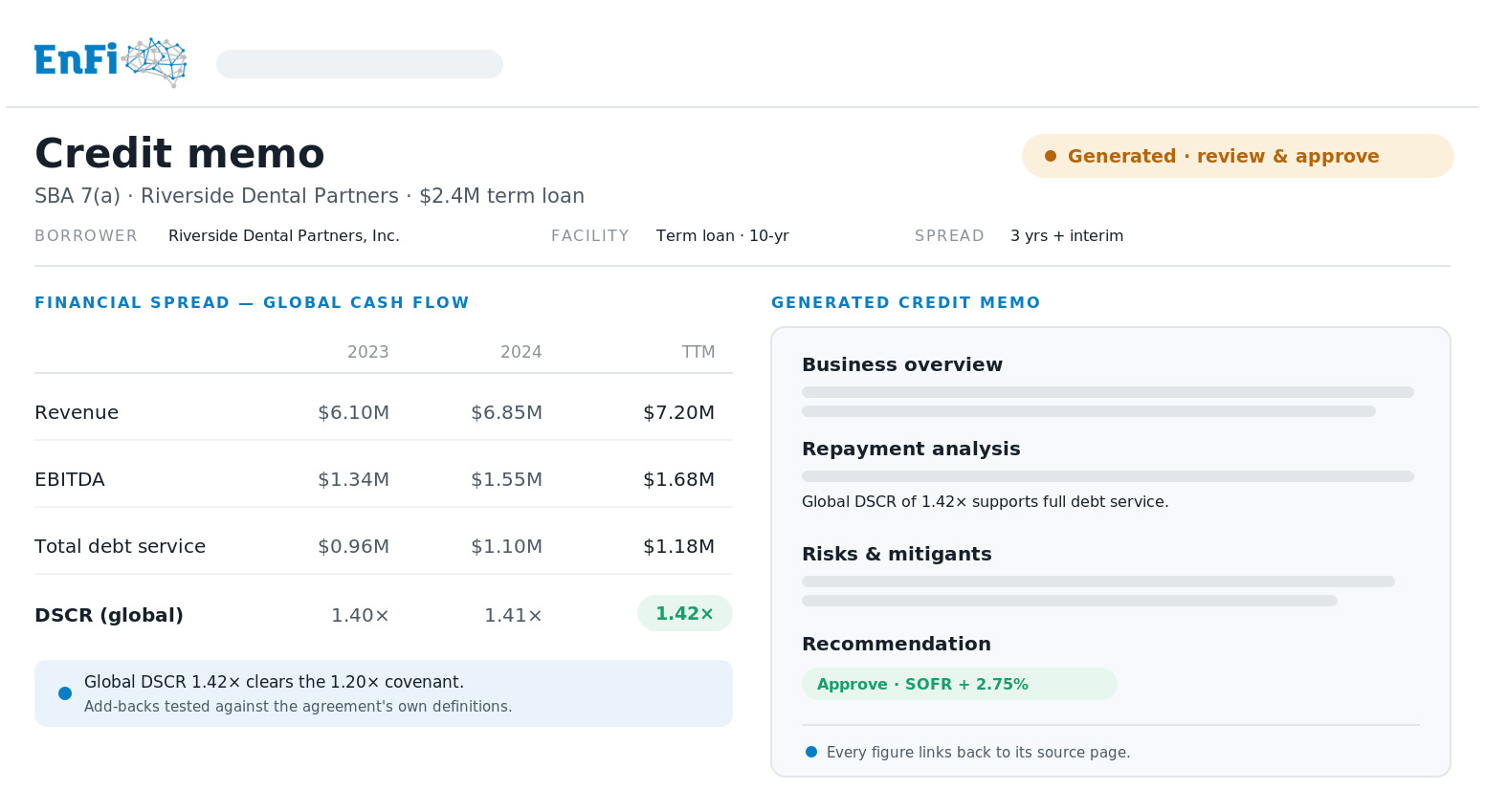
A commercial borrower may have several related businesses and a personal guarantor. Looking at one company’s earnings can leave an incomplete picture of repayment capacity. EnFi’s global cash-flow tools consolidate personal and business information across the relationship. Lenders can configure ownership treatment, eligible entities and adjustments to match their own methodology.
Its credit-memo tools apply policy checks and prepare a written analysis on the lender’s template. Spreads, ratios and risk commentary arrive together. A credit officer signs the decision. That distinction matters because a fluent paragraph is easy to mistake for a settled argument. A reviewer needs to inspect the supporting figures, assumptions and exceptions.
EnFi links figures to their originating documents. Its platform also describes reproducible calculators for the mathematics that matter to a loan. AI can help read and draft; a debt-service calculation should produce the same result when run again. In lending, a number with an address is considerably more useful than a number with confidence.
The second workload begins at closing
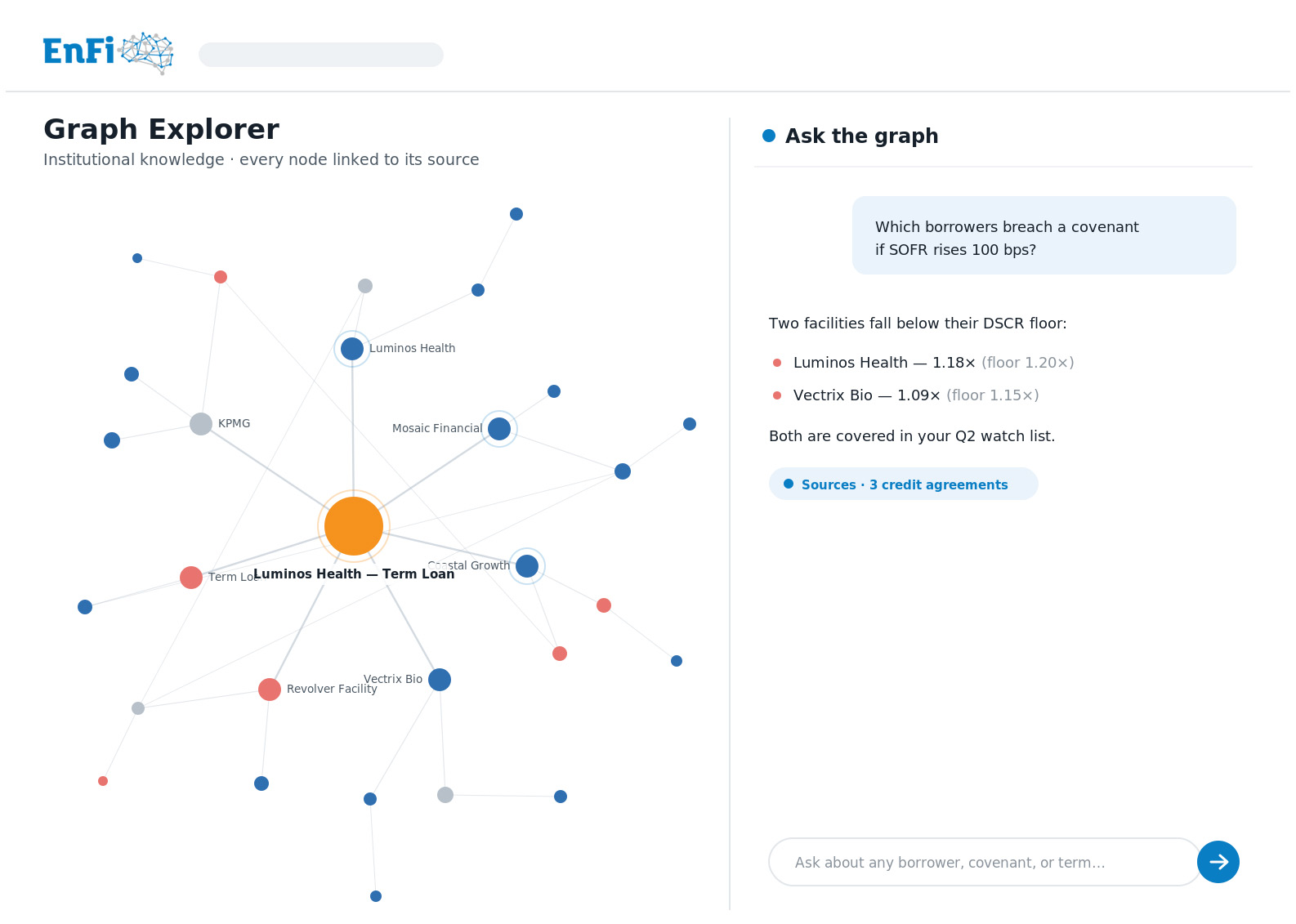
The signed loan creates another queue. Borrowers submit fresh financials; covenants require testing; annual reviews come due. EnFi extracts obligations from executed agreements and tests them as new information arrives. Monitoring results feed the next review, rather than requiring someone to assemble the history again.
The company’s covenant product covers financial, reporting and payment obligations. An overdue certificate and a deteriorating financial ratio are different problems, but both require attention. EnFi presents the exceptions and prepares annual-review drafts using the bank’s template. The operational attraction is continuity: the file used to make the loan becomes the file used to follow it.
The spreadsheet keeps its chair
EnFi sells to banks, credit unions, private credit funds and fintech lenders. Its public customer roster includes Grasshopper Bank, Citadel Credit Union, Cogent Bank, Sungage Financial and Coastal Community Bank. Grasshopper announced its partnership in November 2024, targeting credit analysis and risk monitoring. These are institutions with existing habits and software, rather than empty rooms awaiting an AI demonstration.
That helps explain EnFi Grid, introduced in September 2025. Lenders can bring spreadsheets into the platform, create models and use AI assistance on scorecards and trackers. Formulas, charts and pivot tables remain available. A spreadsheet may be inelegant, but asking an analyst to abandon a trusted model is a fairly expensive way to begin a friendship.
EnFi’s alternatives include manual spreadsheet work, document-extraction tools and established lending software. It positions itself alongside core banking and loan-origination systems, handling analytical jobs those systems leave to people. Buyers are purchasing enterprise software through a sales conversation; its published distribution strategy also includes other fintech platforms.
The capital comes with introductions
EnFi raised a $7.5 million seed round in 2024. On February 4, 2026, it announced a $15 million Series A led by FINTOP, with Patriot Financial Partners, Commerce Ventures, Unusual Ventures and Boston Seed Capital participating. Total funding reached $22.5 million, intended to support technology, hiring and sales.
The investors’ networks collectively span more than 150 financial institutions. That is a channel into the market, rather than a count of EnFi customers. Bank-connected investors can provide introductions and familiarity with purchasing constraints. The experience on the founding team also predates EnFi: Summers co-founded clypd, acquired by AT&T; Weller co-founded SessionM, acquired by Mastercard.
“AI isn’t replacing human judgment”
John Philpott, FINTOP / February 2026
Give it an ordinary file
The useful lesson for another operator is to begin with a bottleneck people already recognize. EnFi’s founders asked questions before they had a product to pitch. Its workflows keep familiar templates and approval roles. Summers’ public writing describes AI as a colleague; here, that philosophy has a practical expression in work prepared for review.
A sensible pilot would use representative loan files, compare extracted figures with the originals and measure the time reviewers spend correcting the output. Current documents, explicit credit rules and functioning integrations are prerequisites. Monitoring cannot reveal financial changes a borrower has yet to report. Automating a poorly specified policy simply applies the ambiguity faster. The worthwhile question is how much sound analytical attention returns to the people carrying the credit.