The trouble arrived near the finish line. Bizbe, a business brokerage, had buyers moving toward acquisitions. It also had direct integrations with individual banks. Yet financing delays on significant deals exposed the awkward difference between connecting to a lender and getting a transaction through one. By September 2026, Bizbe had chosen another arrangement: a financing experience powered by Lendflow, built into its own platform.
- Lendflow supplies the infrastructure; participating lenders supply financing.
- Its three layers connect borrowers, organize credit decisions and automate lending chores.
- A second-look marketplace gives declined applications another route, without promising approval.
The bank integration that got in the way
This is a revealing customer story because nobody needed persuading that capital mattered. Bizbe already had bank connections. What changed was its view of the machinery required to manage them. According to the partnership announcement, individual integrations added complexity and limited buyers’ flexibility. Bizbe Capital centralizes that work, using information gathered during diligence to support financing.
The lesson is pleasantly unromantic. A business can have a financing button and still have a financing problem. Lendflow sells what happens behind the button: application handling, lender connections, data collection, decisions and follow-up. Its buyers are fintechs, lenders, brokers and software companies. Their customers are the small businesses hoping the button leads somewhere useful.
A rejection becomes a junction
Consider the company’s Second Look Marketplace. A lender declines an application. Ordinarily, the relationship might end there. Lendflow can route that application to specialist lenders within the original brand’s experience, while tracking referral fees. The proposition rests on a modest distinction: unsuitable for one lender does not necessarily mean unsuitable for every lender.
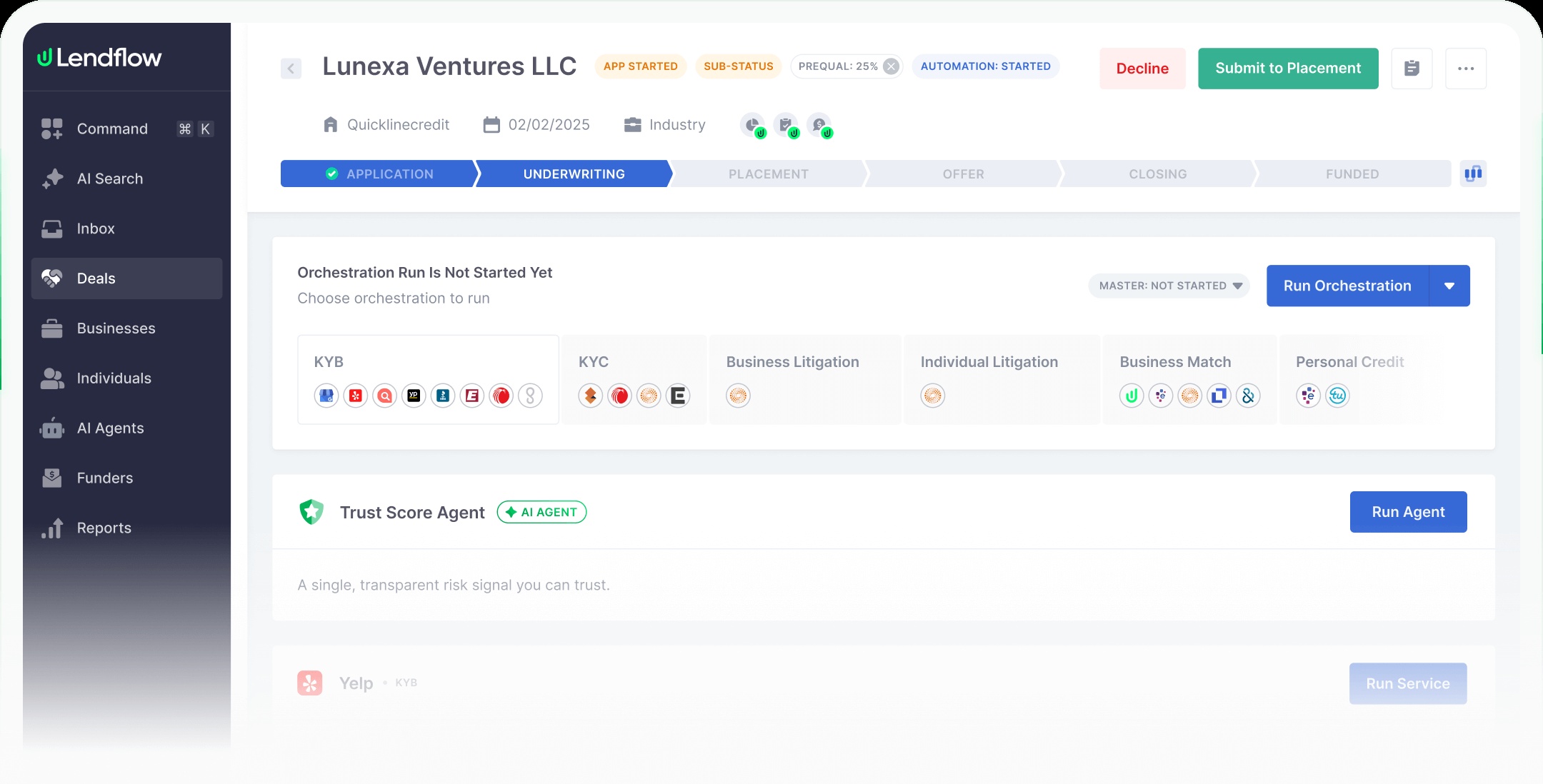
That route belongs to Lendflow Connect, the distribution layer. Intelligence supplies data aggregation, configurable scorecards and decision workflows. Automate handles the work between decisions: extracting document data, calling borrowers and sending reminders. Customers can buy components separately. The modularity matters because a lender with established underwriting needs different help from a software company offering financing for the first time.
Experian provides the recognizable example. Its November 2025 announcement described a marketplace inside the Experian app: one application, near real-time offers informed by cash flow, credit scores, business age and industry, followed by document upload after an offer is selected. Experian can choose which lenders appear. The marketplace wears the distributor’s clothes.
“the building blocks for our own credit product offering”Andrew Dunn, VP of Financial Products, Levelset, in a customer testimonial
A provider such as Liberis offers another path, bringing funding and underwriting to platform partnerships. Lendflow emphasizes a network of lenders plus tools customers can assemble around their own policies. For a buyer, the choice concerns who supplies capital, who controls the workflow and how much infrastructure already exists.
The machinery behind the manners
Jon Fry had encountered lending well before founding Lendflow in 2019. His Y Combinator biography lists ChannelGrowth, a borrower-acquisition business launched in 2014, and Quicklinecredit, launched in 2017, where he built software for stages of the lending process. Co-founder Matthew Watts brought engineering experience, including leading teams at SpendHQ. Distribution and software were already acquainted.
The company’s published account of its evolution runs through three stages: an embedded marketplace, an infrastructure layer exposing tools built for itself, then AI automation. That progression broadens what customers can purchase. A platform can use the marketplace; an established lender can use the components behind it.
Documents remain stubbornly relevant. In its Ocrolus partnership, Lendflow uses document automation and cash-flow analysis to help assess applications and route them. A bank connection does not eliminate every statement or every verification task. Automate targets precisely those repetitive jobs, while voice and chat agents pursue missing information. The grand title “AI agent” often conceals the humble occupation of asking for page three.
September 2026 brought another interface. Lendflow says its hosted MCP connection lets authenticated users work through ChatGPT, Claude and Grok, retrieving application information and performing supported actions such as adding notes or uploading documents. Configuration and permissions determine the available actions. The lending records remain connected even when the screen becomes a conversation.
Who pays for the second door?
Lendflow’s pricing page distinguishes managed partnerships charged as a percentage of revenue from direct partnerships charged transaction fees. Software modules have software fees. AI agents use credits, with monthly usage and prepaid bundles. Buyers therefore need a quote covering their expected modules, activity and partnership arrangement. Comparing only a software fee would miss part of the bill.
Credit offers made over the preceding 12 months, as of March 2025, according to Lendflow.
The company’s own financing is more straightforward to label. It announced a $10.8 million Series A in October 2021, led by Underscore VC. In May 2025, Trinity Capital committed $15 million in growth capital. These announcements concern money financing Lendflow’s business, a different ledger from credit offered through its platform.
The rules travel with the money
There is also a concrete regulatory cost. California’s October 2025 enforcement summary records a Lendflow consent order. The order imposed a $210,000 penalty and $40,000 in investigative costs, and directed the company to stop specified unlicensed brokering or lending activity. Financial infrastructure carries obligations alongside its conveniences.
The product has a practical boundary, too. Its credit-engine documentation says unmatched applications can be declined and uncertain information escalated for manual review. More routes do not manufacture a creditworthy borrower or an affordable offer. A second door remains a door with someone else’s admission policy.
What can another business copy? Start with a stalled step that customers already experience. Reuse information already collected. Make lender routing explicit. Automate repetitive follow-up and keep a route to human judgment. Bizbe’s experience suggests the moment to reconsider individual integrations: when managing the connections begins obstructing the transaction they were meant to help.