A client has sent the document. The document is incomplete. Someone has replied asking for the missing page. Someone else has replied to an older message. Everyone has been conscientious, and the work is still stuck. This is an illustrative scene, but it captures the kind of business problem Moxo has chosen to pursue: activity that looks like progress until you ask what can happen next.
- Moxo turns requests, documents, approvals, and handoffs into shared workflows.
- Its customers range from bookkeepers and visa specialists to banks and manufacturers.
- AI prepares and routes work; configured human steps preserve responsibility for decisions.
- The practical lesson: make the next action visible before adding another reminder.
Software has made sending things wonderfully easy. Receiving the right thing, knowing whether it is sufficient, and moving it to the next person remain rather more laborious. An inbox offers chronological order. A business process needs consequential order: this must happen before that, and this person must decide whether it counts.
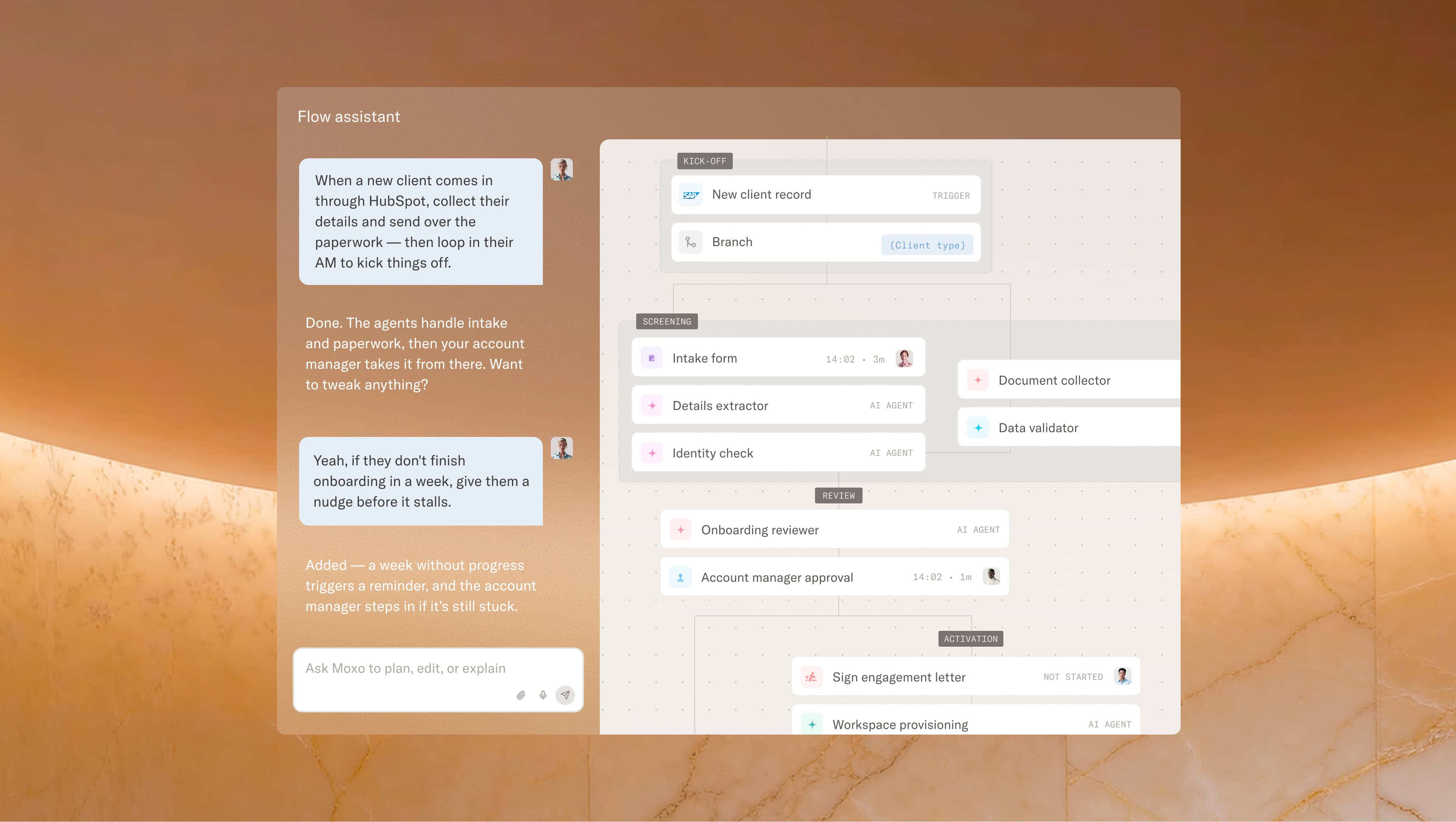
Moxo sells that second kind of order. It now describes its product as a platform where people, AI agents, and systems run the same process. The interesting promise is that a request carries its instructions, evidence, and next action along with it. The recipient should spend less time reconstructing what everyone meant.
01 / The binder grew a to-do list
The company began in 2012 as Moxtra, co-founded by Subrah Iyar and Stanley Huang. Iyar had co-founded WebEx; Huang had held engineering leadership roles at WebEx and Cisco. Their experience supplied a useful starting point: they understood collaboration as a product people actually had to use, rather than a diagram an executive might admire. Their roles are documented in the company’s rebrand announcement.
The early organizing idea was a shared digital binder. Files and conversations could belong together, rather than being scattered across devices and channels. A contemporary funding record describes collecting, annotating, and sharing multimedia content, synchronously or asynchronously. In September 2013, Moxtra announced a $10 million first round, with Cisco, KDDI, Innovation Works, and Barry Sternlicht’s investment arm among the backers.
By 2016, the company was discussing an enterprise-focused version that businesses could rebrand. A contemporary report said its earlier consumer versions had helped it prepare the product for business use. That is an evolution with evidence behind it. The temptation to manufacture a dramatic collapse and triumphant pivot would make a livelier film, but a poorer explanation.
In March 2022, Moxtra became Moxo. The announcement explicitly connected the name change to structured client workflows, extending from onboarding to servicing and exceptions. The company’s stated explanation was customer experience accumulated over time. Communication had become a component of a larger job: helping an interaction reach an outcome.
02 / The first thing to fail was the handoff
At Accountific, a Canadian bookkeeping firm serving food and beverage operators, the trouble was fragmented client communication. Email, texts, and messages from other platforms made conversations difficult to track and multiplied software costs. The firm made Moxo its primary communication space, using document sharing and chat. It introduced the platform during discovery, before the relationship had acquired an unruly collection of channels.
The vendor-published case study reports roughly 90% fewer client emails and 90% client adoption. Founder David Montieth also describes dropping other software. These are customer-reported results, rather than a controlled experiment. Still, the mechanism is comprehensible: give the client a familiar place to return, then keep the work there.
Peninsula Visa makes the same problem more intricate. Travel-document requirements vary with nationality, location, and destination. Its team had been searching long email threads for attachments while clients struggled to understand submissions. Moxo supplied a guided checklist, conditional branches, and milestones.
“The 'aha' moment was definitely the Flows.”Evan James / CEO, Peninsula Visa
That is a revealing reaction. The attraction was the sequence. A traveler could follow requirements, acknowledge items, and receive contextual help. The case-study summary reports a 50% reduction in average processing time; its narrative also cites a larger reduction for document preparation. Those measures should not be casually merged. The useful lesson survives without choosing the most flattering number.
03 / A process crosses the company boundary
A private banking client and a restaurant owner are unlikely to share a calendar. They do share a need to exchange sensitive material with someone outside their own organization. This is where Moxo’s combination of portals and workflows becomes distinctive. The person supplying information is a participant in the process, with a place to act.
BNP Paribas Wealth Management used Moxo in MyWealth, combining secure messaging, file exchange, digital signatures, and video meetings within its existing digital environment. The relationship manager remained part of the service. The software gave that relationship a digital place to operate.
Then consider FLEX Racing, which supplies custom branding for motorsports and action sports. Its spreadsheets and manual follow-ups could not keep pace with orders. Branching workflows guided customer choices; internal flows coordinated staff and suppliers while customers saw a simpler view. Its vendor-published story reports a 150% throughput increase without additional staff. The common thread is work crossing organizational boundaries with dependencies attached.
As a market comparison, buyers can think of project trackers such as Asana, communication tools such as Teams, and specialist client portals as neighboring approaches. Moxo’s pitch combines participant access with process execution. A team choosing among them should bring an actual external handoff to the demonstration. A tidy task board can conceal a messy client experience.
04 / Give the machine a job description
Moxo’s Agent Foundry lets businesses configure agents around their documents, policies, and playbooks. Its published capabilities include document outputs, model routing, spending caps for test flows, and escalation paths. It also allows outside agents to join the process. The question is less “Can it answer?” than “What work may it do, and when must it stop?”
The AI offering separates preparation from accountable judgment. Agents can read documents and prefill information; people handle approvals and exception calls. This design still requires a business to specify the boundary. An uncertain policy does not become certain because a model has expressed it in elegant prose.
Integration matters just as much as intelligence. Moxo offers data synchronization, third-party actions, APIs, and webhooks, including connections through Zapier. Its 2024 Wealthbox integration announcement places client workflows alongside an advisor’s CRM. Moxo can coordinate work while another system retains the authoritative record. That division needs deliberate configuration.
For sensitive processes, the company’s security materials describe encryption in transit and at rest, role-based access, and SOC 2 Type II controls. Buyers should match permissions, retention, and deployment to the actual process. A feature list becomes useful when the team can explain who is allowed to see each document.
05 / Count flows before counting savings
At the time of this profile, Moxo’s Team plan lists $5,000 annually, 100 flows per year, $100 of AI per year, and unlimited seats. Scale and Enterprise use custom quotes. Scale adds branching, Agent Foundry, portals, and APIs; Enterprise includes SDK embedding and more advanced agent options. A buyer should price the plan containing the workflow they intend to run.
100 flows · $100 of AI · Unlimited seats
Dividing the subscription by its included allowance gives $50 per flow if all 100 are used. That is an allocation of the annual fee, not an advertised transaction price. Implementation time and additional usage can change the economics. The more helpful calculation compares the complete expense with time spent chasing, reviewing, correcting, and re-entering the same information.
06 / Copy the sequence, then buy the software
The transferable habit is simple enough to test on paper. Pick one recurring request. Give it an owner, define the evidence required to close it, and decide what happens when the evidence is missing. Show the participant the next action. Measure elapsed time and rework before declaring the process improved.
My assessment is that a workflow platform becomes useful when repeated handoffs are consuming attention and the business can define them. It is a weaker fit for occasional, simple requests or for teams that keep accepting work through disconnected channels. Automation will also struggle where nobody owns an exception. Those are operating conditions to test, rather than conclusions a polished demo can settle.
Moxo’s stated values put people and clarity at the center of the product. Its evolution gives that philosophy a practical expression: the binder became a process, and the process acquired agents. The client still has to supply the missing page. At least someone can now see where it belongs.