A customer had a complaint that ought to have been a compliment. Survey programming had become about 60 percent faster. Yet quality assurance was taking as long as ever. On Metaforms’ website, the customer’s predicament gets a splendid image: a Ferrari inching through Times Square. The engine was doing its job. The road had other ideas.
- Metaforms automates the delivery work inside research agencies.
- It keeps specialists reviewing code, logic and data.
- Its $9 million Series A backed a business built around existing research tools.
- The practical lesson: measure the whole project, then follow the next queue.
That traffic jam explains the company better than a promise of instant insights. Market research has a production line: a brief becomes questions, questions become code, respondents supply answers, and somebody checks whether those answers deserve belief. Speed up one station and work piles up at another. Metaforms sells software for those stations. Its customers include research agencies and sample providers; the work is often invisible to the businesses buying the final report.
The inbox was the syllabus
Akshat Tyagi and co-founder Arjun S did not arrive with a finished map of this industry. The company’s current account is unusually candid about the wandering. It built things people did not want and sold across unrelated industries. By late 2024, it says, the team was only beginning to understand market research.
The intervention was delightfully ordinary. They paid someone who had run an agency to explain his inbox and spreadsheets. Think about that choice. An inbox records requests, revisions, missing information and who is waiting for whom. A spreadsheet records the machinery beneath the presentation. Together, they offered an apprenticeship in the work customers actually performed.

Metaforms’ mission now follows from that education: reduce the operational burden so reliable research becomes available to more businesses. The buyers are the people producing research. Its current website reports more than 35 agency customers and displays names including Dynata, Savanta, Prodege, PureSpectrum and STRAT7. This is a business selling capacity to businesses whose scarce resource is skilled attention.
An AI that has to learn the local dialect
A questionnaire is not simply a list. It contains routing rules, screening conditions, quotas and instructions that must survive translation into executable software. A respondent’s answer can determine which questions appear next. A careless change can spoil comparability with a previous study. “Looks plausible” is a poor acceptance test.
Arjun’s July 2025 engineering account describes the initial difficulty: general models struggled with proprietary research languages and SPSS workflows. Fine-tuning looked tempting, but useful public training data was scarce and customer data could not simply become training material. The team recruited experienced practitioners to help create synthetic examples and test difficult cases.
That expertise also changed the product. Agents needed practical tools: syntax checks, test links and ways to examine survey behaviour. Generating text was only one task. The company’s team roster now includes specialists in Decipher, Dimensions, Confirmit, Qualtrics, SPSS and QA. The seemingly old-fashioned people are part of the modern machinery.
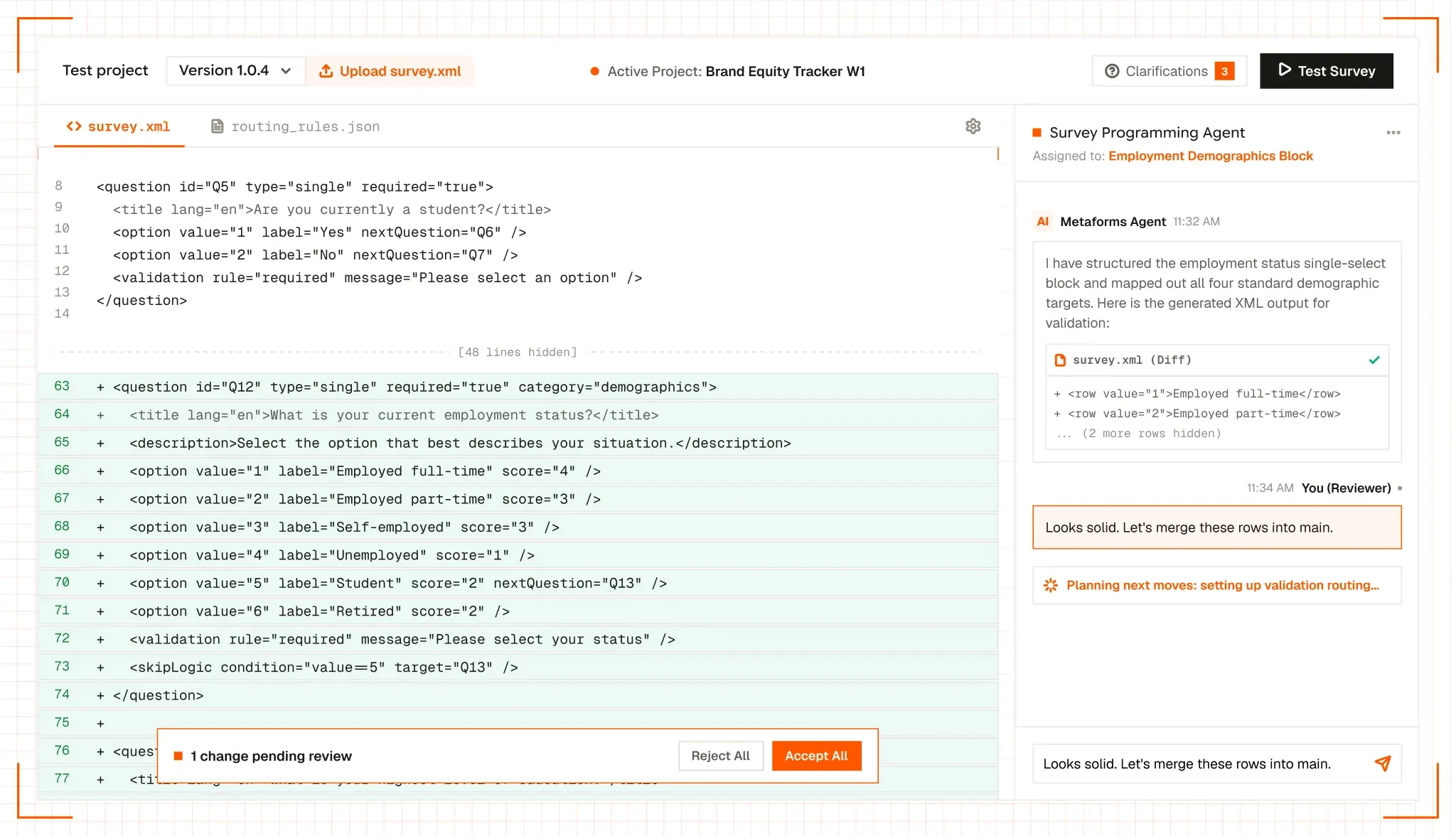
In the current programming workflow, the agent applies a team’s templates and conventions, proposing code for three to five questions at a time. A programmer can accept, reject or edit the changes. Decipher and Dimensions use its workspace; Qualtrics and Confirmit use an extension. This makes Metaforms an additional operating layer around familiar tools, with the agency’s specialist still responsible for the result.
The Ferrari meets the next queue
The earlier agentic programmer preview, published in August 2025, described software that sequences tasks, synchronises code to Decipher and attempts repairs. It was a limited release. The distinction matters: a demonstration of autonomy is not evidence that every complicated study can proceed unattended.
“We use it as a smart assistance tool”
Paolo Gambetti · Head of Innovation, Purdie Pascoe
Metaforms’ current Professional Services page reports programming-time reductions of 30 to 80 percent, depending on questionnaire complexity. Those are company claims, not a universal performance guarantee. Its broader proposition is modular: once programming improves, agencies can address QA, revisions, validation or tabulation. An elegant interface is pleasant; a shorter queue is billable.
Long queue→QA
Next stage
Faster handoff→QA
Queue exposed
There is a method here that other teams can copy. Start with a questionnaire your people already understand. Compare manual and assisted work, record corrections, and time the review as well as generation. Metaforms offers this sort of side-by-side pilot. The useful result is the time to approved output, followed by the time to delivery.
Adoption also takes work. The company tells teams to expect several weeks of real use, templates, rules and support before seeing the full benefit. If a team cannot articulate its standards or supply reviewers, more generated code may simply give it more to inspect. The next bottleneck gets a vote.
Pay for the study, keep the experts
The commercial arrangement is designed around projects and modules in an annual package. Within those projects, extra seats and token use do not set the bill. That removes a small but consequential hesitation: whether another check will cost extra. The implementation expense remains partly organisational, because experts must spend time establishing and reviewing the work.
A $9 million Series A, announced in July 2025, was led by Peak XV Partners with Nexus Venture Partners and Together Fund participating. The announcement put total funding just above $10 million. It earmarked expansion into additional workflows and deeper integrations, rather than treating survey programming as the entire destination.
Konovo supplies a concrete example of that expansion. Its November 2025 Survey Studio announcement described an exclusive healthcare and life sciences partnership using Metaforms’ programming AI alongside Konovo’s domain intelligence. Meanwhile, Metaforms’ own Agentic Flow puts planning, building and processing under one research manager’s review. Its final reporting stage is still labelled in development.
The attraction is easy to understand: agencies can spend less specialist time moving a study between stages. The test is equally plain. When the next deadline arrives, did the team finish more trustworthy work? A Ferrari makes a marvellous purchase only when somebody has considered the traffic.
Follow the work
Explore Metaforms, its delivery modules and engineering and product blog. Read the funding announcement and Konovo’s Survey Studio news. Follow the company on LinkedIn and X.