At Palomar, an insurer covering earthquake, hurricane and flood risks, growth had acquired an irritating companion: more requests for policy documents, cancellations and endorsements. Each was ordinary. Together, they were becoming a staffing problem. The company wanted its business to expand without an equally ambitious expansion of its customer service department. Pace arrived with a proposal: give the procedures to agents that could actually carry them out.
- Pace handles insurance work across documents, calls, email and existing systems.
- Customers include carriers, brokers and claims providers; the work runs from submissions to servicing and claims QA.
- Its new builder, Tempo, lets operators shape agents using their own procedures and sample cases.
01 The queue is the business
Palomar selected three high-volume service flows. Pace and the insurer translated the work into Agent Operating Procedures, or AOPs: instructions written in plain English, connected to the systems where the job had to happen. The first agents shipped in 90 days. According to the published case study, they handled hundreds of requests daily and resolved more than 90% of cases without human intervention.
“Pace takes work from intake to outcome,” said Palomar COO Rudy Hervé. The scope matters. This result concerns those deployed servicing flows, rather than every decision an insurer makes. But it explains the appeal: the request arrives, the necessary information is retrieved, the action is completed, and the case closes. Nobody has to escort the paperwork between desks.
“Pace takes work from intake to outcome”Rudy Hervé · COO, Palomar
02 A procedure with somewhere to go
Founded in 2024 by Jamie Cuffe, Pace describes itself as an AI operations partner for insurance. Cuffe grew up around the industry through his father’s work in reinsurance and brokerage. His company addresses a familiar expense: the administrative labor that carriers and brokers either keep inside or purchase from business process outsourcers. The customer buys help getting insurance work done.
An agent can read an application, request missing information, communicate by phone or email, and update a system of record. Pace uses APIs where available, but also interacts with web portals and desktop applications. Its expertise lives in the awkward junctions between insurance documents, business rules and software. Requiring a carrier to replace its old systems would make the proposition considerably less attractive.
- 01ReceiveEmail, call, document
- 02ReasonFollow the procedure
- 03ActUpdate the system
- 04CheckVerify or escalate
Human review remains part of the route for sensitive actions and exceptions.
The alternative might be an internal team, an outsourcer such as Cognizant or Wipro, or a collection of document extraction, robotic automation and call-routing tools. Pace’s argument is that coordinating the entire case removes handoffs those separate tools leave behind. That is a positioning claim; the practical comparison belongs in a customer’s pilot.

03 The machine had to learn where to look
Pace’s engineering accounts contain a useful confession: an obvious approach did not work well enough. Traditional retrieval-augmented generation, which finds relevant passages by semantic similarity, fell short on some insurance tasks. Finding text about coverage limits does not establish which limit applies after amendments. A policy is a collection of relationships as much as a collection of sentences.
Pace built a contextual reasoning engine that keeps tables connected to surrounding material, evaluates relevance and assembles selected passages with structural information. Its June architecture account describes another difficulty: agents repeatedly rediscovering information and loading excessive context drove cost and latency beyond workable levels. Specialized agents now share persistent working memory and retrieve smaller portions of the case.
By September, the team was describing improvements based on historical runs. Grouping fields that tend to share evidence reduced repeated document reading; Pace reported average cost and latency reductions of 19% and 16%. A simple model-routing heuristic had hurt accuracy. The replacement tests routing choices against past extractions. These are reported engineering results, rather than a customer price list.
04 The operator gets the controls
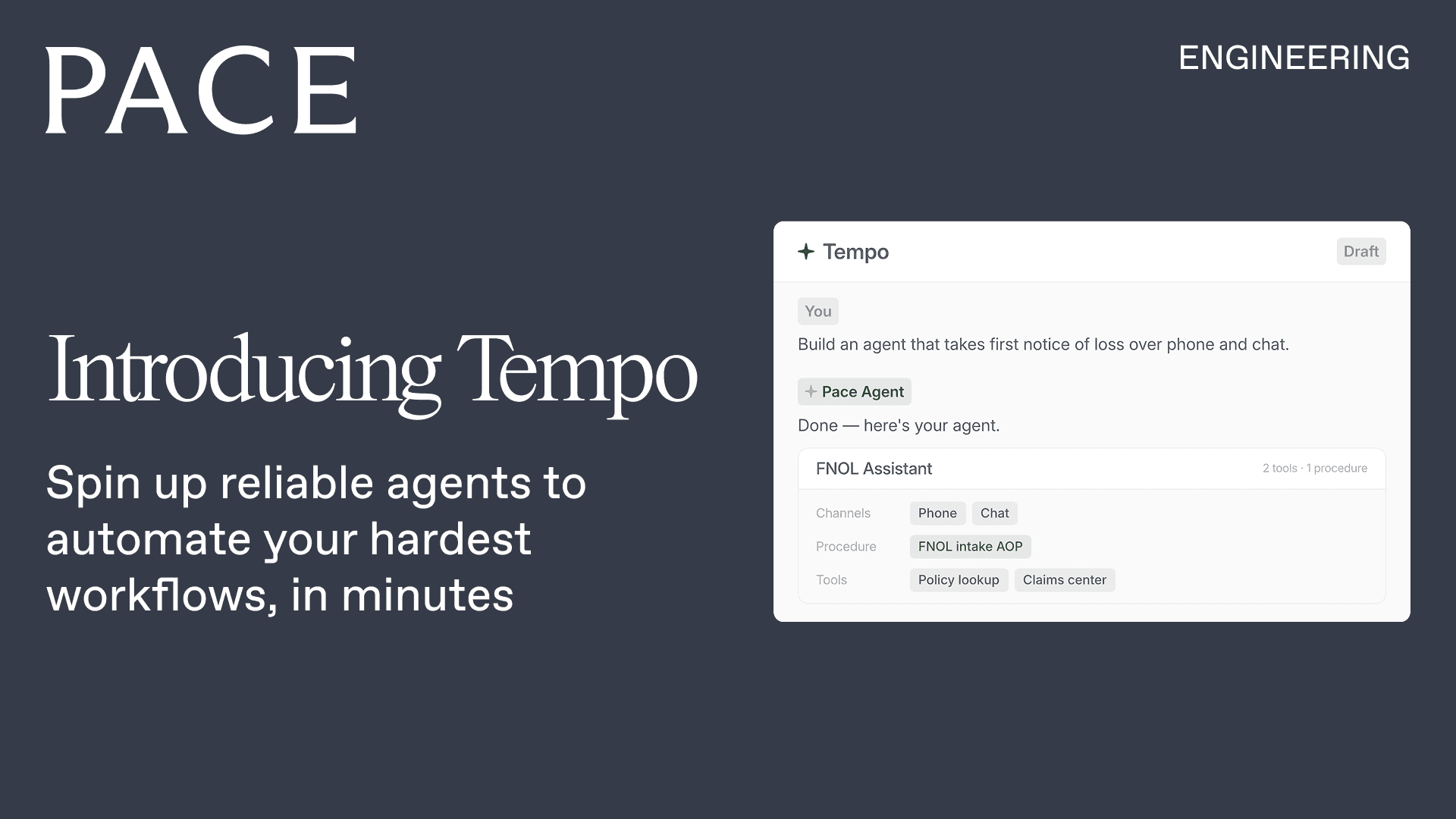
Tempo, launched in July 2026, reflects a lesson from deployments: people closest to the work should shape the agents. Customers supply operating procedures, sample cases and the systems the agent needs. Tempo builds an AOP, tests it against the samples and iterates. Pace says the initial build gets about 80% of the way there in minutes. The remaining exceptions still require attention.
RYZE Claim Solutions provides a sensible deployment pattern to copy. It began claims QA with one client and expanded after meeting accuracy and efficiency benchmarks. Its case study reports 30% shorter QA cycles, twice as many errors identified and 98% audit accuracy. Those figures come from internal analysis. The workflow checks quality; it does not make coverage decisions or damage determinations.
Indexed comparison: baseline = 100. The reported 30% reduction yields 70. Internal analysis; results vary by workflow.
The operational lesson is concrete: pick a bounded job, agree on the correct answers, test representative cases and expand after performance earns permission. Without clear procedures, dependable system access and a way to catch exceptions, faster execution merely moves uncertainty downstream. Pace’s permissions, audit logs and human verification make those requirements part of the product.
05 The price of serving one more customer
Pace sells to enterprises, with deployment support and agreements such as its multi-year Prudential relationship. In January 2026 it announced a $10 million Series A led by Sequoia. In May came a $46 million Series B co-led by Thrive and Sequoia, with Emergence and Pruven participating. Capital gives Pace room to pursue its larger proposition: reducing the cost of servicing insurance changes the economics of offering it.
That proposition deserves attention without a victory parade. Capital, regulation and the underlying risk still constrain insurance supply. Yet an account can be attractive to underwrite and expensive to administer. Pace is working on that second calculation. If the routine work becomes cheaper and more dependable, the interesting question is which customers an insurer can finally afford to welcome.