At Plaid Enterprises, Halloween had become a filing problem. The craft-products maker had images, instructions and product information, but its makeshift asset system could not reliably connect seasonal descriptions with product names and stock numbers. A customer looking for a project could miss the video that belonged with the paint. The content existed. Its usefulness depended on somebody finding it.
- The job: connect marketing work, approved assets and the channels that use them.
- The buyer: enterprises with many teams, brands and review requirements.
- The evidence: reported customer gains in approvals, reuse and migration efficiency.
- The new bet: govern content even after it leaves the central library.
Aprimo makes software for this peculiar predicament: a company can own an abundance of content and still experience a shortage. Its digital asset management system, or DAM, gives images, videos and documents a shared home. Its wider platform manages the work around them. The attraction is less the pleasure of a tidy library than the possibility of avoiding another unnecessary commission, another delayed launch, another afternoon spent asking who approved which version.
The trouble with Halloween
The pandemic’s craft boom exposed Plaid’s cataloging weaknesses. Its old content management system was doing a job it had not been built to do. Aprimo’s account describes a replacement organized around classification, automated descriptions, optical character recognition and duplicate detection. Product information visible on a label could become searchable metadata. The company completed the rollout in six weeks and reduced the volume being migrated, saving $15,000 on that work.
That last detail deserves attention. Moving fewer files was part of the benefit. A migration can be an occasion to decide what deserves to survive. An old system’s clutter need not become a new system’s inheritance.
The lesson I would copy is modest: test whether your content can answer the questions your colleagues actually ask. A seasonal word, a product identifier and an approved usage matter more than a filename that made sense to the person who uploaded it. Give the library a vocabulary the business shares.
A library with a working memory
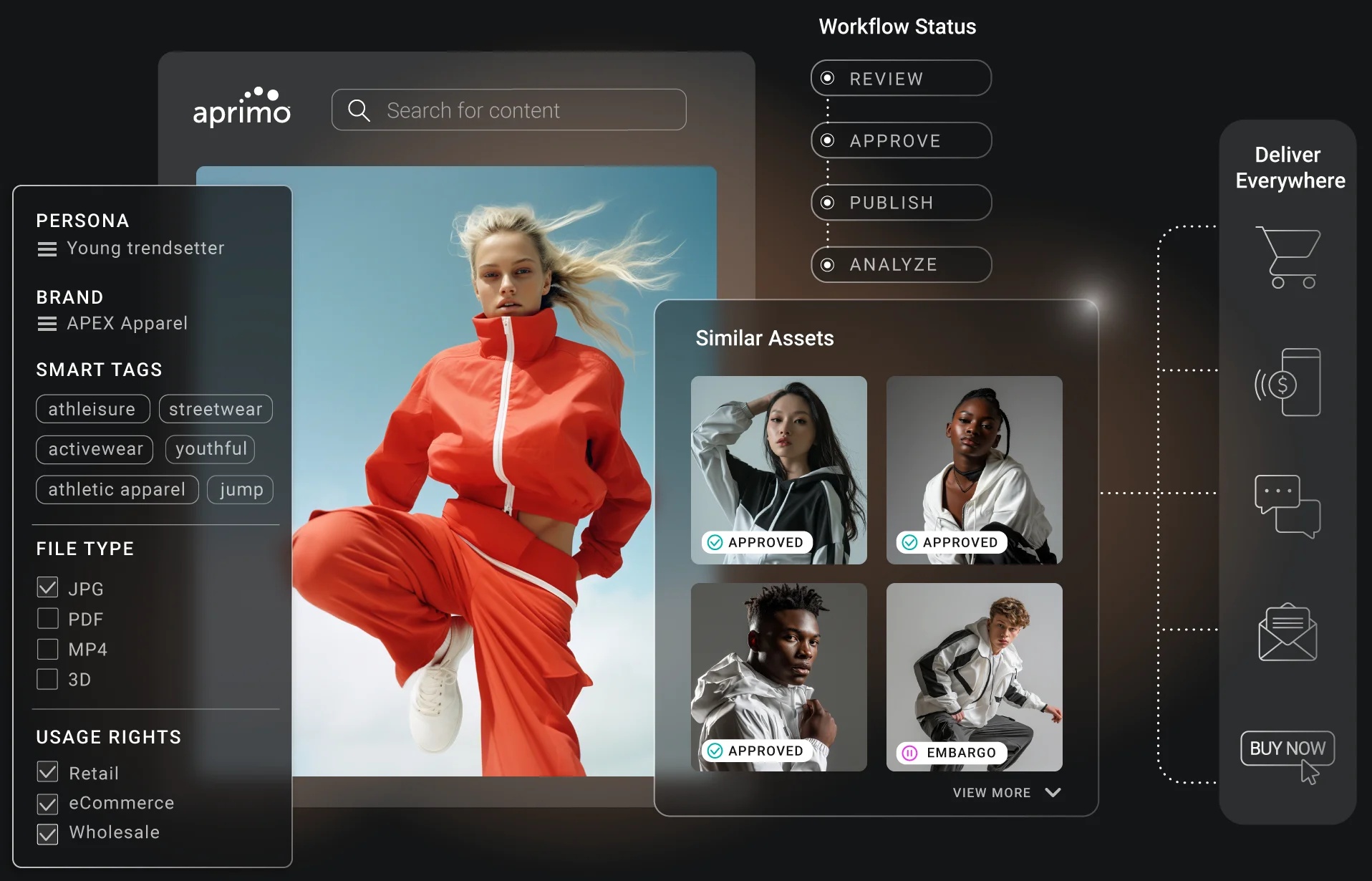
Aprimo’s DAM combines storage with configurable metadata, version control, search, permissions and rights management. These are distinct jobs. Finding a picture does not establish whether the team may use it. Possessing yesterday’s approved version does not establish whether it remains appropriate today. The software gives teams ways to attach those decisions to the content rather than leave them in somebody’s recollection.
The current AI offering extends that arrangement. Librarian agents enrich incoming assets. Critic and Compliance agents review material and flag issues. Production agents prepare variants. Aprimo describes human oversight through feedback, annotations and evaluation tools. The names are unusually apt: a librarian organizes knowledge; a critic asks uncomfortable questions. Marketing has use for both.
There is a practical distinction between recognizing what appears in an image and understanding how an enterprise intends to use it. Business-specific metadata, access rules and approval processes supply that context. The buyer’s task is to make those rules explicit enough for software to apply them. AI does not remove the need for somebody to decide what “approved” means.
- 01BriefWhat are we making?
- 02EnrichHow will it be found?
- 03ReviewMay we use it?
- 04DeliverWhere does it belong?
The campaign has an administrative life
The other half of Aprimo’s proposition begins before a file enters the DAM. Plan connects objectives, campaigns, calendars and briefs. Productivity handles intake, assignments, resource use and review workflows. Spend follows budgets, purchase orders, invoices and actual expenditure. Content Intelligence examines engagement, while Personalization helps decide which content a visitor receives.
Consider the management questions this combination permits. What is being made? Which team is waiting for approval? What has already been paid for? Could an existing asset serve this campaign? A finance system and a creative library each hold part of the answer. Aprimo’s market position rests on connecting that work, with integrations into other enterprise tools.
“Aprimo takes care of the boring, so the design team can focus on the fun.”
Marketing Operations Director, Pacific Life
Its public customer examples span banks, insurers, manufacturers, publishers and nonprofits. Bank of America, Grainger, Hachette Book Group and the National Park Foundation appear alongside consumer brands. The common concern is coordination: multiple people need to create, inspect, retrieve and distribute material under shared rules. An insurance review queue and a publisher’s asset library look different, but each punishes a missing handoff.
Kimberly-Clark’s case study makes the operational problem concrete. Disconnected systems, email and spreadsheets slowed content work. The company rolled out Aprimo across three brands with partner Ntara supporting the DAM and product-information flow. Aprimo reports an 80% reduction in approval time, a 480% increase in asset reuse and 40% more content without added headcount. These are vendor-published customer results, rather than a forecast for the next purchaser.
A company assembled around the handoffs
Aprimo’s breadth has a history. Bill Godfrey and Robert McLaughlin founded the company in Indianapolis in 1998. Teradata completed its acquisition in January 2011 for $525 million, subject to adjustments. In 2016, Teradata agreed to sell its broader marketing applications business to a Marlin Equity Partners affiliate for $90 million, again subject to adjustments.
The prices invite an easy morality tale. They concern different transactions and different bundles of assets, so treating the gap as a precise measure of Aprimo’s decline would be careless. Teradata said it wanted to concentrate investment on its core data and analytics business. Under Marlin, marketing execution and marketing operations were organized as separate businesses; the operations business joined Revenew and revived the Aprimo name.
Two later acquisitions explain today’s shape. ADAM Software brought enterprise DAM capabilities in 2017. Personify XP added personalization and real-time analytics in 2024. The first strengthened the handling of content; the second helped connect content with audience behavior. You can read the resulting product as a sequence of decisions: organize the work, manage the asset, determine its use.
There was a people problem to solve, too. A 2016 Built In Chicago report described leadership choosing to rebuild culture after the merger. Aprimo’s current public values emphasize innovation, trust, collaboration and reducing waste. Those are statements of intent. The more tangible expression is the partner ecosystem: implementation specialists such as Ntara and technology connections such as Inriver help adapt the platform to the customer’s existing operations.
The asset has left the building
A central library has an obvious boundary. Content keeps traveling. A website may display an older version; a partner portal may retain a campaign after its useful life. In September 2026, Aprimo announced Content Portfolio Management to address that distributed problem.
The product uses Aprimo Mesh to discover and map content across connected systems without demanding that everything move into the DAM. Agents apply checks, and a risk dashboard prioritizes findings. Aprimo describes options to govern material where it lives or promote it into the repository. Its documentation assigns exceptions requiring judgment to human reviewers.
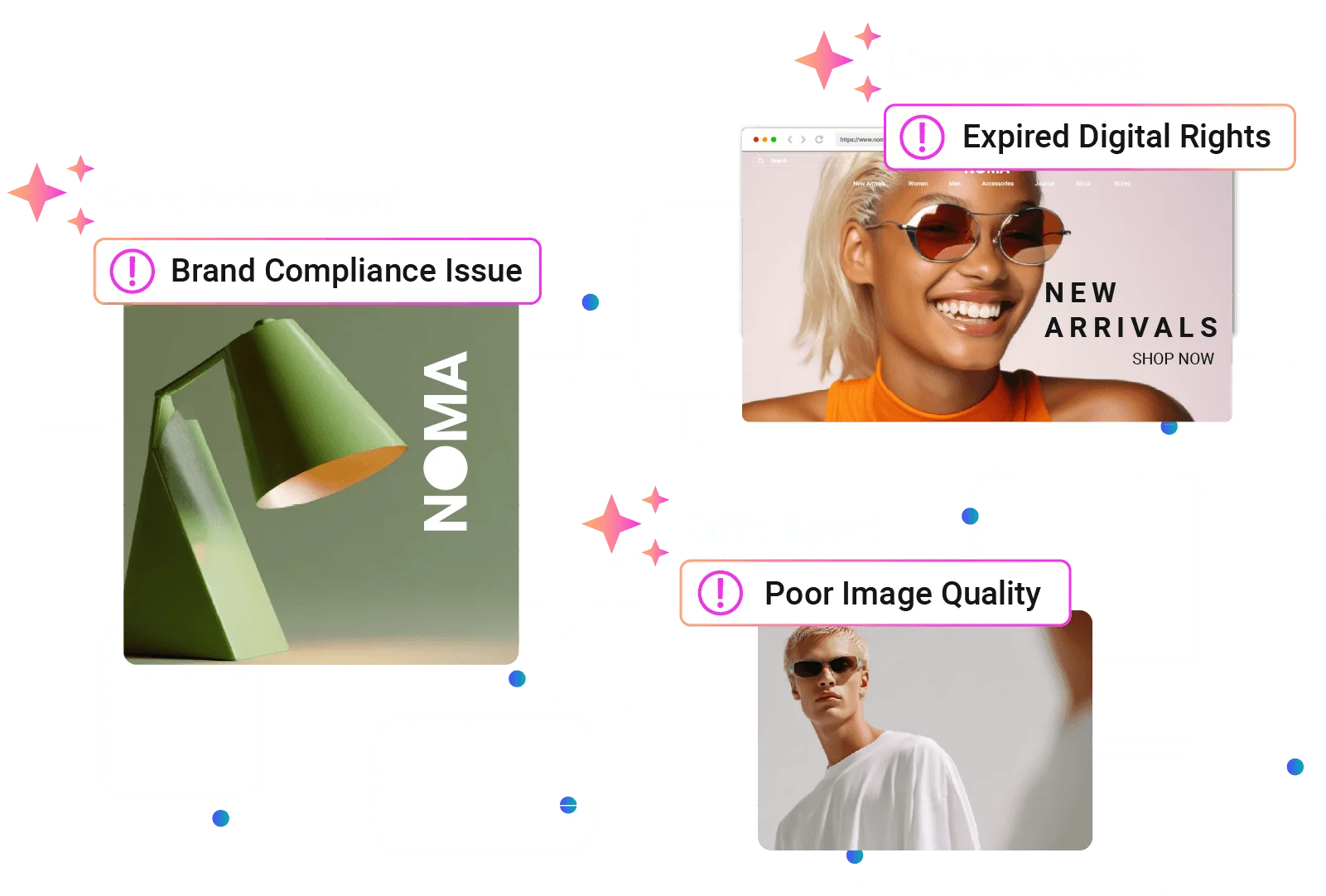
This changes the scope of the proposition. A repository can answer what it contains. Portfolio governance asks what the enterprise has put into circulation. The distinction matters when creating another variant becomes easier than keeping track of the last hundred. More automation makes the quality of the rules, and the handling of exceptions, more consequential.
Buy a workflow, then prove it
Aprimo sells enterprise SaaS through custom quotes based on products and users, with integrations and add-ons part of the buying discussion. Contracts typically start at twelve months. Its commercial logic is straightforward: charge for the machinery that reduces coordination costs across a substantial content operation.
The important comparison is with other DAM options, including Adobe Experience Manager Assets, Bynder, Orange Logic and Acquia DAM. Aprimo’s particular pitch joins assets to marketing planning, financial control and work management. Buyers should test that connected workflow against their requirements rather than assume breadth is automatically a benefit.
My suggested proof of concept would include an awkward search, a revision that needs approval, an expired permission and an asset published through an existing channel. Count the handoffs and the time required. Then repeat the exercise with the proposed system. A demonstration should encounter the inconvenient parts of your business.
A small team with simple sharing needs may have little use for this amount of machinery. A team that cannot agree on ownership, metadata or approval rules will carry that disagreement into its configuration. Aprimo’s strongest case begins where those decisions can be made and where repeating them manually has become expensive. The useful ambition is wonderfully unglamorous: let people spend less time wondering whether the right work already exists.
Open the library
Explore Aprimo’s products, watch the software at work, or hear its leadership discuss content operations.