Somewhere inside a large company, a network engineer has written a brilliant Python script. It turns a tedious change into a three-minute job. It also lives on the engineer's laptop, knows too much, documents too little, and becomes a minor constitutional crisis whenever that engineer takes vacation. Itential built a business for this precise species of progress: automation that works locally but cannot yet be trusted institutionally.
Founded in Atlanta in 2014 by Ian Bresnahan and Chris Wade, Itential began with a plain idea that was radical enough at the time: networks should be programmable and managed with software practices. The company now sells a platform that connects network devices, cloud services, IT ticketing, inventory, observability, security tools, APIs, and the scripts engineers already use. It does not insist that Ansible, Python, OpenTofu, ServiceNow, or Cisco NSO disappear. It wants to be the traffic cop above them.
That makes Itential an enterprise orchestration company, not a device manager and not merely a low-code builder. Its software composes long-running jobs, checks conditions before and after a change, asks for approval when policy requires it, retries or rolls back failures, and keeps evidence of who or what did what. The work can be requested in a portal, triggered by a ticket, called through an API, launched from a CI/CD pipeline, or selected by an AI agent. Different front doors, same guarded hallway.
The product is the handoff
Network automation has plenty of capable point tools. The awkward part arrives between them. A firewall request may begin in ServiceNow, require data from an IP address manager, touch a cloud account and a physical appliance, run a validation command, update inventory, and close the original ticket with proof. Each system can perform its own task. The operational product is the handoff - sequence, state, credentials, error paths, approvals, and accountability.
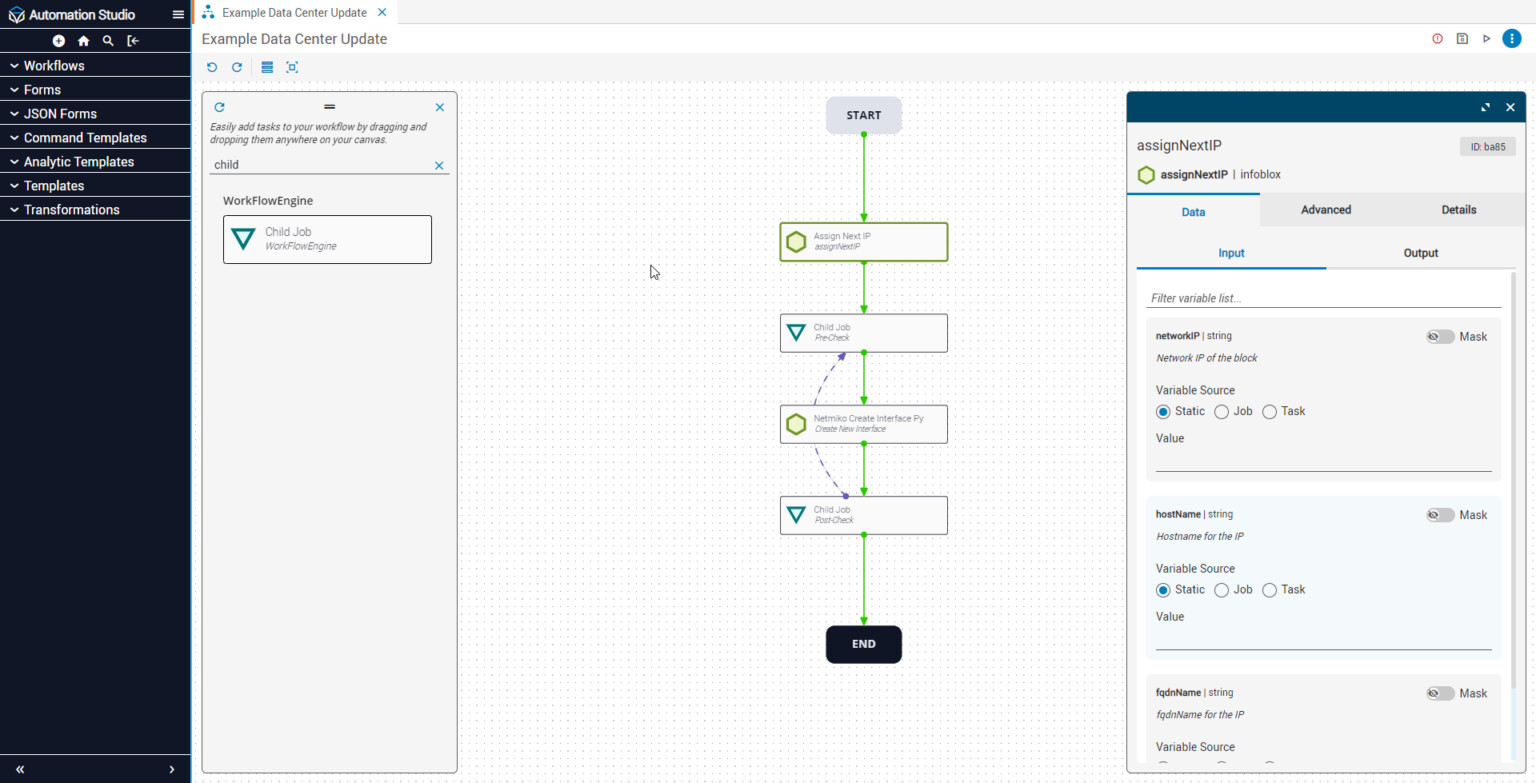
Itential's visual studio gives network specialists a drag-and-drop canvas for those handoffs, while its Gateway runs the code-heavy assets they already have. Gateway pulls content from Git, creates a clean temporary runtime, injects the needed secrets, executes the job, records it, and removes the environment. The company even treats the lack of a Gateway web interface as a feature: less manual server tending, less attack surface, and fewer opportunities for production to drift away from code.
about the goal
scope and policy
and records
AI gets a badge, not a skeleton key
The company's newer product, FlowAI, extends that architecture into agentic operations. A FlowAgent receives a goal, consults current context, reasons through possible steps, and chooses from an allowlisted set of tools. Those tools are workflows, automations, APIs, or gateway services already registered in the platform. The agent does not receive raw, open-ended access to the infrastructure. Builders set its authority before the run; role-based access, approval gates, schema checks, and audit records apply when it acts.
“AI is a transformative tool, but it's just a tool. Governance is no question the key here.”Peter Sprygada, former chief architect at Itential
This is Itential's most coherent competitive argument. Large language models are useful precisely where fixed workflows are clumsy: interpreting an alert, gathering context, selecting a path, drafting a change plan. They are also probabilistic. Network changes are useful precisely when the outcome is boringly repeatable. So Itential separates reasoning from execution. The model can decide which approved instrument to pick up; the platform controls how that instrument operates.
The market is crowded. A company can buy orchestration from Cisco, use Red Hat Ansible Automation Platform, stitch Terraform to a pipeline, extend ServiceNow, choose specialists such as Gluware or BackBox, or keep building internally. Itential's difference is breadth without a rip-and-replace demand. Its strongest buyer has a hybrid, multi-vendor estate and several automation islands that need one operating model. Its weakest prospect has a small, tidy network and one tool that already does the job.
The customer story starts with a bottleneck
The public case studies follow a recognizable plot. At S&P Global, network service requests were moving too slowly across clouds and data centers, while adding headcount or retraining everyone as developers was off the table. Itential says the team moved toward same-day self-service across three cloud providers and ten data centers, with manual effort reduced by as much as 90 percent. The winning feature was not a faster command. It was one reusable workflow that could be consumed through ServiceNow, APIs, or CI/CD.
A global bank offers the sharper failure story. Automation already existed, but it lived in scattered scripts on individual laptops. The first thing that failed was not code. It was the enterprise pattern: no shared method, no common scaffolding, and too much knowledge trapped with a few people. After centralizing execution and exposing workflows to a wider internal audience, the bank reported more than 5,000 workflow runs in year one, 120-plus users, 1,500 hours saved per F5 upgrade cycle, and a 90 percent drop in incidents tied to manual error.
When the workflow becomes the product
The most charming example is smaller in staff and larger in nerve. A national retail and fuel chain had two network people caring for more than 9,000 devices at over 1,000 locations after a consultant left. In a two-hour workshop, a supervisor with no previous automation experience built an interface-change workflow. The company later reported 60 to 80 percent fewer overnight escalations and estimated that it avoided a $150,000 annual backfill. The result that changed minds was not a grand transformation deck. It was one colleague making one useful thing before lunch.
What it costs - and what it avoids
Itential does not publish dollar prices. Its cloud plans are fixed subscriptions sold in tiers, measured by monthly FlowAgent runs and workflow-engine throughput rather than the number of devices or users. Contracts can run one to five years; on-premises licensing and AWS Marketplace procurement are available. That pricing is designed for large estates, where per-device fees can punish adoption. It also means a buyer needs a sales conversation before calculating payback.
The more honest cost is organizational. Inventory must be trustworthy. APIs and credentials need owners. Teams must agree on a standard change path, name reusable components, and maintain them. A low-code canvas does not settle a turf war or repair bad source data. Itential can orchestrate complexity, but a customer can also use it to make disorder run faster.
The playbook worth stealing
- Pick one repetitive change with visible pain and a measurable before state.
- Keep the current systems of record; automate the handoffs beneath them.
- Put validation, approval, rollback, and evidence inside the workflow from day one.
- Publish the result as self-service through the interface people already use.
- Show saved hours and avoided incidents, then earn the next use case.
A sensible place in an overheated market
Itential's public identity has shifted from network automation to the broader phrase “agentic operations platform.” The move makes sense. Founded before the current AI cycle, the company already had the unglamorous machinery that production agents need: permissions, secrets, integration, job state, pre-checks, post-checks, human approval, and audit. FlowAI, introduced in private preview in November 2025 and added to the cloud platform in July 2026, places a reasoning layer on top rather than inventing a separate route around those controls.
Partnerships fill out the picture. ServiceNow supplies tickets and catalogs; Cisco NSO handles deep service models; Ansible, Python, and OpenTofu supply automation assets; GitHub versions them. A 2025 partnership with Selector connects AI-driven detection and root-cause analysis to Itential's remediation workflows, aiming at closed-loop operations. The platform's job is to preserve accountability as the loop gets faster.
The company says it has automated more than 10 billion processes, employs more than 200 people, and holds three U.S. patents. Publicly reported funding totals $25.5 million, all from Elsewhere Partners across a 2017 round and a $20 million Series B in 2021. Customers named in its materials include Lumen, Colt, Southern California Edison, Fiserv, and S&P Global, alongside anonymized banks, insurers, retailers, airlines, and service providers. The common denominator is not industry. It is a large network, a small tolerance for surprises, and too many valuable scripts that have not yet become products.
That leaves Itential in a useful position. AI vendors want access to production systems. Infrastructure teams want less repetitive work. Auditors would prefer neither party become creative at 2 a.m. Itential's answer is procedural, almost comically so: give intelligence a narrow badge, make every action pass the same controls, and retain the receipt. In network operations, boring is not an insult. It is what success looks like after the change window closes.
Explore Itential