The capital markets company had a Salesforce bill of more than $2.4 million a year. It also had a peculiarity: according to 360 Degree Cloud’s account of the engagement, it used none of Salesforce’s native sales or service functionality. Instead, engineers had turned the platform into a system for governing software development. Sixty-eight custom objects kept that arrangement running. The software had become something its original buyer might barely recognize.
- 360 Degree Cloud sells Salesforce expertise, embedded specialists and its own apps.
- Its messaging flagship keeps customer conversations alongside CRM records.
- A revealing audit identified potential savings by moving engineering work to Jira.
This is a useful place to meet a Salesforce partner. Enterprise technology is full of purchases whose original logic survives long after the job changes. 360 Degree Cloud’s opportunity sits in that gap: helping organizations work out what their systems should do, then building the connections and tools that make those decisions practical.
01 / The expensive habit
In the capital markets engagement, the team mapped the custom objects to Jira equivalents and counted more than 50 automation flows, ten Apex triggers and three external integration dependencies. It delivered three costed approaches, with financial models and risk ratings, in four weeks. One route, a full Jira migration, offered a potential 93% reduction in licensing costs.
That word, potential, matters. The published result describes a decision and a model, rather than a completed migration delivering cash savings. Still, the exercise exposes an ordinary failure of oversight: leadership had never formally compared what the organization paid for with what people actually used. An inventory made the mismatch visible.
Potential license cost reduction under the full Jira migration model.
The lesson a reader can copy is refreshingly unglamorous. Before renewing a platform or adding another feature, list the work it performs. Count the dependencies. Price the alternatives. The same reasoning also limits the conclusion: a business actively using Salesforce’s sales and service capabilities cannot assume an engineering team’s Jira economics will apply to it.
02 / The message that became a business
Siddharth Sehgal and Pooja Singhal founded 360 Degree Cloud in 2012. Its company history dates the launch of 360 SMS to 2016. That progression, from services to a repeatable product, helps explain why the business is more interesting than a long menu of consulting capabilities.
In a January 2026 AppsemblyLine interview, Sehgal discussed the communication needs behind the app, customer feedback and the difficulty of balancing consulting with product development. The episode summary describes a fully bootstrapped company, financed through consulting revenue, with 60% of revenue coming from AppExchange and 40% from consulting. Dedicated product teams were part of the lesson.
The mechanism is straightforward. A consulting team encounters individual customer problems. Some recur. A product turns a recurring problem into something another customer can install. Feedback then supplies the next adjustment. That is an interpretation of the company’s trajectory, rather than evidence that every consulting project produces a promising app.

03 / Keep the conversation with the record
360 SMS puts two-way messages, bulk outreach and automated sequences into Salesforce. Its current product materials include WhatsApp and other channels alongside SMS. The underlying attraction is easy to understand: a customer record becomes more useful when the conversation is attached to it. Someone taking over an account can see what happened without asking a colleague to excavate another inbox.
The companion products address adjacent interruptions. 360 CTI connects calling and call logging to Salesforce. InstantDocs creates documents from CRM data. In a company-published case study, an IT services firm replaced spreadsheet pricing and manually maintained templates with proposals generated from live opportunity records, including conditional sections. The reported outcome was 62% faster proposal generation and more than 80 sales hours saved each month.
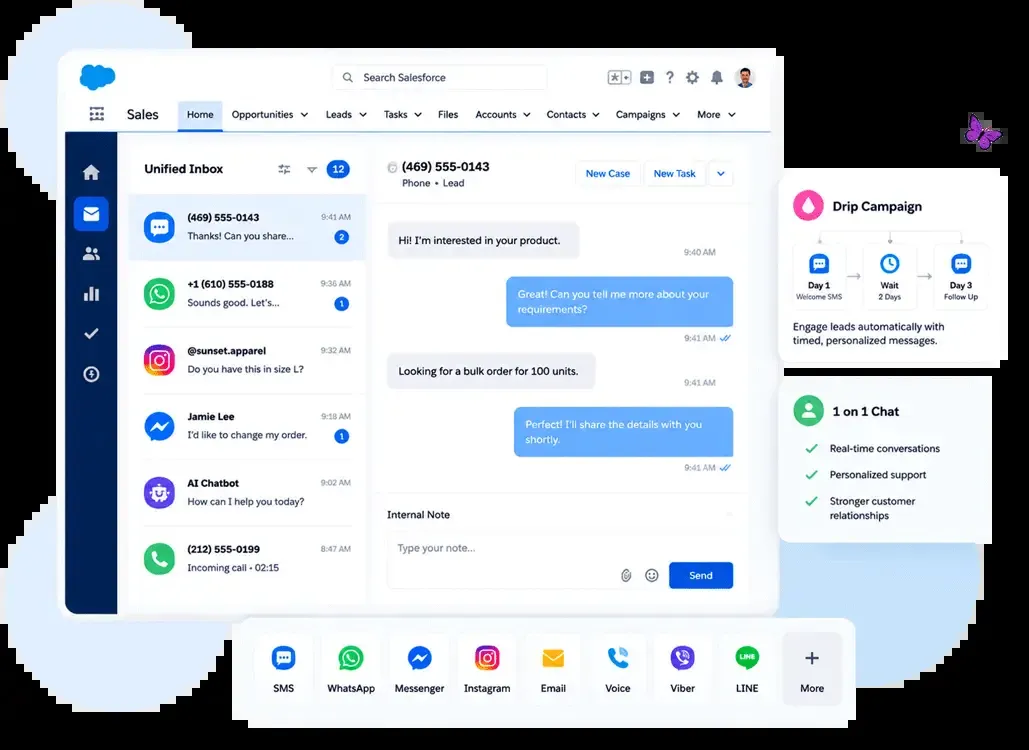
These tools reach beyond sales departments. Vendor-published customer stories describe 211 San Diego using bulk messages, scheduled campaigns and surveys for community outreach; Eastern Florida State College using messaging for student engagement; and UNICEF Mexico using WhatsApp for donor engagement. The common thread is a relationship that needs follow-up, context and a reliable place to keep both.
04 / The price of fewer handoffs
The commercial offer combines project work, continuing support, embedded specialists and app licenses. Services can use fixed-cost, time-and-materials or resource-based engagements. Buyers can bring in an architect, commission an integration or retain help after launch. The technical practice includes Apex, Lightning components, Salesforce Flows, APIs and data migration, with wider application and cloud services available too.
There is a concrete entry price for the messaging product: 360 SMS advertises $7 per user per month, billed annually. Carrier messaging fees are separate. Extra channels and capabilities can change the bill. For ten users, that advertised base rate means $840 a year before those additions and the underlying Salesforce subscription. A software budget should preserve those distinctions.
“One Salesforce Summit Partner for Every Need”
The company’s stated proposition
That proposition competes with assembling an internal team, another consultancy and specialist app vendors. Its attraction is fewer organizational handoffs; its trade-off is relying on one provider across more work. A fixed-price engagement also needs stable requirements. The company explicitly positions that model for projects whose discovery and scope are already defined.
Inc. placed 360 Degree Cloud Technologies at No. 1,331 on its 2024 Inc. 5000 list. Recognition establishes a milestone, but the more useful buying question is smaller: which repeated task will become easier? Start with one workflow, record its present cost and measure the result. The capital markets audit offers a fitting reminder. Sometimes getting more from a platform begins with deciding what to stop asking it to do.