Chocolate is a rather unforgiving customer-service test. A convincing apology cannot put a melted bar back together. The Conscious Bar, a vegan chocolate brand, was facing summer delivery complaints when it brought in Notch. The useful intervention happened before the complaint: encourage customers to accept SMS updates, tell them when a package would arrive, and help keep it off a hot doorstep.
- Notch turns customer requests and office paperwork into executable workflows.
- Its insurance roots explain the attention to permissions and audit trails.
- Customers pay for resolved tickets; humans retain judgment and exceptions.
According to Notch’s case study, return requests fell 40%, and implementation took three weeks. Those are reported customer results, not a promise for every deployment. But the episode captures an appealing idea: a service system can change the circumstances that produce a complaint. The most elegant refund is sometimes the one nobody needs to request.
The insurer’s inconvenient discovery
Notch arrived at that idea by an indirect route. In 2021, Rafael Broshi, Elool Jacoby and Yuval Peled founded a specialty insurance business for digital assets. Broshi is now CEO, Jacoby CPO and Peled CTO. They were operating in a world where documentation, policy wording and customer communications carried consequences. A cheerful guess was an expensive habit.
“When we founded Notch in 2021, we were not planning to build a software company,” Broshi wrote in the Series A announcement. The team wanted AI for its own operations. Available tools could handle conversational exchanges, he says, but could not safely complete workflows with hard limits and a clean audit trail. The first disappointment was the tooling’s inability to do accountable work.
They built an internal layer joining language models to structured execution, permissions, validation and compulsory escalation when the policy or data was unclear. Its usefulness changed their ambition. The machinery behind the insurance business became the business they wanted to sell. Notch launched its AI customer-support platform in February 2024.

A conversation with permission to act
Consider a refund request. The agent has to identify the customer, find the purchase, check eligibility, execute an authorized transaction and confirm the result. A polished answer covers only a fraction of that work. Notch’s product description follows the whole sequence: match the customer and policy, collect requirements, select a solution, then execute through connected systems or send the case to a person.
That puts the company in the market for enterprise AI agents alongside Intercom Fin, Zendesk AI, Salesforce and newer specialists. Its pitch rests on regulated operations and managed delivery. Buyers should compare actual workflow coverage, permissions and escalation behavior. A vendor’s vocabulary is an unreliable purchasing guide; a completed transaction is considerably more informative.
- 01 Identify customer
and applicable policy - 02 Validate facts
and permissions - 03 Execute action
or escalate - 04 Record outcome
and review
Today its offering spans customer-facing agents, internal coworkers and back-office automation. An underwriter can query documents; an intake agent can gather claim details; an office workflow can extract data and route a file. Insurance, banking and telecom anchor its current positioning, with earlier customers in retail, SaaS and gaming. Phoenix Insurance is both a named customer and a strategic investor.
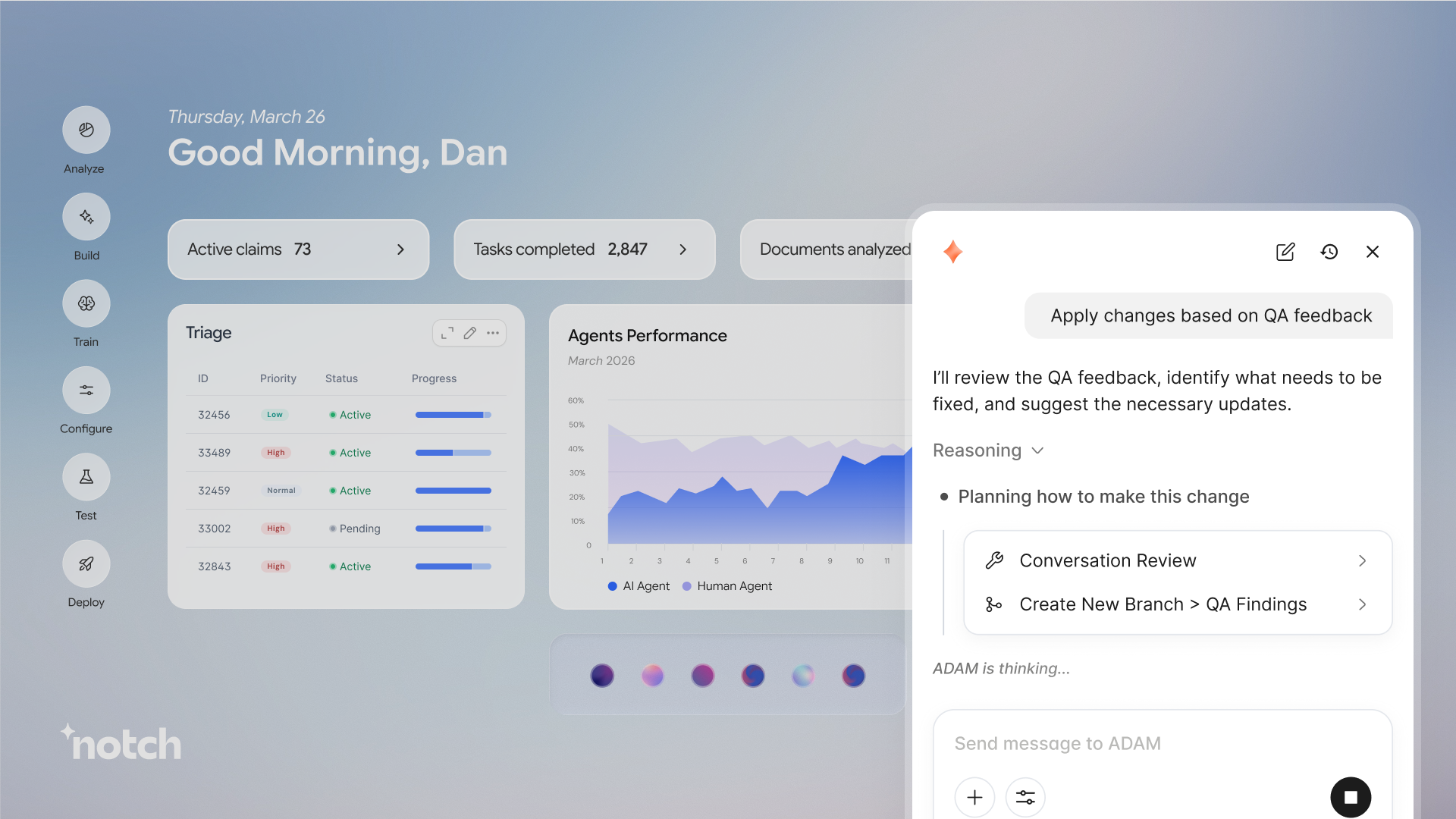
The coordinating layer is called ADAM. Notch describes it as a system that reviews interactions, finds policy gaps and bottlenecks, and helps teams build improvements. The team controls what ships. That matters because updating an agent’s instructions can change what a customer is told, what a system does and which exception reaches a human.
An invoice for finished work
Notch’s public commercial model charges per fully resolved ticket. It calls the definition TRUE: Ticket Resolved, Unmanned, End-to-end. The interesting contractual question is what qualifies as finished. A refund should have reached the payment system, for example. A customer pointed toward an article may still have the original problem.
The service includes implementation and continuing optimization. This makes the purchase partly an integration project and partly an ongoing operational relationship. For a buyer, the useful calculation combines the vendor bill, retained staff, repeat contacts and quality review. Cheap messages can produce expensive unfinished business.
Guardio supplies a concrete example. Notch’s published account says the cybersecurity company turned policies, historical conversations and staff knowledge into agents. Within four months, 87% of incoming cases were being resolved autonomously. The implication is operating capacity: customer growth need not demand an equivalent increase in support staffing. The remaining cases still deserve attention.
Reached within four months. A customer case, not a platform-wide guarantee.
“It feels like I suddenly doubled my team.”
Mai Hatuel, Yves Rocher
Notch customer testimonial
The bargain that disappeared
A revealing engineering post describes another kind of cost. Research engineer Zacharie Cohen found a stale pricing alias that made a candidate model appear several times cheaper than its real price. The projected saving largely disappeared when corrected. The team redesigned around a cascade: cheaper models first, stronger models for disagreements, with automatic price checks.
The same post admits that a difficulty classifier useful for one component failed to distinguish difficult examples in another. They turned that part off. The lesson is practical: build labeled evaluations, include known production failures, and check whether each measurement transfers. Agreement between models can still conceal a shared mistake; voice latency also changes which design is acceptable.
Start with one workflow
In March 2026, Notch announced a $30 million Series A led by Headline, bringing total funding to $45 million. It reported twelvefold annual recurring revenue growth over the preceding year. The money is earmarked for U.S. expansion and platform development. The commercial bet is that regulated companies want a partner for daily execution.
The part readers can copy is smaller than that ambition. Pick a repeatable workflow, establish what completion means, connect the necessary systems and test exceptions before widening access. Notch describes simulations, shadow mode and gated rollout. Work requiring legal interpretation or claim adjudication still needs human authority. Automation earns its place one bounded task at a time. Even chocolate appreciates boundaries.