Kellogg had a problem that had very little to do with cereal. It was moving workloads to Amazon Web Services, while its existing monitoring system struggled to see both the cloud and its own data centers. Extending that system, according to a historical customer account, would have cost more than $10 million. The infrastructure had changed. The view through the control-room window had not.
This is the sort of awkward moment ScienceLogic sells into. A business acquires new technology faster than its people can assemble a coherent picture of it. Eventually, somebody has to work out which blinking light matters.
- Connect the estate: discover infrastructure across clouds and data centers.
- Connect the consequences: map devices to the services they support.
- Connect the response: bring context into tickets, investigations, and automated workflows.
The cloud arrived. The monitoring stayed behind.
ScienceLogic’s answer to Kellogg was a platform designed to monitor hybrid infrastructure. The published case study estimated more than $2 million in savings over five years. That was a projection in a vendor case study, rather than an audited result. Still, the purchasing logic is clear: replacing an inadequate view can make more sense than paying to enlarge it.
The company’s founders knew the operator’s side of this problem. David Link and Richard Chart had worked at Interliant, a managed-services business. Together with Christopher Cordray, they started ScienceLogic in 2003. Multi-tenancy was part of the early design: a service provider could manage multiple customers through one platform.
At the company’s twentieth-anniversary retrospective, Chart recalled: “It probably took 14 or 15 months just to build the first version of the product.” The original job was unglamorous and difficult: get unlike systems into a shared operational picture. The cloud made that job more valuable.
The company now describes a culture built around customer focus, collaboration, and individual responsibility. Its named employee groups include PowHer, SciLo Vets, and Spectrum, which focuses on neurodiversity. These are the employer’s descriptions, but they add a human detail to an otherwise technical business: the people making complex systems understandable arrive with different experiences of their own.


A map before a verdict
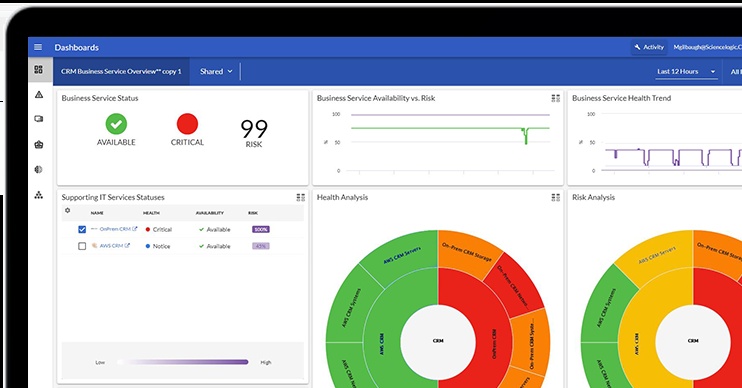
Today, the core offering is Skylar One, the observability platform earlier materials call SL1. It gathers operational information across physical equipment, virtual machines, clouds, containers, and older systems. It also discovers relationships between them. Those connections let an operator move from a device-level fault to a question the business understands: which service might suffer?
Consider a simplified example. A network connection fails; several dependent systems report trouble. Treat every alert separately and several people may investigate the same underlying problem. A dependency map gives them a reason to investigate together. ScienceLogic’s bet is that the relationship between signals is often more useful than another signal.
The portfolio then divides the work. Skylar Automation connects operational workflows. Skylar Compliance handles network configurations, backups, and auditing. Skylar Analytics adds exploration, anomaly detection, and predictive alerts. Skylar Advisor works across telemetry and organizational knowledge to offer explanations, investigations, and recommendations.
Two acquisitions help explain the range. Restorepoint brought network configuration capabilities in 2021. Zebrium added machine-learning analysis for root-cause investigations in 2022. Configurations reveal what changed; logs can help explain what happened afterward. ScienceLogic has been assembling more of that investigative chain.
The price of joining the dots
The market is enterprise IT operations, with particularly clear applications for service providers and systems integrators. ScienceLogic says it serves hundreds of customers globally. Public customer materials include CDW, Rackspace, World Wide Technology, and GDIT. These organizations manage environments where several generations of technology must keep working together.
Alternatives include LogicMonitor, SolarWinds, Zabbix, BMC Helix, and OpsRamp. ScienceLogic publishes comparisons with all five. Its case for consideration rests on combining heterogeneous infrastructure coverage, service context, and operational workflows. Buyers still need to test the integrations and service models that matter in their own environment.
The business model is subscription software, sold directly and through partners. Published Skylar One list pricing starts at $5 per managed device per month for Standard and $6 for Advanced, which adds workflow automation. AI pricing requires a conversation. Those starting prices are useful for orientation; they are not a complete deployment budget.
USD. Device-group pricing applies. AI and implementation may add costs. Checked October 17, 2026.
A ScienceLogic-commissioned Forrester study of Capgemini makes that distinction concrete. Its three-year model included licenses, services, support, hardware, deployment labor, and maintaining customizations. Risk-adjusted present-value costs totaled $3.03 million against $6.40 million in benefits. It also described seven retired tools. These are modeled economics from one customer, not a promised return.
Partners help turn the software into an operating practice. Tech Mahindra pairs ScienceLogic’s monitoring and AIOps with its own services for customers including telecom and financial-services organizations. ServiceNow integration connects the monitoring environment with the systems where incidents and changes are managed. For a buyer, that makes the implementation partner and the workflow design part of the purchasing decision.
Scale takes money on the supplier’s side, too. In February 2021, ScienceLogic raised $105 million in a Series E led by Silver Lake Waterman, with Goldman Sachs, Intel Capital, and NewView Capital participating. The stated purpose included product development and engineering expansion.
Now give the operator a brake
The latest direction makes the story more interesting. At Nexus Live 2026, ScienceLogic announced Skylar AI 2.7 with agent-routing traces, controls over individual agentic functions and tools, and inspection of uploaded documents before they inform AI guidance. Suspicious documents can be quarantined for review.
That is a revealing product choice. Once software recommends actions across important systems, operators need to understand its evidence and control its reach. Better diagnosis does not automatically authorize a change. Oversight becomes part of the product’s usefulness.
Better diagnosis does not automatically authorize a change.
There is a practical lesson here even for teams that never buy ScienceLogic. Pick one important service. Map what supports it. Measure how long incidents spend being created, routed, and understood. Automate one bounded response, then verify the result. This is an operating suggestion drawn from the approach, rather than a guaranteed recipe.
It also exposes the conditions required: accurate discovery, maintained relationships, usable knowledge, and people responsible for the workflows. A small, simple environment may gain less from that investment. In a sprawling one, the first useful improvement may be wonderfully ordinary: several teams finally looking at the same problem.