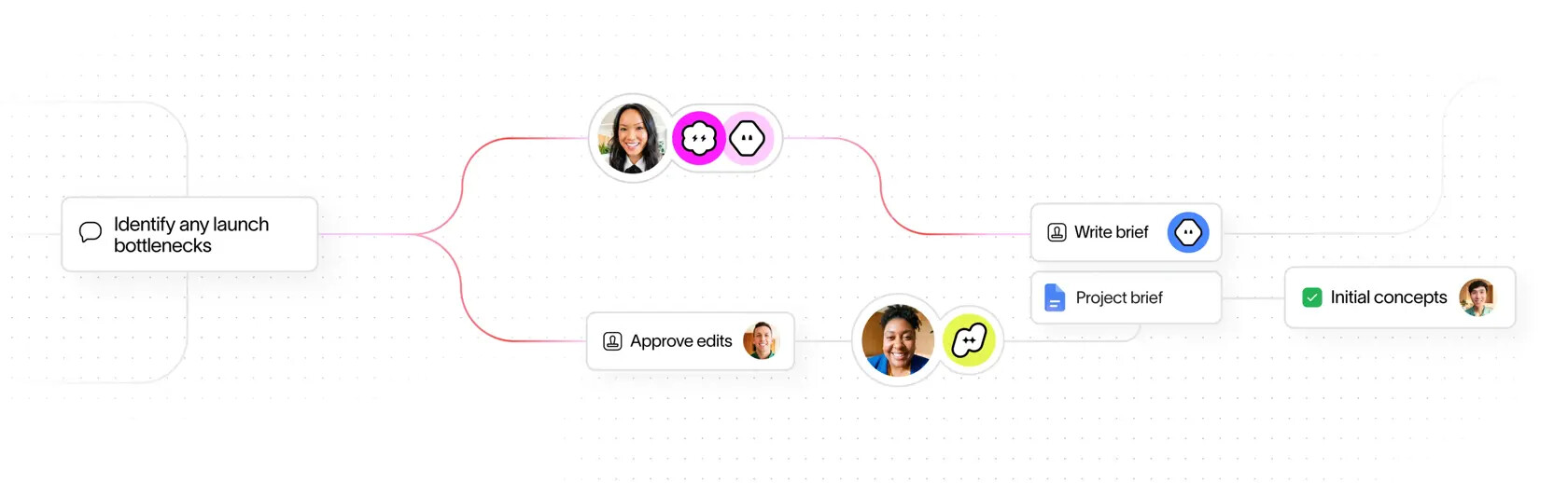
The task is tiny. The promise is not. A line in Asana can say who owns a job, when it is due, what blocks it, which project contains it, which portfolio contains that project, and which company goal justifies the whole exercise. For years, this was a neat way to prevent a launch plan from dissolving into email. Now Asana wants the same line to tell an AI agent what to do, what it may read, when a human must approve, and where the result belongs.
That is the company in one move: turn the invisible machinery of teamwork into structured, inspectable objects. Asana is often filed next to project managers such as Monday.com, Smartsheet, ClickUp, and Jira. The label is accurate but undersized. The product stretches from personal tasks and kanban boards to company goals, project portfolios, capacity planning, intake forms, automation rules, security controls, time tracking, and AI workflows. Its happiest customers use it as the connective tissue between departments that otherwise speak in decks, tickets, spreadsheets, and hurried Slack messages.
The meeting was the original bug
Dustin Moskovitz and Justin Rosenstein met at Facebook, where they built an internal coordination tool called Tasks. Facebook was growing quickly; its engineers were talented; and too much of their day still disappeared into meetings and status chasing. In 2008, the pair left to attack that problem directly. Asana launched publicly in 2011 and commercially in 2012. The name, borrowed from the Sanskrit word for a yoga pose, was supposed to suggest form without rigidity. It also produced a pleasingly strange fact: one of enterprise software's best-known task lists is named after sitting still.
The early product made assignments fast and updates visible. The deeper invention came later in the language of the Work Graph. A social graph maps people and relationships; Asana's version maps people, work, and purpose. A task is not merely a checkbox. It can belong to projects, depend on other tasks, consume a person's capacity, roll into a portfolio, and advance a goal. This structure is why Asana can show an executive a red program without forcing twelve project managers to rebuild the truth in PowerPoint on Friday afternoon.
Our aim is to give organizations the clarity they need to execute their projects and processes.Dustin Moskovitz, announcing Asana's 2018 funding
A task list learns to run the company
The everyday layer is familiar: list, board, calendar, timeline, and Gantt views; tasks with owners and dates; comments and files; templates for repeatable projects. Forms turn incoming requests into structured work. Rules assign, route, and notify. Reporting dashboards expose stalled tasks and late milestones. Advanced plans add goals, portfolios, workload, approvals, proofing, formulas, and connections to Salesforce, Tableau, and Power BI. Enterprise plans add the controls that procurement and security teams expect.
AI Studio pushes beyond “summarize this project.” A team can describe a workflow in plain language, attach instructions and reference material, then let a model check submissions, classify requests, detect duplicates, route work, draft briefs, translate copy, or create status updates. The rule sees only the Asana objects it is permitted to reference. AI Teammates go further: they are shared agents assigned to initiatives, visible to multiple people, with approvals and handoffs living beside the human work.
The May 2026 acquisition of StackAI addresses a limit Asana could not politely automate around. The Work Graph may know that a contract needs approval, but the actual job can require Salesforce, Oracle, SharePoint, DocuSign, an internal database, and a compliance system. StackAI builds and governs agents that act across those systems. The purchase price was not disclosed, and the product continues under its own brand. The strategic logic is clearer than the accounting: Asana had context but needed hands.
The sticker price is simple. Adoption is not.
Asana sells subscriptions, mostly by seat. Personal is free for up to two users. Starter costs $10.99 per user per month when billed annually, or $13.49 monthly. Advanced costs $24.99 annually or $30.49 monthly. Enterprise and Enterprise+ are negotiated. Paid subscriptions begin at two seats and then move through set increments, so the bill does not always track the headcount one person at a time. AI Studio Basic is included with paid tiers under credit limits; heavier AI Studio options and add-ons can create another line item.
| Plan | Public price | What changes |
|---|---|---|
| Personal | $0 | Two users, unlimited tasks and projects, basic views |
| Starter | $10.99/user/mo annual | Timeline, Gantt, forms, rules, dashboards, AI credits |
| Advanced | $24.99/user/mo annual | Goals, portfolios, workload, approvals, BI integrations |
| Enterprise | Quote | Governance, provisioning, security, support, scale |
The expensive part is changing how people behave. A stale Asana project is just a spreadsheet wearing nicer shoes. Teams have to agree on intake, ownership, naming, status rules, and what belongs in the system. Leaders have to use the dashboards instead of demanding a parallel slide deck. Someone has to prune automations after the process changes. Asana's product is flexible enough to mirror almost any workflow, which is useful right up to the moment every department invents a different one.
What failed first at FedEx
FedEx provides the cleanest view of the product doing real work. Its marketing operation had more than 24 intake forms, disconnected spreadsheets and email, duplicate efforts, and requests that could take up to eight hours of manual coordination. Leadership visibility arrived late because teams assembled status updates by hand. The first thing to fail was not creativity. It was intake: the front door to the work had become a corridor of 24 doors.
The redesign consolidated demand into a single stream. AI Studio checked submissions, identified duplicates, categorized work, and routed requests to strategy leads. AI Teammates drafted go-to-market plans, creative briefs, and technical documents. Humans kept decision authority over priorities and final approval. Approved requests entered a global portfolio with automated timelines and reporting. FedEx says intake administration fell 88%, more than 1,288 hours were released annually, and speed to market improved ninefold, with more than $200,000 in annual operating-cost avoidance.
What changed their mind was not a dazzling prompt. It was the realization that the value sat between teams, where incomplete requests, repeated context, and unclear ownership created friction. The copyable move is to redesign the path before adding the agent. AI can route a bad form faster; it cannot decide why the form exists.
The five-step version worth stealing
- Collapse competing intake channels into one visible front door.
- Require enough context to size, prioritize, and assign the request.
- Connect every project to an owner, a deadline, and a business outcome.
- Automate classification and reporting before automating judgment.
- Keep named humans responsible for exceptions, approvals, and bad output.
The moat is structure. The risk is structure.
Asana's differentiation becomes sharper when AI enters the market. Chatbots are good at helping one person in one moment. Enterprise work is multiplayer, permissioned, and annoyingly persistent. Yesterday's rejected draft matters. So does the legal approver's absence and the dependency two teams away. Asana argues that its graph and history give agents the memory and governance they lack in a blank chat window. Its integrations with Slack, Microsoft, Google, Salesforce, Figma, GitHub, Zoom, and hundreds of other tools make the graph less isolated.
The counterargument is that structure has a carrying cost. Jira is deeper for software delivery. Notion is looser for documents and knowledge. Slack and Teams are faster for conversation. Monday.com and ClickUp package overlapping work-management ideas with different tradeoffs. Microsoft can bundle planning into a stack a company already buys. A spreadsheet is still undefeated when three people need a list for six weeks and nobody wants an implementation project.
The financial picture gives this strategy urgency. Fiscal 2026 revenue reached $790.8 million, up 9%, while the GAAP net loss was $189 million. Adjusted free cash flow improved to $84.5 million. In the April 2026 quarter, revenue grew 9.5% to $205.1 million and the GAAP net loss narrowed to $14.4 million. Overall dollar-based net retention was 96%, meaning the existing customer base still shrank slightly on a trailing basis after expansions and churn. AI product bookings represented 17% of net new annual recurring revenue in that quarter, according to management. The agent story has begun to sell; it has not yet rewritten the growth rate.
Dan Rogers took over as chief executive in July 2025 after Moskovitz spent nearly 17 years in the job. Moskovitz remains chair. The change did not discard the old mission - helping teams work together effortlessly - but it sharpened the commercial assignment. New products now reach into service management, agency client work, product development, and personal prioritization. Several were announced for phased availability, so buyers should separate what is usable today from the architecture drawn onstage.
When the system will not save you
Asana will not work well when nobody has authority to standardize the process, when managers keep asking for updates outside the platform, or when the work is too fluid to maintain as structured objects. It can be excessive for solo work and awkward for a tiny team on a short project. It should complement, not replace, specialist systems that hold richer engineering, financial, clinical, or compliance records. Regulated organizations need the appropriate security and governance tier, not a casual workspace with optimistic permissions.
AI adds another condition: the underlying work has to be legible. Missing owners, vague acceptance criteria, and obsolete project data become confident automated mistakes. The human-in-the-loop design matters only if a human actually looks. The best deployment begins with one expensive, measurable workflow where the exceptions are known. If it saves time, expand. If it merely makes more text, turn it off.
Asana's original insight survives every rebrand. Work fails in the gaps: between the request and the project, the project and the goal, the specialist and the executive, the promise and the person expected to deliver it. The company now believes agents can cross those gaps. Perhaps. First, someone still has to make the gaps visible. That remains the less glamorous product, and the more valuable one.