Taskade is for the person who opens a modest to-do app and quietly wonders whether it could also brief a contractor, update the client portal, draft Friday’s report, and chase an overdue invoice. The answer is now a slightly unnerving yes. What began in 2017 as a collaborative outliner has become a workspace where lists hold data, AI agents read that data, automations act on it, and a prompt can wrap the whole contraption in a publishable app.
That makes the best customer easier to describe than the product. Picture a five-person agency, an operations lead with a heroic spreadsheet, a consultant repeating the same onboarding ritual, or an educator coordinating plans with a team. They need software shaped around the job, but they do not want to hire a developer or spend a month dragging database widgets around. Taskade offers a fast middle path: describe the outcome, inspect what it made, then keep the work and the interface in the same place.
If all you need is a grocery list, this is a sheep carrying a toolbox, a server rack, and perhaps your tax return. The old task manager remains available, and AI is optional, but Taskade’s center of gravity has moved. New users should arrive for connected workflows, not merely prettier checkboxes.
The oddly logical origin story
Founders John Xie, Stan Chang, and Dionis Loire were already working across time zones when they grew tired of stitching projects, notes, chat, and calls together. Their answer was deliberately compact. A 2019 TechCrunch profile called the early product the “love child of Notion, Slack and Asana,” but the more revealing detail was restraint: one database per project and fewer knobs than Notion. The aim was to keep a team moving instead of turning workspace design into a hobby.
Taskade joined Y Combinator’s Summer 2019 batch and raised a $5 million seed round led by Grishin Robotics and YC. Creative agencies supplied an early foothold. The team itself stayed small and remote. Then the product followed the industry’s weather: AI chat in 2023, custom agents, automation, and finally Taskade Genesis in November 2025. By September 2026, the public changelog counted 649 releases, with 199 in that year alone. This company does not stroll.

How the machine fits together
Taskade calls its architecture Workspace DNA. Ignore the biology lesson and remember three nouns. Projects are memory: tasks, notes, tables, files, relationships, and status. Agents are intelligence: assistants trained on that workspace, plus uploaded documents or web sources. Automations are execution: triggers and actions that move information, send messages, update records, and call outside services. Genesis generates the visible app on top.
This loop is Taskade’s real advantage. A generic chatbot can draft an email, but it usually does not know which deal changed stage or where your team stores the approved pricing. A Taskade agent can read the connected project, draft with that context, and hand the result to an automation. The outcome can write back into the project, giving the next run better information.
TSK-1, introduced in July 2026, sits above this machinery. Despite the name, it is not Taskade’s own foundation model. It is a kernel that routes work across more than 15 models, carries workspace context, coordinates agents, and keeps workflows running after chat ends. Users can accept automatic routing or choose a model for a particular agent. That distinction matters: the value is orchestration, not a secret synthetic brain in San Francisco.
What you can make before lunch
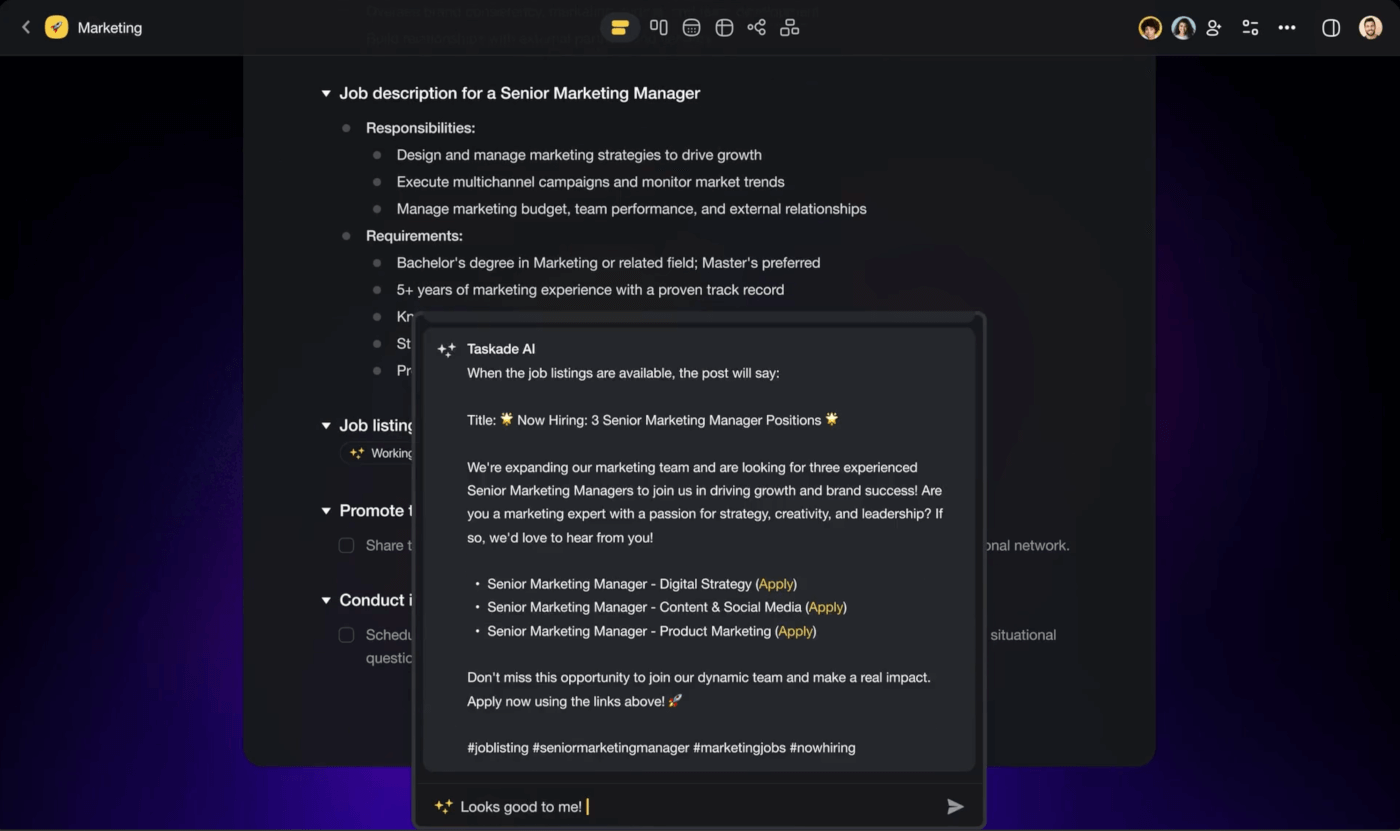
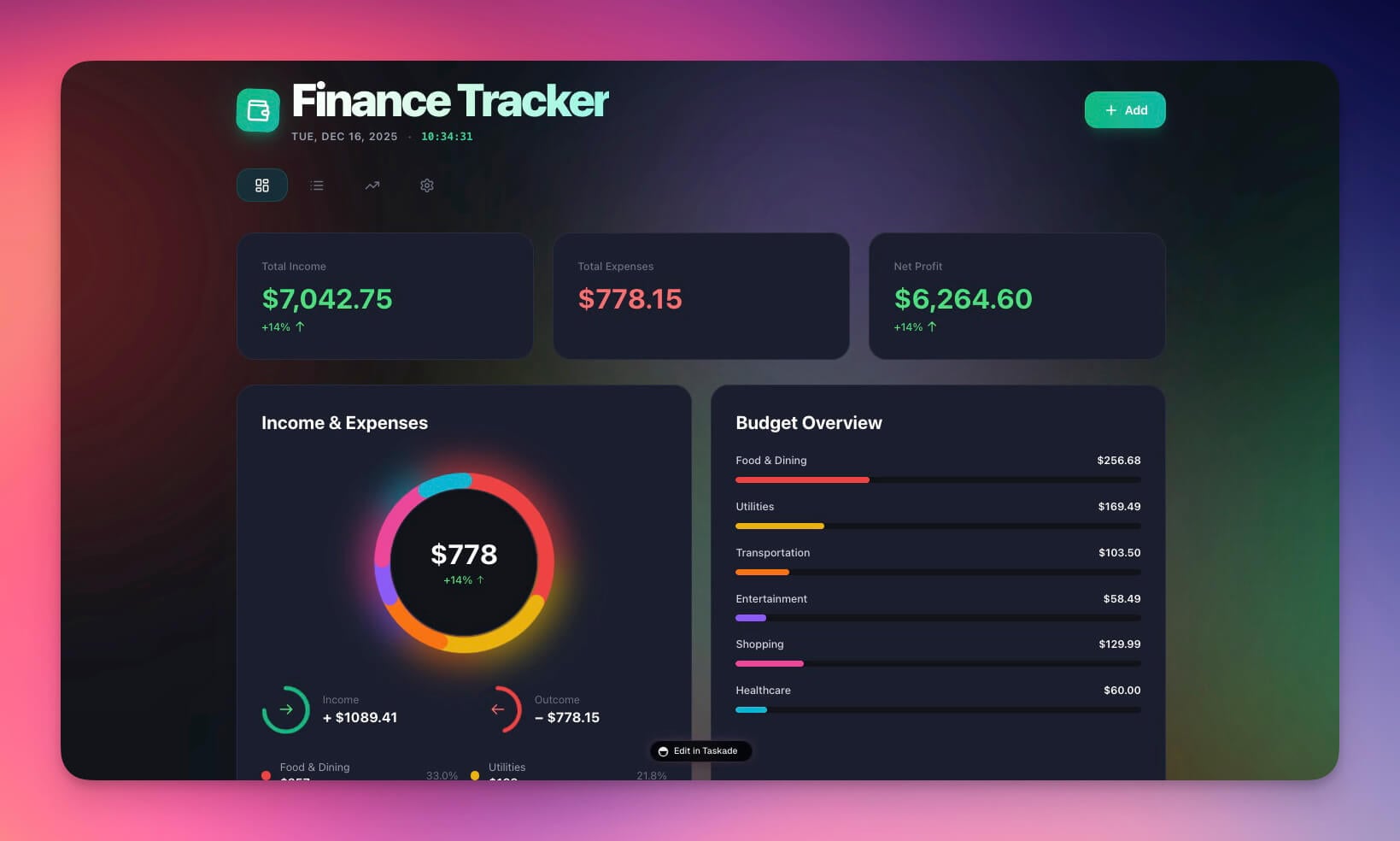
Genesis is the showy part. Type “client portal with booking, invoices, and a weekly status summary,” and Taskade attempts the interface, the underlying projects, relevant agents, and the flows between them. Typical outputs include CRMs, intake forms, approval queues, inventory tools, knowledge bases, dashboards, and event sites. Publishing produces a live link; Business plans add custom domains and fuller branding.
The less glamorous project layer remains useful. A single project can switch among list, board, table, calendar, mind map, timeline or Gantt, and action views. Teams can comment, chat, call, assign, and edit together. Native apps cover iOS, Android, Mac, Windows, and Linux, while Chrome, Firefox, and Edge extensions handle quick access. The catalog lists more than 100 integrations, including Gmail, Slack, Stripe, GitHub, Google Drive, HubSpot, and Microsoft tools.
| Need | Taskade | Likely better alternative |
|---|---|---|
| Fast shared workspace plus AI | Strong fit. Context, agents, and tasks share one roof. | Notion if document depth and database design matter more. |
| Mature portfolio management | Capable for small teams, lighter at enterprise planning depth. | Asana, Monday.com, or ClickUp. |
| Thousands of app connections | Good integrated catalog with 100+ services. | Zapier or Make for breadth and specialist controls. |
| Prompt-built client tool | Fast when the app should stay tied to team data and agents. | Bubble or Lovable when code, design, or deployment control leads. |
The price is simple. The credits are not.
The Free plan is a proper sandbox: two users, three Genesis apps, hosting, and 6,000 one-time AI credits unlocked through verification and a first build. It is enough to learn the vocabulary and produce a first useful system. Once those credits are spent, they do not renew. Published visitors do not consume them, but building, editing, agent reasoning, tool calls, file analysis, and AI steps do.
At annual-billing rates, Pro costs $10 a month and includes ten users, 50,000 monthly credits, unlimited apps, agents, workspaces, and automations. Business is $25 a month with unlimited users, 150,000 credits, custom domains, white labeling, analytics, and admin controls. Max is $100 for heavy AI use; Enterprise is listed at $250. Monthly billing is higher. Those are unusually team-friendly numbers, but one elaborate multi-agent run can spend several credits because each reasoning step and tool call counts.
What users love, and what makes them mutter
The broad pattern across Product Hunt, G2, Trustpilot, app stores, and Reddit is consistent. People like getting tasks, notes, views, collaboration, and AI into one approachable space. The iOS app shows 4.7 from roughly 6,400 ratings, while Product Hunt shows 4.7 from 108 reviews. One Product Hunt reviewer described the move from manually mapping a workflow to describing the outcome as “a real mental model change.” That is the fairest compliment.
The complaints are equally coherent: lag, occasional editing or sync friction, a mobile interface made busier by AI, and credits that can disappear quickly during experimentation. Longtime users have also had to absorb repeated pricing and product-position changes. A candid Reddit reassessment captured both sides: the broader platform has real value when structured well, but the pivot was jarring for people who loved the lightweight task manager.
Security-conscious buyers should read the fine print, not infer certifications from enterprise vocabulary. Taskade says data travels over TLS and stored credentials and backups use AES-256 encryption. Its August 2026 security page also says SOC 2 Type II, ISO 27001 certification, and full GDPR compliance are still in progress. For sensitive workflows, that status belongs in procurement notes.
A sane first afternoon
Do this and Taskade’s breadth starts to feel coherent. Start with a squad of agents and a dozen integrations, and debugging turns into a séance. The latest releases help: run timelines show each automation step, app versions can be restored, model choice can be set per agent, and September’s update allows two builds at once. Still, plain instructions and boring test data beat clever prompts.
The verdict
Taskade is most persuasive when the interface and the work underneath should change together. A consultant can update the client record and the portal reflects it. An agency can turn campaign data into a report and have an agent explain the wobble. An operator can replace a spreadsheet ritual with a form, a table, and a flow without waiting for engineering.
It is less persuasive as a pure task manager, a deeply governed enterprise portfolio system, or a fully controlled software development environment. Specialists go deeper. Taskade’s bet is that many small teams do not need deeper; they need connected, understandable, and live by Friday. If that sounds like your office, give the sheep one stubborn process and see whether it can carry it.