The first thing to fail is rarely the giant system with a giant contract. It is the handoff beside it. A project manager exports a report, an estimator adds three private columns, a supervisor texts a photo from the field, and someone in finance retypes the result. The ERP remains officially healthy. The work around it becomes folklore.
Quickbase has made a business of that folklore. Its software lets operations teams create relational applications, forms, dashboards, permissions and automations without assembling a conventional software stack. The company does not usually ask to evict Salesforce, Procore, an ERP or a data warehouse. It asks to connect them, then build the missing process in the middle.
That sounds abstract until the process is a construction schedule, a safety inspection, a product launch, a field dispatch or a contract approval. These are jobs with odd local rules and expensive consequences. Packaged software covers the common path. Quickbase sells the detour.
A database grew up and found a hard hat
Quickbase began in 1999 as OneBase, a web-based database created by Joe Rice, Jim Salem and Claude von Roesgen. Intuit acquired it, renamed it Quickbase in 2000 and kept it for more than 15 years. In 2016, private-equity firm Welsh, Carson, Anderson & Stowe bought the business and made it independent. Vista Equity Partners took a majority stake in 2019 in a transaction reported at more than $1 billion.
The old idea survived every ownership change: put application building close to the business user. The market labels changed around it - online database, low-code, citizen development, dynamic work management and now AI operations. Underneath sits the same observation. The person who knows why a workflow breaks is often not a professional developer.
Quickbase sharpened its focus as it moved into construction, manufacturing, real estate and field operations. These markets are full of physical work, changing conditions and software seams. Its 2022 acquisition of specialist MCF added industry templates and consulting depth. Buying Merge Mobile in 2023 brought FastField, an offline-capable mobile forms product. Juiced Technologies added documents, signatures, mapping and messaging. Solvice, acquired in 2026, brought routing and workforce-scheduling algorithms.
OneBase becomes Quickbase, then leaves Intuit as an independent company.
Pipelines connects outside systems; MCF adds vertical expertise; FastField reaches the job site.
AI imports spreadsheets, Juiced fills workflow gaps, Solvice optimizes schedules and Pave builds full apps from prompts.
The 90-hour preview that became a coffee break
The clearest Quickbase story belongs to Helm, a marketing-services company. Its employees once coordinated work for 65 clients with email, spreadsheets, mail and phone calls. IT was overloaded. Helm evaluated Caspio and Salesforce's database.com, then chose Quickbase in 2010 because staff could configure it and reach it in the cloud.
The first app managed campaigns. Then success changed the company's mind about what ordinary employees could build. Helm expanded into job numbering, sales tracking, contracts and production. It says the platform eliminated more than 3,000 spreadsheets, removed hundreds of thousands of emails and cut a product-line preview from 90 hours to less than one. More than half its business processes eventually ran on Quickbase apps.
“It saves our team countless hours trying to figure out if these projects will be profitable for us.”Thomas Christianson, Vertical-One
Vertical-One offers the same pattern in miniature. Its first construction system was too rigid, while spreadsheets were inaccessible when staff left the office. The company built an operations app in Quickbase. Project-cost analysis that once bounced between spreadsheets and approvals for hours or days fell to 15 or 20 minutes through automatic calculations.
What it costs - and what gets displaced
Quickbase publishes starting prices, not a simple checkout total. Team begins at $35 per user each month and Business at $55, billed annually. A platform minimum applies. Enterprise pricing is negotiated, integrations vary by plan, and services or Extensions add more. The company also offers usage-based licensing for teams where not everyone works in the product equally.
That makes a small pilot harder to price from the website alone. The honest comparison is not $35 against a free spreadsheet. It is the subscription plus implementation and ownership against the errors, delay and licenses the process already consumes.
A disclosed CRM trade
BMG said a year of Salesforce cost about $78,000. Its Quickbase renewal was $46,000 including additional services, and the company allocated roughly half of that to CRM - about $23,000.
BMG's result was more than a cheaper contact database. The manufacturer rebuilt its process into an internal hub and kept expanding it. The disclosed saving was above $55,000 a year for the CRM component. But the number came with a condition: BMG had a lean IT team willing to understand, build and own the replacement. Software flexibility is useful only when somebody accepts the responsibility it creates.
AI can build the app. Governance keeps it employed.
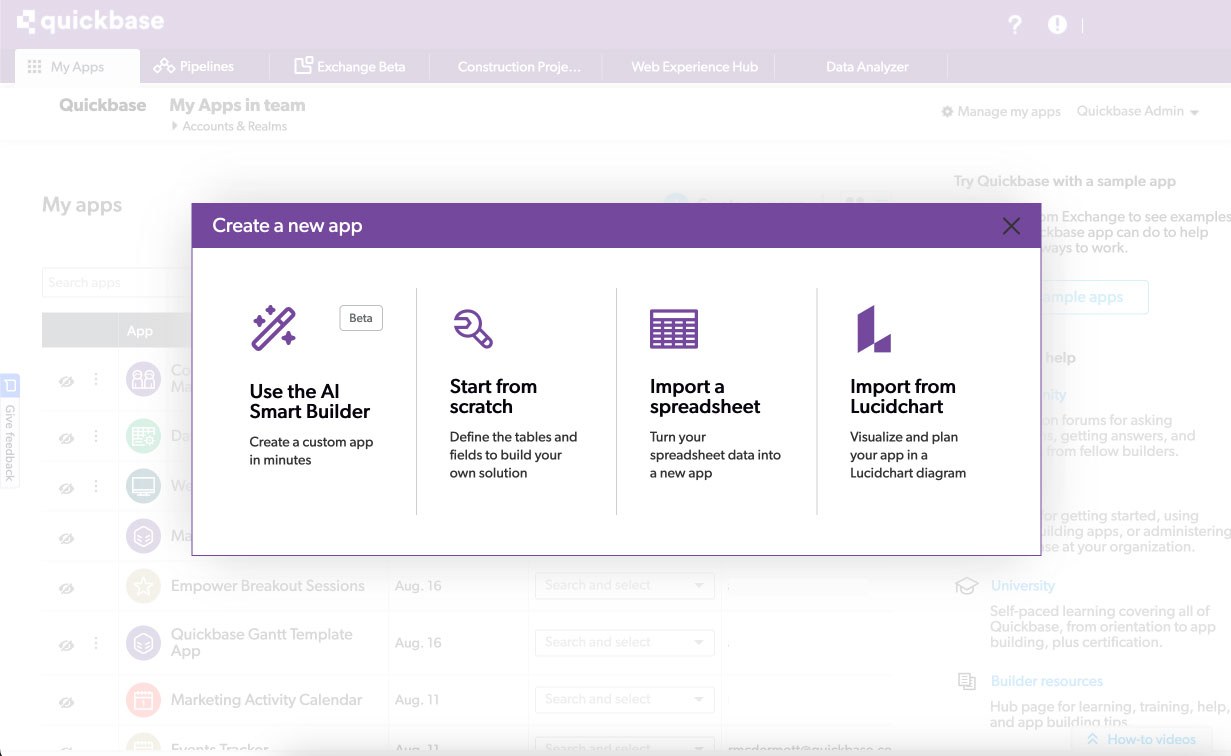
Quickbase introduced generative AI features in 2023 and later taught Smart Builder to turn spreadsheets into applications. Its pitch is helped by history: recommendations can draw on patterns from more than 26 million fields and 800,000 tables created on the platform. In 2026, Pave pushed further. A user describes an app in plain language, then receives a hosted application with data, logic, permissions, versioning and deployment included.
This is where Quickbase differs from the cheerful crop of AI prototype builders. The company is selling the unglamorous second half: single sign-on, granular roles, audit trails, rollback, backups and IT oversight. Pave has separate pricing, including a free entry plan and paid tiers. The core Quickbase product remains the deeper operations platform.
Competitors approach from every direction. Microsoft Power Apps benefits from the Microsoft estate. Appian, OutSystems and Mendix serve enterprise low-code. Airtable, Smartsheet and monday.com make collaborative work approachable. Salesforce Platform extends CRM. Quickbase's defensible corner is a flexible operational database with mature governance, strong permissions and a growing bridge from field worker to back office.
The weakness is the mirror image. A configurable platform can become a thicket of homegrown systems. Builders leave. Logic gets buried in formulas. Two departments solve the same problem differently. Quickbase provides sandboxes, admin controls, audit logs, training and services, but it cannot appoint an application owner or force a company to simplify a bad process.
Its enterprise credentials are practical rather than decorative. Quickbase lists AES-256 encryption at rest, TLS in transit, role-based access, service accounts, audit logs, single sign-on, SCIM provisioning and app sandboxing across its paid tiers, with availability varying by plan. Business and Enterprise customers can build workflows intended for qualified FDA and HIPAA use cases. The company keeps 14 days of daily backups and six months of weekly backups. Those controls explain why Quickbase can sit closer to regulated operations than a clever spreadsheet or a weekend prototype.
The service layer matters, too. Quickbase and its partner network will scope, build and iterate applications, train internal builders and provide ongoing technical account management. That can rescue a team that understands its process but lacks platform craft. It can also make the real bill depart quickly from the public seat price. Buyers should price the first useful workflow, its integrations, migration, training and a year of ownership - then compare that whole number with a packaged product and a conventional build. “No-code” describes how screens and logic are assembled. It does not mean no design work, no data cleanup or no maintenance.
It works when
- The workflow is unusual and changes often.
- A credible operator owns the process.
- Data must cross several existing systems.
- Permissions and auditability matter.
Walk away when
- A standard SaaS tool already fits.
- Nobody will maintain the app.
- The interface must be fully bespoke.
- The platform minimum exceeds the pain.
The playbook worth stealing
Do not begin with “digital transformation.” Begin with the ugly Tuesday afternoon ritual. Find the spreadsheet copied into email, the approval that waits for one traveler, or the field photo that must be renamed before anyone can bill. Measure its time, errors and license cost. Give one process owner authority. Build the smallest shared record that removes a handoff. Add governance before adding more apps.
That sequence explains what changed customers' minds. It was not a keynote about citizen development. It was one working application. Helm's campaign manager earned the right to become a job-number system, sales tracker and contract manager. BMG first reproduced the Salesforce process, preserved access to old data during the transition, then expanded. Trust arrived app by app.
Quickbase now has a new chief executive, Kim Eaton, a longtime board member who took the permanent role in April 2026. Her assignment is to carry a 27-year-old builder into the agentic-AI market without discarding the controls that made it credible. That is a sharper challenge than generating another dashboard.
The company's future rests on a useful tension. Business users want software now. IT wants software that will still behave later. Quickbase has spent its life between those demands, translating the improvised work a company actually does into systems it can admit to running. The result is not always elegant. Neither is the work. That is the point.