An ambulance call is not a checkout funnel. A workers’ compensation claim is not a three-step form. A police investigation does not politely wait for every document to arrive in order. Yet much of business software is built as if work were a train running down a fixed track: request, approve, close. Eccentex exists for the moment the train leaves the timetable.
The Culver City company builds low-code software for “dynamic case management,” an unlovely phrase that describes a useful idea. A process follows a known route. A case gathers people, evidence, deadlines and decisions around an outcome, then changes course as the facts change. Eccentex gives organizations a way to model both: the predictable steps a machine can handle and the exceptions that need a person.
Its core technology began as AppBase, a platform for configuring data models, forms, rules, workflows, documents and integrations. The current umbrella is HyperAutomation Cloud. Under it sit dynamic case management, work distribution, customer service, business intelligence, portals, document processing and a growing set of AI services. The names multiply; the basic proposition stays put. Put the full case in one place, automate what is safe to automate, and show the next person enough context to make a decent decision.
The case, not the channel
The product begins where the flowchart lies
Eccentex founders Alex Stein and Len Tokar started the company in the mid-2000s. Stein remains chief executive; Tokar runs operations as executive vice president. Their long bet was that enterprise work would become more digital without becoming more orderly. That distinction matters. Traditional business-process management is excellent when every instance should travel the same path. Dynamic case management is designed for claims, investigations, complaints, patient journeys and public services, where the path is partly discovered while the work is happening.
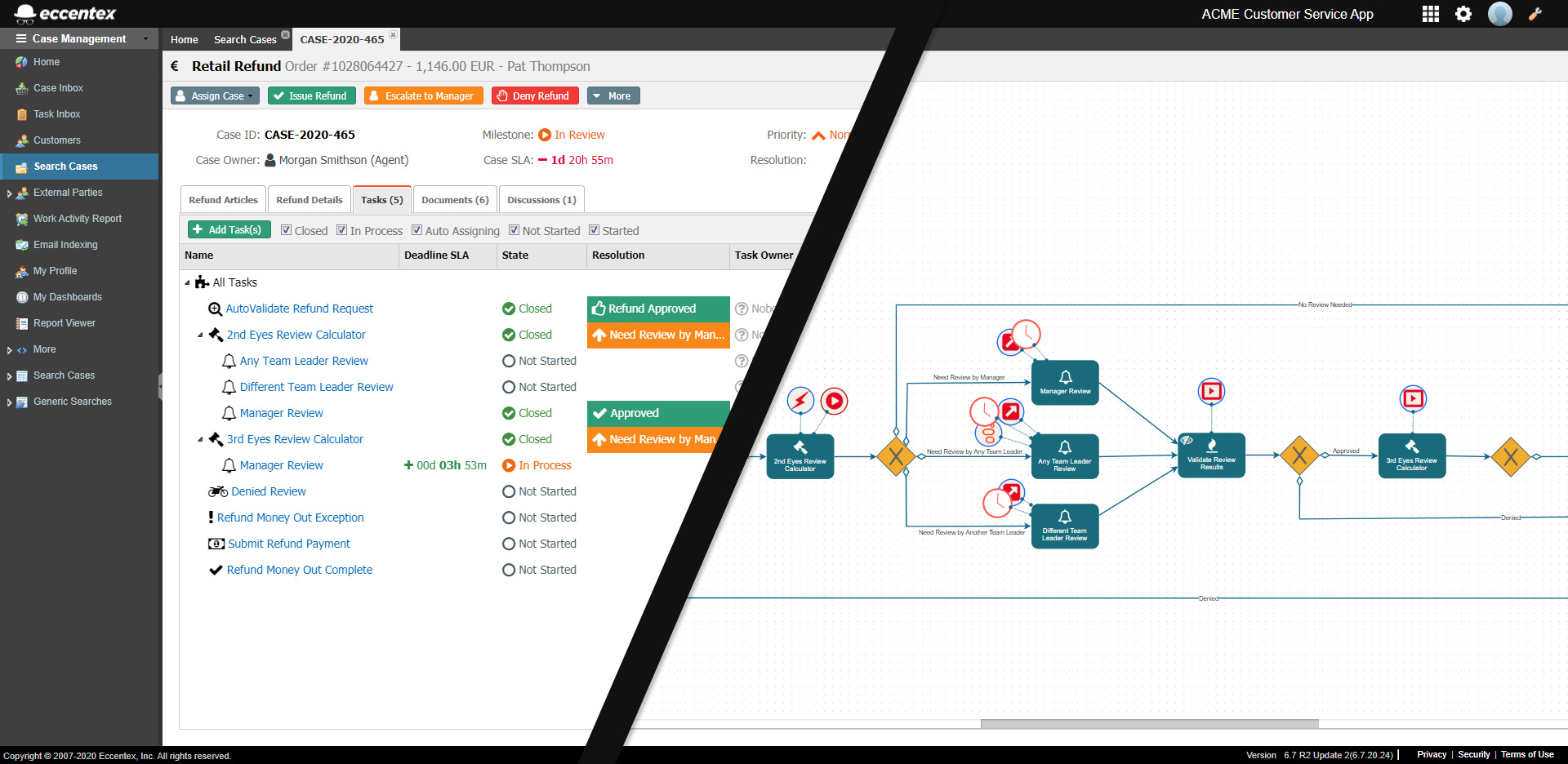
In AppBase, each case type can carry its own fields, milestones, service-level agreements, rules and access controls. Workers can create an unplanned task, split a difficult matter into sub-cases, request a review or bring in another party. Emails can become cases. Documents can be searched, versioned, redacted and tied to the record. A routing engine can assign work by urgency, workload or skill. The audit trail records not only what people did but what automated rules decided.
That is the meaningful difference from a simple ticket queue. A ticket says, “Somebody must answer this.” A case says, “Here is the customer, every related interaction, the policy deadline, the missing medical record, the people permitted to see it, the tasks already attempted and the decision still outstanding.” Eccentex tries to turn that sprawling noun pile into one working environment.
The proof is in the handoff
The company’s most persuasive examples are not five-minute app-building demos. They are operations where a bad handoff is expensive or dangerous. For emergency medical services in Ukraine, Eccentex implemented its ERIM system across Kyiv, Vinnitsa and Poltava. The Vinnitsa operation served more than 1.46 million citizens with 210 ambulances and over 1,700 emergency-care staff. Eccentex reported that response time and time-to-treatment were cut by roughly half. Its later account of the wider deployment lists 5,500 users and 600 vehicles across three regions.
In an anonymized American workers’ compensation deployment, the first thing to fail was manual coordination. Nurses, adjusters, providers, employers and lawyers were all part of the claim; experienced staff were spending time scheduling appointments, chasing records and preparing routine next steps. The customer had already tested a high-touch “Clinical Concierge” model and liked the care outcomes. What changed its mind about scaling was the economics: human attention had to be extended to every injured worker without assigning an expensive specialist to every administrative task.
ServiceJourney unified workflows and service levels, routed routine work to lower-cost teams, integrated with core systems and Genesys Cloud CX, and automated personalized updates. The company-reported result was 20 percent lower claim cost, 60 percent lower litigation and a 9.4-out-of-10 user satisfaction score. Those are vendor case-study figures, not a controlled experiment. Still, they reveal what buyers are paying for: fewer dropped tasks, earlier intervention and less specialist time burned on clerical motion.
“We don’t offer ‘cookie cutter’ solutions for our customers.”Eccentex, describing its adaptability value
What it costs - and what the price hides
Eccentex does not publish a universal enterprise price. Capterra currently lists AppBase from $120 per user per month, while G2 says buyers must contact the seller. Neither number tells you the total cost of a serious case-management program. Data migration, integrations, configuration, security, training, cloud operations and support can dwarf a neat per-seat figure.
Maximum value of a public 2020 Houston contract for Eccentex professional services and a police case-management system - three years plus two one-year options.
That public contract is a better reality check. Houston approved a maximum of $1.062 million for three years of professional services and case-management software for its police department, with two one-year options. It is one deployment, not a rate card, but it makes the category legible: this is enterprise infrastructure bought on a negotiated scope, not a team tool charged to a credit card on Friday afternoon.
The business model mixes software subscriptions with consulting, configuration, deployment, integration and managed services. That combination can help a smaller vendor tackle tangled environments. It also creates the familiar platform risk: a buyer may acquire a flexible toolbox and underestimate the work of deciding how the organization should operate. Low-code reduces the amount of custom programming. It does not eliminate process design, data cleanup or politics.
A small vendor in a heavyweight market
Eccentex competes in neighborhoods occupied by Pega, Appian, Salesforce, ServiceNow, Creatio, Newgen, Hyland and OpenText. Forrester included it among 11 significant cloud dynamic-case vendors in a 2018 evaluation. Its advantage is not scale. LinkedIn places it in the 51-to-200 employee band, and supplied business data estimates roughly 54 employees. Its wedge is specificity: complex case work, deep document handling, and the seam between a Genesys contact center and the back office that must actually resolve the issue.
Genesys is the most visible partnership. Eccentex products can screen-pop a customer record during an interaction, convert email into managed work, route tasks and carry context from the conversation into resolution. This sounds mundane until you have watched an agent ask a customer to repeat the story because the phone system, CRM, claims database and document store are four islands with excellent uptime.
The company is now recasting that orchestration layer for AI. HyperAutomation Cloud can federate Eccentex capabilities with outside models and services. Recent releases include intelligent document processing with human verification and an AI Task Assistant for repetitive and knowledge-heavy work. The sensible part is the control structure around the model: cases, permissions, source documents, rules, audit history and a named human reviewer. Generative output becomes one step in a governed process rather than an oracle floating above it.
The part a reader can steal
You do not need to buy Eccentex to copy its best idea. Start with a case, not a channel. Pick one outcome - resolve an injury claim, answer a complaint, approve assistance - and map every participant, document, deadline, decision and exception around it. Mark which steps are deterministic, which require judgment and which exist only because two systems do not speak. Automate the deterministic pieces first. Give the judgment calls full context. Keep a visible audit trail.
Then measure an outcome that the operation cares about: time-to-treatment, claim cost, litigation rate, missed service levels, repeat contacts. “We deployed AI” is not an outcome. Eccentex’s better case studies work because the metric belongs to the customer, not the software category.
Copy this
- Design around the whole case, not the incoming email.
- Automate routine decisions and expose the reasoning.
- Let workers add tasks when reality changes.
- Measure operational outcomes after launch.
It will not work when
- The workflow is simple enough for a lightweight tool.
- No owner can settle process and data disputes.
- Buyers expect low-code to erase integration work.
- Opaque AI decisions are unacceptable and no review is funded.
There are conditions where this approach is wrong. A ten-person business with a stable approval flow may find the platform excessive. A company demanding transparent self-serve pricing will dislike the sales process. An organization with no appetite for integration, governance or continuous ownership may simply recreate its silos inside a more capable system. And if every case truly follows the same short path, dynamic case management is elaborate furniture in an empty room.
But the harder the work becomes - more documents, more departments, more deadlines, more exceptions - the more Eccentex’s old thesis earns its keep. The company is not trying to remove people from the process. It is trying to stop the process from wasting the people. That is a modest ambition by AI-era standards, and a rather practical one.