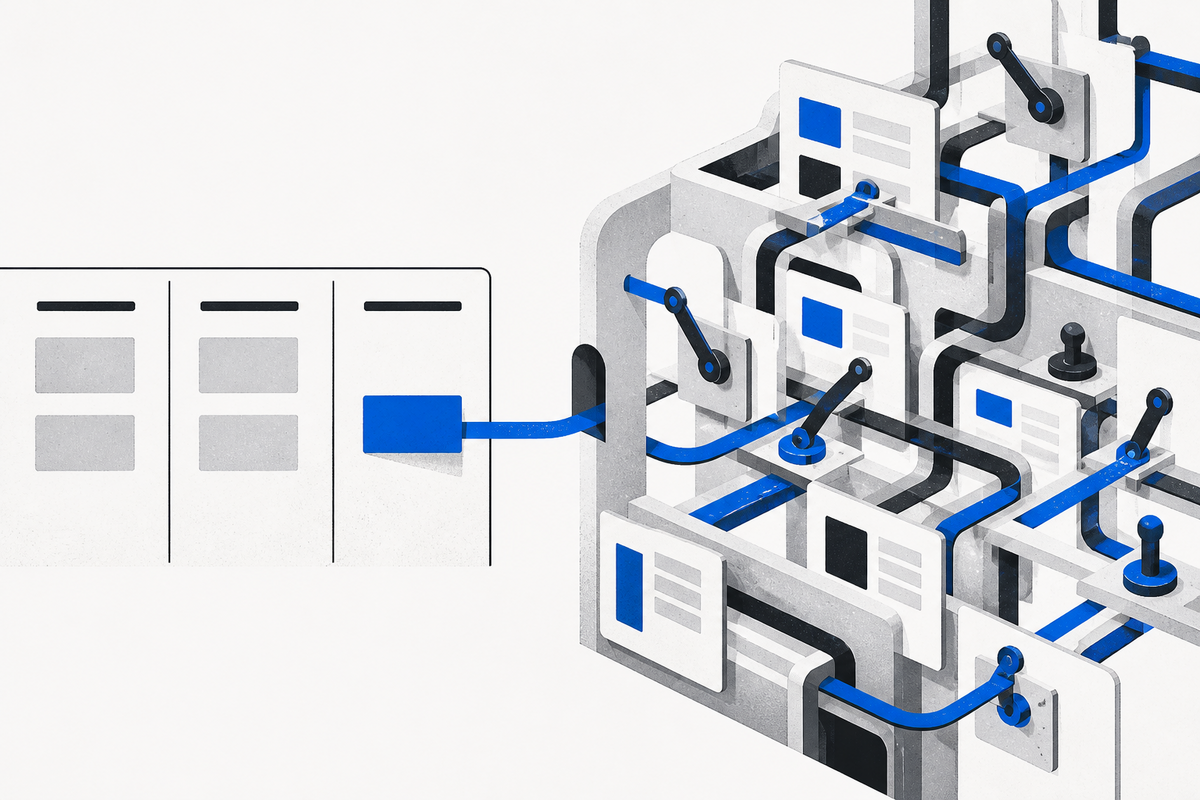
A project-management demo always begins in a spotless world. The cards have owners. The dates are plausible. The dashboard glows with honest green. Nobody has created a column called “misc,” and the chief executive has not asked for a private spreadsheet. Then the software meets Tuesday.
A request arrives in chat. A decision stays in a meeting. Somebody moves a deadline without moving the dependencies. By Friday, the team has two systems: the official one that describes how work was supposed to happen, and the living one carried in people’s heads. The problem is rarely that the chosen tool lacks a feature. It is that maintaining the model asks more of the team than the model gives back.
Choose the burden before the brand
Trello, Asana, monday.com and ClickUp occupy the same software roundup because all four can hold tasks, owners, dates and comments. That resemblance is real but shallow. They propose different bargains. Trello asks for the least ceremony. Asana asks teams to make relationships between everyday tasks, projects and organizational goals explicit. monday.com offers boards as building material for custom business processes. ClickUp tries to collapse a shelf of separate tools into one broad workspace.
A buyer can compare automations, views and AI assistants until every tab blurs into the next. A more revealing question is: what recurring behavior does each system require? Every custom field must be filled. Every portfolio must be curated. Every dashboard depends on clean upstream data. Every consolidated app needs rules for where conversation, documentation and decisions belong. Features create options, and options create governance.
The best system is the one that tells the truth on a dull Wednesday, after the launch team has gone home.YesPress analysis
Trello is the friendly door into Atlassian
Trello’s vocabulary still fits on a sticky note: boards contain lists; lists contain cards. A new teammate can usually understand the state of work by looking. This makes Trello useful for editorial calendars, recruiting pipelines, client deliverables, household projects and small teams that need shared visibility before they need portfolio management.
Its apparent independence can mislead a comparison. Atlassian bought Trello in 2017 in a deal valued at roughly $425 million. At the time, Atlassian described Trello as filling a space between Jira’s structured workflows and Confluence’s free-form collaboration. Trello remained a standalone service, but it became a sibling product, not an outside challenger. That position explains the pitch: start with a visual board, then connect to the heavier Atlassian system when work demands it.
The product is not frozen in 2017. Trello added Inbox and Planner around a personal-productivity redesign, and in July 2026 Atlassian announced Trello MCP, which lets compatible AI assistants work with boards, lists, cards and checklists according to existing permissions. Even so, the durable advantage remains legibility. The danger is stretching one board across too many teams until labels become a private language and card movement stops explaining what is actually happening.
Asana makes commitments visible
Asana’s natural unit is not the card but the commitment. A task can sit within projects, connect to goals, feed portfolios and appear in reporting. The product supports lists, calendars, timelines, Gantt charts and Kanban boards, yet its distinctive value appears above the project level. Leaders can ask how a launch relates to a company objective, whether a portfolio is at risk, or where capacity is tight.
That structure suits cross-functional programs in which marketing, product, operations and leadership need a shared account of progress. It also creates a test. If the organization will not maintain goals, portfolios and status updates, it should not pay emotionally for pretending that it will. Asana is at its best when managers want fewer status-chasing meetings and are prepared to treat the system as the place where commitments are made.
In 2026, Asana pushed further into what it calls an operating system for human-agent teams. Its Work Graph is the strategic asset: a map of who is doing what, by when, how and why. AI teammates make the pitch more ambitious, but they also raise the stakes for data hygiene. An agent reading stale ownership faster is still reading stale ownership.
monday.com turns the board into a factory
monday.com begins with the friendly geometry of rows, columns and colorful statuses, then invites the buyer to keep building. Boards can become campaign trackers, intake queues, production schedules, sales processes or service operations. Dashboards summarize them; automations move information between them; workload and Gantt views expose capacity and dependencies.
The company was founded in 2012, launched its first product in 2014 and grew beyond work management into CRM, development and service products. In 2026 it described its next turn as an AI work platform. That trajectory reveals the core idea: monday.com wants to be configurable enough for teams to encode their own operations without commissioning conventional software.
The gift is flexibility. The bill arrives as system ownership. A custom workflow is a small internal product. Somebody must decide which columns matter, how automations fail, when templates change and who can alter the schema. For an operations-minded team, that is a fair exchange. For a loose creative group that wants to drag cards into “done,” it can feel like maintaining a machine built to describe the machine.
Setup intensity, in practice
Editorial assessment, not a product benchmark. Intensity rises with the amount of configuration and governance needed to use the broader feature set well.
ClickUp asks what you can remove
ClickUp’s argument is easiest to understand by counting browser tabs. Tasks are joined by Docs, Chat, Whiteboards, Dashboards, Goals, time tracking, forms, clips and more than fifteen view types. The company calls this convergence. A team using separate tools for planning, documentation, messaging and reporting can see an obvious economic and cognitive appeal: fewer subscriptions, fewer integrations and more context beside the work.
Consolidation also concentrates complexity. Replacing several narrow tools produces one wide tool, and people still need to know where a decision belongs. ClickUp fits teams that feel real pain from app switching and have a motivated owner who can hide irrelevant features, create conventions and train people. It is a weaker fit when the team’s main problem is simply remembering to update tasks.
Pick for speed, visual flow and small-team adoption.
Pick for cross-functional commitments, goals and portfolios.
Pick for configurable processes and operations-led workflows.
Pick to consolidate a fragmented work stack under one roof.
Run the boring-work trial
Do not test these products with an imaginary product launch. Choose one active project that contains late work, ambiguous ownership, a dependency and at least one person who dislikes project software. Give the trial enough reality to reveal friction. Keep the rules short: every task needs an owner, every commitment needs a date, and important decisions must be linked where the work lives.
After a month, ignore how attractive the dashboard looks. Ask whether a teammate can open the system on Monday morning and know what matters next. Count how often people had to request status in chat. Look for duplicate fields and abandoned views. Notice whether the team updated the system during the work or performed a cleanup ritual before the review meeting.
The one-month test
- Use one live, imperfect project and a representative team.
- Require only an owner, a deadline and a clear next state.
- Record every time someone leaves the tool to find context.
- Measure stale tasks and status-chasing, not card volume.
- Keep the system only if it reduces private explanation.
The winning product may have fewer features than the procurement spreadsheet recommends. That is not a compromise. It is an acknowledgment that a work system succeeds through repeated human behavior. Trello can be enough. Asana can make a growing organization coherent. monday.com can turn operations into reusable software. ClickUp can retire a tangle of subscriptions. Each can also become expensive scenery.
Buy the smallest amount of structure that makes ownership, deadlines and risk visible. Add complexity only when a specific failure proves that the team needs it. Software can hold the map. People still have to walk the route.
Explore the products and reporting
Frequently asked questions
Which tool is best for a solo user or very small team?
Trello is usually the fastest to understand because boards, lists and cards expose the workflow with little setup. Asana and ClickUp also support personal use, but introduce more structure.
Is Trello a competitor to Jira?
They overlap, but both belong to Atlassian. Trello is positioned as a flexible visual work-management tool, while Jira supports more structured and technical workflows. They can be integrated.
When does Asana make the most sense?
Asana fits teams that need to connect tasks and projects to cross-functional portfolios, goals, reporting and resource planning without combining every workplace function in one app.
What distinguishes monday.com?
monday.com treats the board as a configurable base for many business processes. Its strength is modeling workflows with columns, views, dashboards and automations across multiple product areas.
Why would a team choose ClickUp?
ClickUp is designed for teams that want tasks, documents, chat, whiteboards, dashboards, goals and time tracking in one workspace and are willing to govern a broad feature set.