BREAKING Motion raises $60M at a $550M valuation • AI Employees hit eight-figure ARR in ~4 months • 100,000+ paying customers and ARR tripling YoY • Series C reportedly 5x oversubscribed • Backed by Y Combinator since 2020 • "Work better, in motion" •
BREAKING Motion raises $60M at a $550M valuation • AI Employees hit eight-figure ARR in ~4 months • 100,000+ paying customers and ARR tripling YoY • Series C reportedly 5x oversubscribed • Backed by Y Combinator since 2020 • "Work better, in motion" •
Company Profile / AI Work Suite
Motion
The calendar that scheduled itself grew up, learned to work, and started hiring.
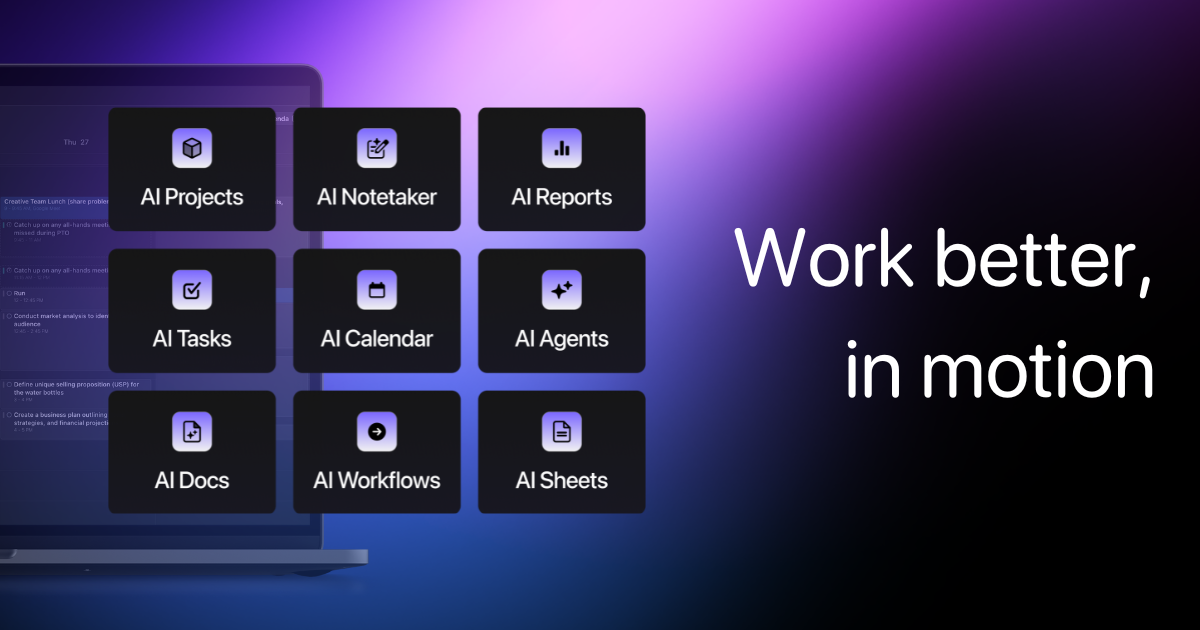
Ten apps wearing one trench coat. Motion's own product card lays out the modules - AI Tasks, Calendar, Agents, Sheets - under a tagline that doubles as a dare: "Work better, in motion."
Founded 2019
Y Combinator
$550M valuation
$60M raised (2025)
SOC 2
SF Bay Area
Who they are now
It is a Tuesday, and the software already planned your week
Open Motion on any given morning and the day is already drawn for you. Tasks have slotted themselves around your meetings. A digital teammate named Alfred has skimmed your calendar before you finished your coffee, surfacing who you are about to talk to and why. Somewhere in the background, an AI agent is drafting a proposal a human has not started yet. This is Motion in 2026 - not a to-do list, but a work suite that schedules, tracks, and increasingly does the work itself.
The company calls it the "agentic work suite." That is a lot of syllables for a simple promise: one place where projects, tasks, calendar, docs, notes, SOPs, sheets, reports, search, and chat all live - and where AI "Employees" sit inside them, executing rather than merely reminding. After a $60M raise in 2025 at a $550M valuation, Motion is no longer the scrappy scheduling app it began as. It is making a much larger argument about who, or what, gets the work done.
The tools were supposed to track the work. Motion decided they should do it.- the bet, in one sentence
The problem they saw
Work software multiplied. The work did not get easier.
Here is the inconvenient truth Motion was built on: the average knowledge worker spends a startling share of the week not doing the job, but administering it. Scheduling. Re-scheduling. Updating the project tracker so the project tracker stays accurate. Copying a decision from a meeting into a doc into a task into a calendar. The productivity industry's answer, for two decades, was to sell more tools. Motion's founders noticed the tools had become the chore.
And the newer answer - bolting an AI chatbot onto the side of everything - struck them as only half a solution. An assistant that lives in a separate tab, disconnected from the systems where work actually runs, mostly generates more things to copy and paste. The question that organized the whole company came from CEO Harry Qi.
Why should AI tasks live outside the systems where human tasks already run?- Harry Qi, Co-Founder & CEO
It reads like a rhetorical flourish. It is actually a product spec. If AI is going to do work, it needs to live where the work is - inside the project, next to the task, on the same calendar - not in a chat window pretending the rest of your stack does not exist.
The founders' bet
Four quants and engineers walk into a productivity problem
Motion was founded in 2019 by Harry Qi, Omid Rooholfada, and Ethan Yu, with Chander Ramesh joining as a fourth co-founder. It is a resume that reads less like a wellness app and more like a trading desk: Qi, a Math and CS double major from Dartmouth, walked away from a quant-trading job - reportedly around the $1M-a-year range - to start it. Yu studied CS at Dartmouth, traded for years, and engineered at WhatsApp and Facebook. Rooholfada came out of Yale with Math and CS, and engineering time at Facebook and Optimizely.
People who optimize markets for a living tend to find unoptimized calendars personally offensive. The early bet was narrow and a little nerdy: if scheduling is a constraint-satisfaction problem - deadlines, priorities, energy, meetings - then a computer should solve it better than a human dragging blocks around. Y Combinator backed that thesis in the spring 2020 batch. SignalFire led the Series A the same year.
People who optimize markets for a living tend to find a messy calendar personally offensive.- on the founding instinct
The scheduling wedge worked - but the founders treated it as a beginning, not a business. The real wager was that the same engine deciding when you should do something could, eventually, help do it. That is the line Motion has been walking ever since: from telling you what to do, to doing some of it for you.
The product
One platform, ten apps, and a payroll of robots
Strip away the AI vocabulary and Motion is an all-in-one work platform: tasks, projects, calendar, docs, notes, SOPs, sheets, reports, search, and chat, stitched together so a decision in one place updates the others. The scheduling brain still runs underneath - it slots work into your day around your patterns and deadlines, and quietly re-plans when reality intervenes, which it always does.
AI Calendar
Auto-schedules tasks at optimal times using work patterns, meeting load, and deadlines - then re-plans when the day goes sideways.
AI Projects & Tasks
Planning, prioritization, dependencies, Gantt and Kanban - with the system doing the re-sequencing humans usually forget.
AI Employees
Pre-built agents for Sales, Support, Marketing, PM, HR and Research - plus custom roles - that draft, update, and respond.
Alfred & Meeting Prep
The flagship agent reads your calendar each morning and surfaces objectives, attendee history, and project context.
Most apps give you a chatbot. Motion gives you a coworker who already knows the deadline.- the AI Employees pitch, translated
The headline feature, "AI Employees," is where the company's ambition stops being subtle. These are agents that execute - writing proposals, posting project updates, answering clients - inside the same platform where the human work lives. It is one thing to summarize a meeting. It is another to do the follow-ups the meeting created. Motion is betting the difference is the whole game.
The proof
The numbers behind the noise
Skepticism is the right posture for any company that says "AI" in every sentence, so look at what is countable. Motion reports more than 100,000 paying customers, with annual recurring revenue tripling year over year. Over 80% of new ARR comes from small, mid-sized, and mid-market businesses - the segment big enterprise software tends to ignore, and the one Motion built for. One IT-services CEO reported that Motion's AI Project Manager cut project delivery time by 30%.
The fundraising staircase
// reported 2025 raise, split across rounds, USD millions
Sources: Motion, Scale Venture Partners, SignalFire, BusinessWire (Sep 2025). *Single customer testimonial.
100,000 paying customers is not a vibe. It is a spreadsheet.- the case for taking Motion seriously
The investor list is its own kind of proof. The 2025 round was led by Scale Venture Partners - whose Stacey Bishop joined the board - with HOF Capital, 468 Capital, SignalFire, Valor Equity Partners, Fellows Fund, Leonis Capital, and Y Combinator doubling down across rounds. Leadership filled out with operators from Microsoft Teams and Salesforce. The reviews, to be fair, are not uniformly glowing: some users love the AI Employees, others say Motion should perfect the core scheduling before staffing a robot sales team. Honest tension, openly visible. It belongs in the file.
The mission
Enterprise leverage, without the enterprise budget
Large companies already buy AI leverage - they hire teams to build custom systems most businesses cannot afford. Motion's mission is to hand that same leverage to the small and mid-sized businesses that make up the long tail of the economy, off the shelf, inside the tools they already use. No integration army. No six-month rollout. The work suite shows up already knowing how to work.
The future of work is not a better tab to switch to. It is fewer tabs, doing more on their own.- the long bet
That is a genuinely democratic idea wearing a B2B SaaS suit. If it holds, the gap between a ten-person shop and a thousand-person company narrows - not because the small team works harder, but because their software does.
Why it matters tomorrow
Back to Tuesday morning
Return to that Tuesday. A year ago, the version of you using Motion got a tidy calendar - the software told you what to do, and you did it. The version reading this gets something stranger: a day that is partly already done. The proposal is drafted. The project is updated. The meeting prep is waiting. The plan did not just describe the work. It started clearing it.
The open question is the one every honest reader is already asking: how much of the work should the software actually do, and how much do we want it to? Motion has staked $550M worth of conviction on the answer being "more than you'd think." Whether the robots prove to be coworkers or just very confident interns, the company has already changed the first thing you see on a Tuesday morning - and that, quietly, is the whole point.
It started as the app that planned your day. The ambition now is to be the app that finishes it.- Motion, the short version