Company Profile · Software / Developer Tools
Shortcut.
Fast, no-nonsense project management for software teams - now with an AI agent that plans the work for you.
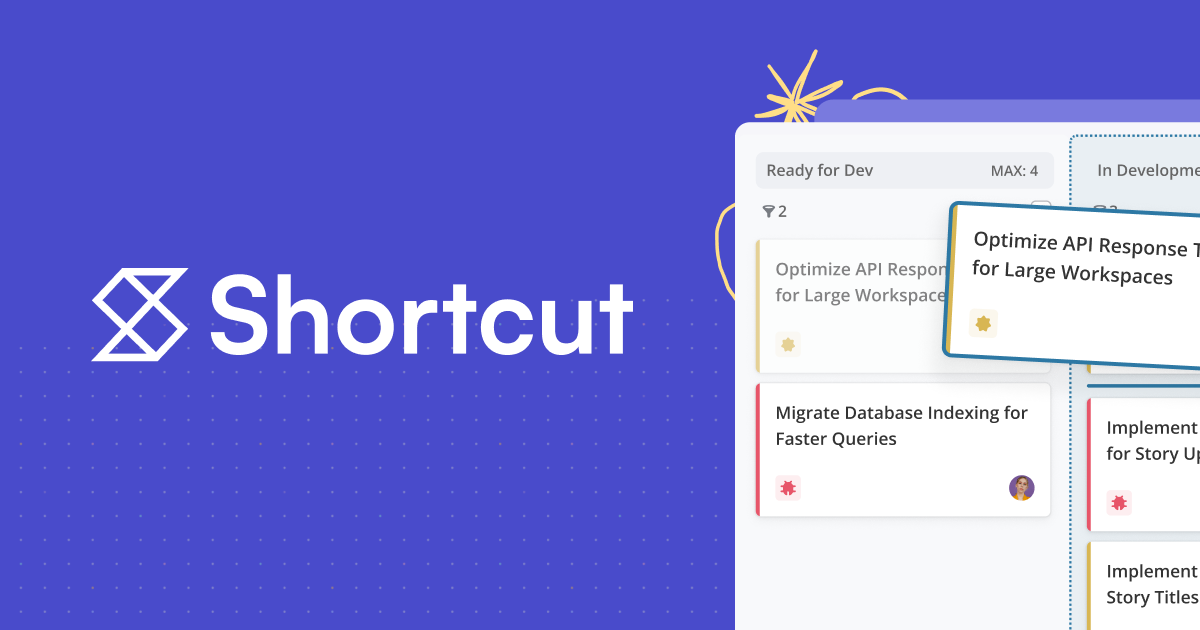
Fast, no-nonsense project management for software teams - now with an AI agent that plans the work for you.
Shortcut sells software that most engineers would rather not think about. Project management - the tickets, the sprints, the status updates - is the connective tissue of building a product, and it is also the part teams tend to resent. The company's wager, since it started in a New York office in 2014 under the name Clubhouse, has been simple: if the tracking tool is fast enough and quiet enough, people will actually use it, and the work will move faster as a result.
The platform gives software teams a shared place to plan and ship. Work is organized into "Stories" that flow across Kanban boards; sprints are called "Iterations"; larger bodies of work roll up into Epics and Milestones, which in turn feed roadmaps. Around that core sit automations, custom workflows, a REST API, and reporting - burndown, velocity, cycle time, lead time - so managers can see progress without pulling engineers into meetings to ask for it. The result has added up: Shortcut reports more than 21 million completed stories across over 50,000 organizations.
Its customers are the people doing the building - developers, engineering managers, product managers, and designers - at companies that range from early startups to larger software organizations. What they tend to have in common is a specific frustration: they found one tool too heavy and another too rigid, and went looking for the seam in between.
Two products dominate how software teams track work, and each leaves a gap. Shortcut was built for the teams stuck in the middle.
Jira, the long-standing incumbent from Atlassian, can model almost any workflow - which is also why it is often described as complex, slow to configure, and heavy to live in day to day. Linear, the newer favorite, is admired for speed and design, but it is opinionated by choice: it makes decisions for you and rewards teams that adopt its defaults. Neither is wrong. But between "too much" and "too fixed" sits a large group of teams who want custom workflows and milestones without a configuration project, and clean speed without giving up flexibility.
That is the space Shortcut occupies. Reviewers consistently place it between the two: more customizable than Linear, far simpler than Jira. It is the tool teams reach for when Linear feels too constraining and Jira feels like overkill - and, notably, it competes on price and clarity rather than on having the longest feature list.
| Dimension | Jira | Linear | Shortcut |
|---|---|---|---|
| Feel | Powerful, heavy | Fast, opinionated | Flexible, lightweight |
| Best for | Large, complex orgs | Teams that adopt defaults | Teams stuck in between |
| Customization | Extensive | Limited by design | Custom workflows + milestones |
| Learning curve | Steep | Gentle | Quick setup |
| Approx. price / user | ~$7.9/mo | ~$8/mo | ~$8.50/mo |
Pricing figures are approximate and drawn from third-party comparisons; check each vendor for current plans.
"It is extremely easy to use. Quick to setup and understand. VERY cost effective." - A CEO reviewing Shortcut
One platform for planning and shipping, plus a growing layer of AI that does some of the planning for you.
Stories, Iterations (sprints), Kanban boards, Epics, Milestones, roadmaps, custom workflows, automations, and reporting - the shared source of truth for a software team's work.
An AI product manager that turns an idea into a build-ready plan in seconds - writing specs with acceptance criteria, breaking work into tasks, tracking dependencies, and summarizing status.
Agent coordination so teams can delegate and orchestrate work across developers, designers, and AI coding agents on the same board - not humans versus AI, but a shared to-do list.
Native links to GitHub, GitLab, Bitbucket, and Slack, plus a REST API - so project data lives where the work already happens. Cursor and other connectors have joined the lineup.
In September 2025, Shortcut introduced Korey, positioning it as the first AI product manager built for engineering workflows. Rather than bolting a chat box onto the sidebar, the company aimed the agent at the least-loved part of the job: the administrative overhead of turning a rough idea into a plan a team can actually execute. Korey drafts detailed specs, sets acceptance criteria, breaks work into tasks, maps dependencies, and reports on status - the busywork, handled.
By mid-2026 the framing had sharpened to "AI orchestration for software teams," with connectors to Slack, GitHub, and Cursor going live across plans, and roadmap plans to reach into Jira, Asana, Monday.com, Linear, Notion, and Confluence. Shortcut says early teams using Korey report moving roughly 40% faster while cutting hours of admin each week - figures worth treating as the company's own, and early.
"Korey takes ideas and turns them into structured, build-ready plans in seconds."
- Shortcut"Early teams report moving 40% faster while cutting hours of administrative work every week."
- Shortcut"The first AI product manager built for engineering workflows."
- Company positioning, 2025Shortcut runs a straightforward B2B SaaS model: per-seat subscriptions across tiered plans - Free, Team, Business, and Enterprise - with published prices in the range of roughly $8.50 to $10 per user per month and custom pricing at the top. Revenue scales with seats and team count, and AI features extend what each seat is worth. Third-party sources estimate annual revenue near $4M, a figure the company has not officially confirmed.
The capital tells the strategy. Shortcut - then Clubhouse - raised about $4M across two seed rounds, then $10M in a 2017 Series A led by Battery Ventures. In January 2020 it closed a $25M Series B led by Sarah Guo at Greylock Partners, with Battery and Lerer Hippeau returning. The round drew a striking list of operator-investors: the sitting CEOs of Datadog, MongoDB, Pendo, and Flatiron Health all wrote checks - a cap table that reads like a who's who of B2B software.
Bars scaled to round size. Total raised across all rounds: ~$40.8M. Series B led by Greylock Partners, January 2020.
Kurt Schrader and Andrew Childs start the company to bring more transparency and better models to software engineering.
The Clubhouse project management platform goes live, backed by $4M across two seed rounds.
Clubhouse raises $10M led by Battery Ventures to grow the platform.
Raises $25M led by Greylock's Sarah Guo - explicitly aiming to challenge the Atlassian suite for modern software teams.
The company changes its name from Clubhouse to Shortcut, effective September 13, after a viral audio app took over the old name.
Shortcut debuts Korey, an AI product manager that plans and orchestrates engineering work.
Positioning sharpens around AI orchestration for software teams; Slack, GitHub, and Cursor connectors go live across plans.
Shortcut was founded by Kurt Schrader, who serves as co-founder and CEO, and Andrew Childs, who drove the original concept. The company is roughly 70 people and describes itself with five stated values: treat people right, spread joy, take ownership, be open by default, and have a bias for action. Read less as wall art and more as a hiring filter - the traits the company says it looks for and rewards.
Leads Shortcut and its push into AI-assisted product development. Email of record: kurt.schrader@shortcut.com.
The driving force behind the initial concept - notably, without a formal computer science background.
Clubhouse changed its name in 2021 to avoid confusion with the viral Clubhouse audio app - and kept its user base through the switch.
Its older Twitter and Facebook accounts still carry the "clubhouse" name - a small artifact of the rebrand.
Shortcut calls sprints "Iterations" and tasks "Stories" - language borrowed straight from agile development.
Its Series B cap table included the sitting CEOs of Datadog, MongoDB, and Pendo.
Shortcut is a project management and issue-tracking platform built for software teams, with sprints, boards, roadmaps, milestones, automations, and reporting - plus an AI agent called Korey.
Yes. The company and product were called Clubhouse from 2014 until September 2021, when it rebranded to Shortcut to avoid confusion with the Clubhouse audio app.
Shortcut was founded in 2014 by Kurt Schrader, who is CEO, and Andrew Childs.
Korey is Shortcut's AI product-management agent. It turns ideas into build-ready plans, writes specs with acceptance criteria, breaks work into tasks, tracks dependencies, and summarizes status.
Shortcut sits between the two - more customizable than Linear, with custom workflows and milestones, but far simpler and cleaner than Jira. It targets teams that find Linear too rigid and Jira too complex.