Every company has a folder that behaves like a junk drawer. The logo is in there, somewhere, next to an expired price sheet, three headshots of the former chief executive and a video so large nobody dares click it. Ask for the approved version and a small office drama begins: a Slack message, a shared-drive expedition, an email attachment and, finally, a file called final_v7_REAL.png. Canto has spent 36 years turning that drama into software.
The Atlanta-headquartered company sells digital asset management, or DAM, to marketing, creative, product, sales and communications teams. The core proposition is simple: put valuable brand files in one governed library, attach useful information to them, make them easy to search, and control how they leave. Around that center, Canto adds permissions, rights, version history, approval workflows, portals for outside partners, brand templates, analytics and integrations with the tools where work already happens.
Calling it storage is like calling a library a room with shelves. Dropbox, Google Drive and SharePoint can hold the bits. Canto is paid to answer the questions around them: What is this? Who owns it? May we publish it? Which market is it for? What replaced it? Who still needs access? The company says more than 4,000 brands use its platform, across retail, manufacturing, universities, travel, healthcare, technology and nonprofits.
The scanner that created its own sequel
Canto's origin story contains an unusually clean product lesson. The company was founded in Germany in 1990 and first made scanning software for the Macintosh. Cirrus helped people turn paper and photographs into files. Then customers encountered the consequence of successful digitization: they had many more files than they could sensibly manage. Canto followed that complaint downstream.
In 1992 it released Cumulus, software that indexed media, generated previews and made digital assets searchable. Early versions lived on individual computers; later ones became client-server systems, then on-premises enterprise installations. Cloud deployment arrived in 2013. The technical shape changed with the market, but the job stayed stubbornly stable: help a person find the right file without knowing its filename.
What failed first? Not necessarily the scanner. The first assumption failed: that creating a digital file completed the job. In practice, creation moved the bottleneck. Once scanning became easy, organization became scarce. That customer observation changed Canto's direction from an input utility to a system of record. It is the sort of pivot founders love to retell because the market handed over the roadmap in the form of a complaint.
What the buyer is really buying
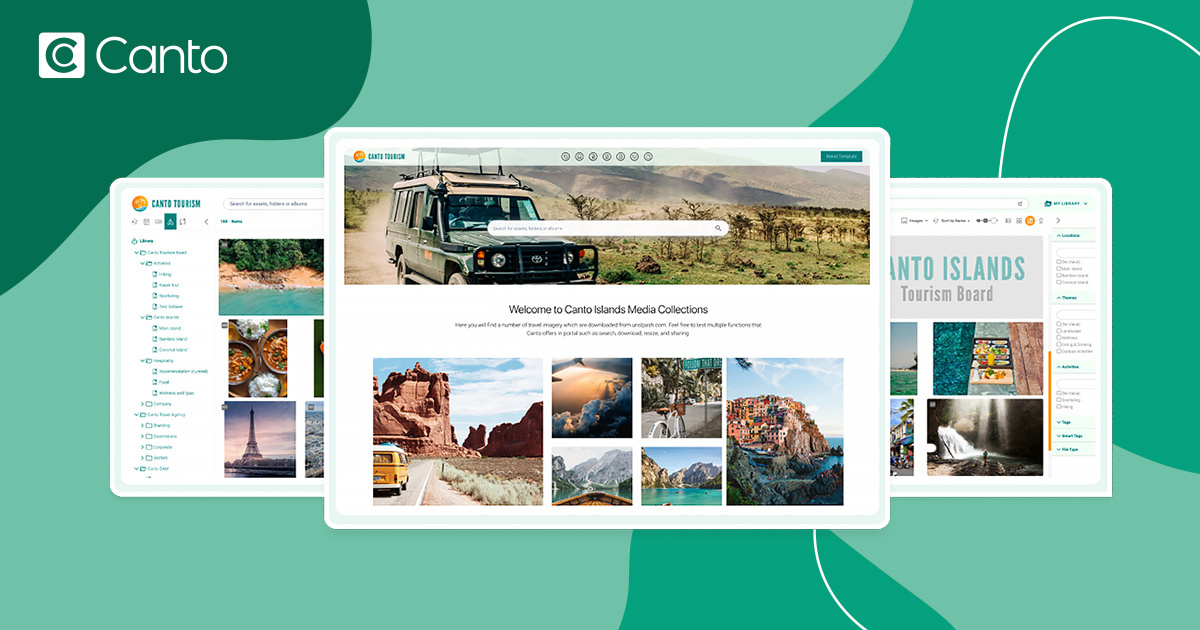
A modern Canto deployment starts with a central DAM library. Teams upload images, videos, PDFs, presentations, design files and other content. Administrators define folders, albums, metadata, user roles and rights. Search covers filenames and fields, while AI Visual Search lets a user describe what appears in an image or video. A marketer can look for “a red bicycle by the sea” without remembering that the photographer uploaded it as DSC_1842.
and ingest
and search
and approve
and govern
and reuse
Portals provide curated, controlled collections for dealers, agencies, journalists or regional teams. Expiration dates can retire old campaigns. Version control keeps a revised price sheet attached to its history instead of spawning another loose copy. Approval Hub handles review and proofing. Brand Studio gives non-designers controlled templates. Media Publisher moves approved content outward. A documented API and integrations with Adobe Creative Cloud, Canva, WordPress, Salesforce, Slack, Microsoft tools and ecommerce systems aim to make the DAM less of a destination and more of a layer inside the existing workflow.
Canto DAM for Products pushes the company into adjacent territory. After acquiring Image Relay in 2024, Canto launched a product-information capability that connects SKUs, specifications and attributes with the photographs, videos and documents used to sell them. That matters when the same item appears on a brand site, a retailer page, a marketplace and a printed catalog. A correct image paired with an obsolete dimension is still wrong.
These numbers come from Canto and Ascend2's 2026 survey of 434 content professionals in the United States and United Kingdom, so they are market research, not a laboratory result. Still, they describe the sales environment nicely. AI has accelerated production, yet governance remains manual and fragmented. More supply makes retrieval, approval and reuse more valuable. Canto is selling a tollbooth beside the content fire hose.
The boring problems are the good ones
The customer stories explain the product better than a feature matrix. Pet-food maker The Honest Kitchen needed to supply approved product images to more than 4,000 retail accounts. Its mix of hard drives and Dropbox could no longer support the network. Ultimate Sales, a food broker, had representatives juggling collateral for hundreds of products. Its marketing team set a wonderfully unromantic target: make any document reachable in three clicks or fewer. Custom filters, text search inside documents, version control and expiration dates did the work.
At Sony Europe, Canto became a common source for imagery arriving from photography ambassadors. At defense and aerospace company Leonardo, controlled links and user access mattered because easy sharing could not come at the expense of security. These customers are different on the surface. Underneath, each has the same collision: many assets, many users, many destinations, and meaningful consequences when the wrong file escapes.
How Canto gets paid - and what it costs
Canto is private, business-to-business subscription software. It does not post fixed dollar prices. A prospect submits its team size, storage needs and desired capabilities, then receives a custom quote. The public packages progress from core storage and search to collaboration, AI, portals, templates, combined product data, enterprise security, integrations, migration, training and dedicated support. The 2021 strategic growth investment from JMI Equity was also announced without an amount, and Canto has not published a valuation.
The hidden price complicates a neat cost comparison, but it reveals where the company wants to play. This is not a $12 personal drive. The buyer is purchasing configuration, governance, migration and adoption along with software. Canto competes with specialists including Bynder, Brandfolder, Aprimo, MediaValet, Air and Frontify; broader suites from Adobe and Sitecore; and the most persistent alternative of all, doing nothing beyond the cloud storage already in the budget.
Its difference is partly temperament. Canto emphasizes a visual, approachable interface, unlimited branded portals in its current positioning, implementation support and three decades of DAM experience. AI Visual Search and the combination of DAM with product information broaden the pitch. None of those features is impossible for a competitor to copy. The durable edge, if Canto has one, is accumulated knowledge about migrations, metadata, permissions and the small rules that determine whether a library becomes habit or shelfware.
The playbook worth stealing
The first thing to copy from Canto is not software. It is the way the company found its market: inspect the mess your successful product creates one step later. Cirrus produced digital abundance; Cumulus managed it. Today's generative tools produce another wave of abundance; Canto XI, AI search and product-content features try to govern it. Follow the bottleneck, especially when it moves because your category is working.
A five-part DAM test
- Name one accountable library owner before buying anything.
- Design metadata around questions people ask, not an archivist's ideal tree.
- Delete, deduplicate and expire before migration. Moving clutter preserves clutter.
- Start with one painful workflow and a measurable promise, such as three-click retrieval.
- Connect the creative, commerce and communication tools people already use.
The second lesson is to sell the interruption you remove. Time spent searching is annoying, but the more persuasive cost is social and operational: designers repeatedly answering requests, salespeople using stale collateral, agencies waiting for access, product pages carrying mismatched data, and legal teams discovering an expired license after publication. A DAM earns its place when it makes those failure modes rarer and visible.
The third is to let a concrete rule beat a transformation slogan. “Everything in three clicks” can shape a taxonomy. “One approved portal for every retailer” can shape permissions. “No expired image reaches a campaign” can shape rights management. Each rule gives users a reason to change behavior and gives an administrator something to audit.
When the system will not save you
Canto is not automatically useful because a company owns photographs. A six-person team with a few hundred files, one reliable owner and simple external sharing may be perfectly served by structured cloud storage. If the annual cost, migration effort and training exceed the interruptions and mistakes being removed, specialist DAM is ceremony.
It also will not work when nobody owns the library. AI can help describe what appears in an image; it cannot decide which campaign is approved, whether a license covers Germany or which team should retire an old claim. Weak rights data stays weak. A beautiful taxonomy that does not match how people search becomes a museum catalog nobody visits. And if Canto is introduced as one more destination without integrations or executive backing, users will keep dropping files into chat and local folders.
That is the quiet tension in Canto's business. More content makes its platform more necessary, while suites and general-purpose storage keep absorbing DAM-like features. The specialist wins where governance, volume and distribution are complex enough to matter. It loses where “good enough” remains cheap and familiar.
Canto has lived through Macintosh desktop software, client-server installations, SaaS, mobile collaboration and the generative-AI boom. Its long run is not proof that every feature survived. It is proof that the underlying office sentence did: “Where is the latest one?” As long as the answer carries a pause, there is a market.