digital-asset-management
(34)
The Ten-Minute Photograph and the Company That Learned to Beat the Clock
WIECK began in a 120-square-foot room where one photograph could occupy a phone line for ten minutes. Three decades later, the same newsroom instinct powers custom publishing systems used by global brands - with humans still on the desk when the deadline bites.

DigitalFusion knows what happens after the shutter clicks
A Venice Beach garage became a photo lab, a software business and a print shop. The thread connecting them: keeping an image intact through every hand it passes through.
Obello Wants Your Brand Rules to Do the Boring Work
After years of watching carefully designed brands unravel in production, two agency founders built software to keep the rules intact. Obello’s bet: the next useful AI design tool will know what it is allowed to change.

Inspired Thinking Group Makes the Big Idea Work Overtime
The Birmingham marketing group has built a business around advertising’s endless variations. Its pitch to brands: keep the creative ambition, cut the repetitive work.

Mohammed Ali Has Spent 26 Years Making Complicated Products Easier to Want
From enterprise computing to photographers' portfolios and photoreal 3D, Mohammed Ali has built a career around a deceptively difficult brief: make sophisticated software feel clear, useful and ready for market.

When Search Broke the Spreadsheet, Erica Gunn Changed the Conversation
The Canto CMO took the scenic route through operations, retail and enterprise software. Now she is helping marketers make sense of a world where content multiplies overnight and yesterday’s dashboard tells only half the story.

The $452.6 Million Bet on Making Product Data Behave
Every retailer wants the same toothpaste described differently. Salsify built a large enterprise software business by turning that maddening fact into a system - and now it wants to teach shopping agents what every product actually is.

Canto Built a Business on the File Nobody Can Find
AI made it cheap to create another image, video or campaign. Canto is betting companies will pay to remember which version they can actually use.

Jessica Ko Is Making the Folder Give Up Its Secrets
The former Google and Opendoor designer built Playbook around a stubborn idea: creative people should spend less time excavating folders and more time making the work that belongs inside them.

Stephen Midgley and the Plumbing Beneath the AI Promise
The MediaValet CMO has spent a career translating invisible systems into practical stories. His latest argument is blunt: AI will scale a marketing team’s foundations, including every crack already inside them.
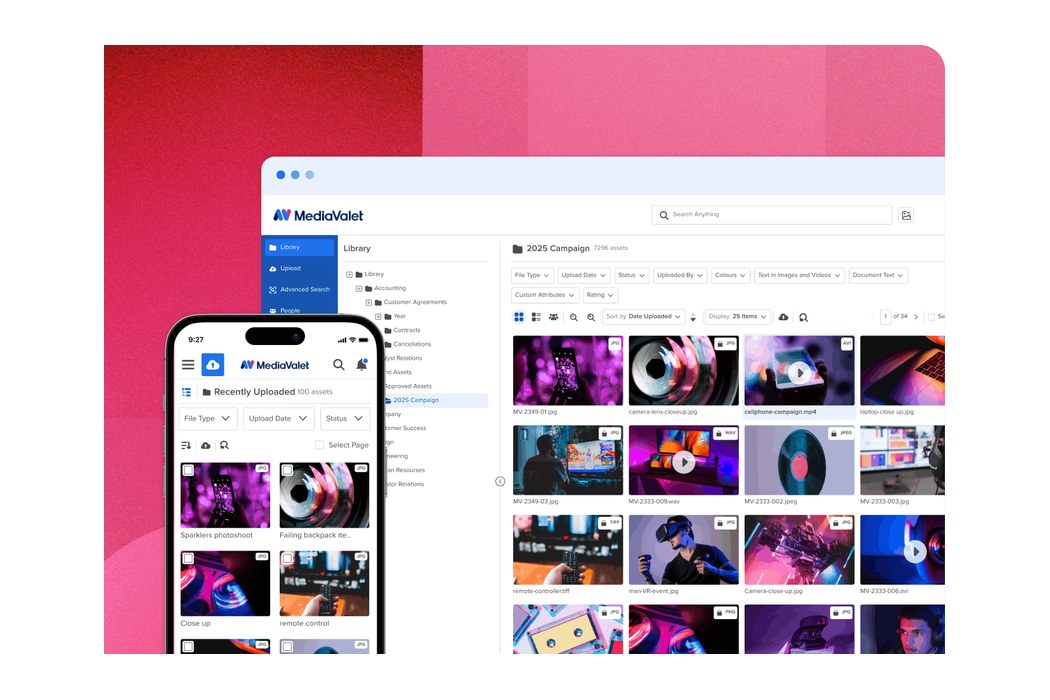
MediaValet Built a Business Around the File Nobody Can Find
A photography company choked on 20 terabytes of its own work. The fix became a cloud-software business - and a useful playbook for any team whose content library has turned into a junk drawer.

Emaze Put Training Wheels on Design - Then Rode Into the AI Sales Stack
The browser startup once fought ugly slides by limiting your choices. A decade later, that same constraint has become its enterprise pitch: turn approved assets and customer data into personalized content without letting every salesperson freelance the brand.

Greenfly Turned the Locker Room Camera Roll Into Sports Media Infrastructure
A retired All-Star started with a video-request app. The useful business appeared when Greenfly stopped chasing clips one at a time and built the plumbing that moves thousands of sports images to the right athlete, sponsor, broadcaster, or feed.

The Invisible 3D Engine Behind the Sofa in Your Shopping Cart
3D Cloud has spent 15 years turning sprawling furniture catalogs into things shoppers can rotate, rearrange and actually understand. Its quiet advantage is not the photorealistic sofa - it is the product logic hiding underneath.

The Zurich Startup That Turned Bitcoin Into a Stock Ticker
Hany Rashwan and Ophelia Snyder built 21.co on a contrarian bet: that the fastest way to get crypto into a portfolio was not an app, but a boring ticker symbol your bank already knows how to buy.
The Company Behind the Box You Never Think About
Esko’s software lives between the designer’s screen and the supermarket shelf, where one wrong allergen, barcode or shade of red can become an expensive problem. Its answer is a connected system for designing, approving and producing packaging at industrial scale.

Arca
Arca is trying to make crypto legible to institutions without sanding off what makes blockchain useful. Its bet is that the winning digital-asset manager will look less like a coin casino and more like a disciplined investment firm with programmable plumbing.
Babel Finance
The Hong Kong lender wanted to be the JP Morgan of crypto. It reached a $2 billion valuation in May 2022 - then froze withdrawals a month later after an unhedged trading bet lost roughly $280 million of client money.

Aspen Digital
Aspen Digital is an ADGM-regulated digital asset management platform built for private wealth. Founded in 2021 and co-incubated by Everest Ventures Group and TTB Partners, it gives family offices, external asset managers and ultra-high-net-worth investors a single regulated account to trade, custody, earn yield on and report across crypto - plus a white-label infrastructure stack that lets other wealth managers offer the same. It is backed by RIT Capital Partners (the Rothschild investment trust) and Liberty City Ventures.

1Token
1Token builds institutional back-to-front office software for crypto funds and financial institutions. Founded in 2018 and led by Damon Xu, the company runs a portfolio management system (PMS), risk management system (RMS), trade reconciliation, and T+0 shadow NAV accounting that stitch together fragmented CeFi exchanges, DeFi protocols and TradFi accounts into one book. Today it connects 80+ CeFi venues and thousands of DeFi protocols, serving 100+ institutional clients that monitor more than $20B in assets across APAC, North America and Europe.

AYC Fund
AYC Fund is an AI-native crypto hedge fund out of Y Combinator's W22 batch, founded in 2021 by MJ Kim in Seoul. It builds systematic, rules-based trading engines for digital-asset markets and now runs a private, invite-only program for qualified clients - high-net-worth individuals, family offices, and advisors - where capital stays in the client's own exchange account and the fund trades through read-and-trade API access rather than taking custody.

Dave Hendricks
Dave Hendricks is the co-founder and CEO of Vertalo, an Austin-based platform that acts as an SEC-registered transfer agent and tokenization engine for real-world assets. He has spent close to a decade building infrastructure to turn illiquid private securities into compliant, transferable digital assets. A serial entrepreneur, he previously co-founded LiveIntent, the programmatic email advertising platform, and helped build CheetahMail into the world's largest email service provider before its 2004 sale to Experian. Earlier he ran the worldwide relationship between Arthur Andersen and Oracle and worked on large securitization projects. He is known for a pragmatic, institution-focused view of crypto and a habit of dismissing hype cycles in favor of durable financial plumbing.

ScorePlay
ScorePlay is an AI-powered media asset management platform built specifically for the sports industry. It centralizes photos, videos and live broadcast content into one system, then uses computer vision and facial recognition to automatically tag athletes, sponsors and moments so teams, leagues and federations can find and distribute content in seconds instead of hours. Founded in 2021 and headquartered in New York, ScorePlay is used by 200+ sports organizations worldwide and raised a $13M Series A in February 2025.

KeyShot
KeyShot, developed by Luxion and now operating under the KeyShot brand, is the widely adopted standard for real-time 3D product visualization. It turns CAD and 3D model data into physically accurate, photorealistic renderings, animations and interactive visuals, letting designers and engineers preview products before physical prototypes exist. Built on rendering research from co-founder Henrik Wann Jensen (an Academy Award winner for subsurface-scattering work), KeyShot is used by tens of thousands of product teams across consumer electronics, automotive, footwear, jewelry and medical devices, and is known for pairing high-end rendering accuracy with an approachable, drag-and-drop workflow.

imgix
imgix is a San Francisco-based visual media platform that optimizes, transforms, and delivers images and video in real time through a simple URL-based API. Founded in 2011 by former YouTube web developer Chris Zacharias, imgix lets developers resize, crop, compress, convert formats, and now apply AI edits such as background removal and generative fill simply by appending parameters to an image URL, offloading image infrastructure to a globally distributed CDN. The company serves tens of thousands of customers, including Unsplash, Kickstarter, Eventbrite, and Porsche, and delivers on the order of billions of image requests a day.

Playbook
Playbook is a San Francisco-based software company building a visual, AI-powered cloud storage and digital asset management platform for creative professionals. Founded in 2019 by Jessica Ko, it blends a Pinterest-style gallery with Dropbox-style storage, adding automatic AI tagging, GPT-powered search, real-time review, and workflow automation so designers and marketing teams can find, organize, and share images and video without digging through folders. Backed by Bain Capital Ventures and Founders Fund, Playbook has grown to millions of registered users managing hundreds of millions of assets.

It'sRapid
It'sRapid is a Palo Alto-based AI creative automation platform that turns product data and existing assets into retailer-compliant commerce content - images, videos, display ads, sell sheets and product copy - at scale. Its Optix engine scores and audits creative before and after it goes live, and the platform has helped brands like PepsiCo cut per-asset production from hours to minutes and retail media networks shrink campaign go-live from ten weeks to under two.

Perforce Software
Perforce Software builds the version control, DevOps, and quality tools that large engineering teams lean on when their codebases and binary assets grow too big for ordinary tools. Its flagship - Helix Core, rebranded P4 in 2025 - moves enormous game studios, semiconductor designers, automakers, and defense programs along, while a portfolio gathered through acquisitions (Puppet, Perfecto, Delphix, Klocwork, Gliffy and more) extends from source control into static analysis, test automation, infrastructure automation, and test data management. Founded in 1995 and now backed by Clearlake Capital and Francisco Partners, Perforce powers more than half of the Global 500.

Scott Bowen
Scott Bowen is the CEO of Tenovos, a New York based digital asset management and content intelligence company he co-founded in 2018 with Sal Hakimi. Often described as one of the founding fathers of the DAM category, Bowen co-founded Artesia Technologies in the late 1990s, an early DAM pioneer acquired by OpenText in 2004, where he went on to launch the company's Customer Experience Management and Cloud Services divisions. A Yale-trained electrical engineer and economist, he has spent more than two decades building software at the intersection of digital media, marketing, data analytics and the cloud, including senior roles at Vistaprint and ICX Media. At Tenovos he is pushing the idea that modern marketing teams should treat content as measurable, data-rich infrastructure rather than files in a folder.

Interlace
Interlace is a Singapore-based fintech that lets companies issue branded physical and virtual cards through a single API, connecting to 30+ card BINs and bridging stablecoins with traditional banking rails. As a Visa Hong Kong Principal Member, it offers card-as-a-service, multi-currency business accounts, banking-as-a-service and crypto on/off ramps to over 12,000 enterprise clients across 180+ countries, having issued more than 6 million cards.