A sectional sofa is a small conspiracy against simple software. It has left arms and right arms, corners and armless middles, six fabrics that are really 600 fabrics, legs that only fit certain frames, prices that change with every choice, and dimensions that must survive a doorway. A shopper sees cushions. A retailer sees a combinatorial weather system.
3D Cloud exists in that gap. The St. Petersburg company supplies the machinery that turns large catalogs of configurable furniture and home-improvement products into something a person can explore. Its applications let shoppers spin a chair, place it in a room through a phone browser, assemble a sectional, design a kitchen or furnish an entire floor plan. Sales associates and professional designers use related tools to quote projects, make renders and produce plans.
The visible result is a smooth picture. The harder work sits below it: geometry, materials, dimensions, product identifiers, pricing and rules about which piece may connect to which. That is why 3D Cloud describes its platform as visual CPQ - configure, price, quote - as much as visualization software. A beautiful rendering that allows an impossible order is merely an attractive mistake.
The picture is only the storefront
Brothers Beck and Barry Besecker founded the business in 2011 as Marxent Labs. Beck became CEO; Barry became CTO. The name shortened to Marxent in 2013, stretched into 3D Cloud by Marxent in 2021, then finally became 3D Cloud in 2024. The renaming reads like a company gradually admitting what its product had become.
Early attention centered on augmented and virtual reality. In 2018, Macy’s deployed the company’s VR furniture experience in 69 stores. A headset could turn a modest patch of retail floor into a much larger virtual showroom. The reported commercial results were more interesting than the goggles: Macy’s said baskets were larger and returns lower for those sales. It was a useful demonstration, but hardware was never the whole thesis.
Today, the central product is a cloud platform and 3D asset management system. It stores product meshes and materials, connects them to catalog data, applies business rules, routes new assets through review and publishes them into applications. The company says more than 116,700 SKUs are in its active pipeline and more than 400 configurators have been deployed. Its broader company count is larger still: more than 10 million 3D products served and more than $3 billion in 3D-enabled sales.
Those are company-reported figures, but they clarify the job. 3D Cloud is not chiefly trying to win a rendering beauty contest. It is trying to keep a high-SKU catalog accurate while many teams, brands, regions and storefronts draw from it. The platform connects with the PIM, ERP, CMS, CRM, cart and analytics systems that already run a retailer. It also carries enterprise table stakes such as SOC 2 Type I and II controls and support for privacy and accessibility requirements.
One chair, five working lives
The airline analogy is sharper than it first appears. Airline booking does not simply display a seat. It checks routes, fare classes, availability, loyalty rules and price, then prevents combinations that do not exist. A kitchen, deck or modular office behaves similarly. Cabinet sizes must meet walls. Finishes must be available. Sofa modules need legal neighbors. A final configuration must become a quote, an order or a bill of materials without losing its meaning.
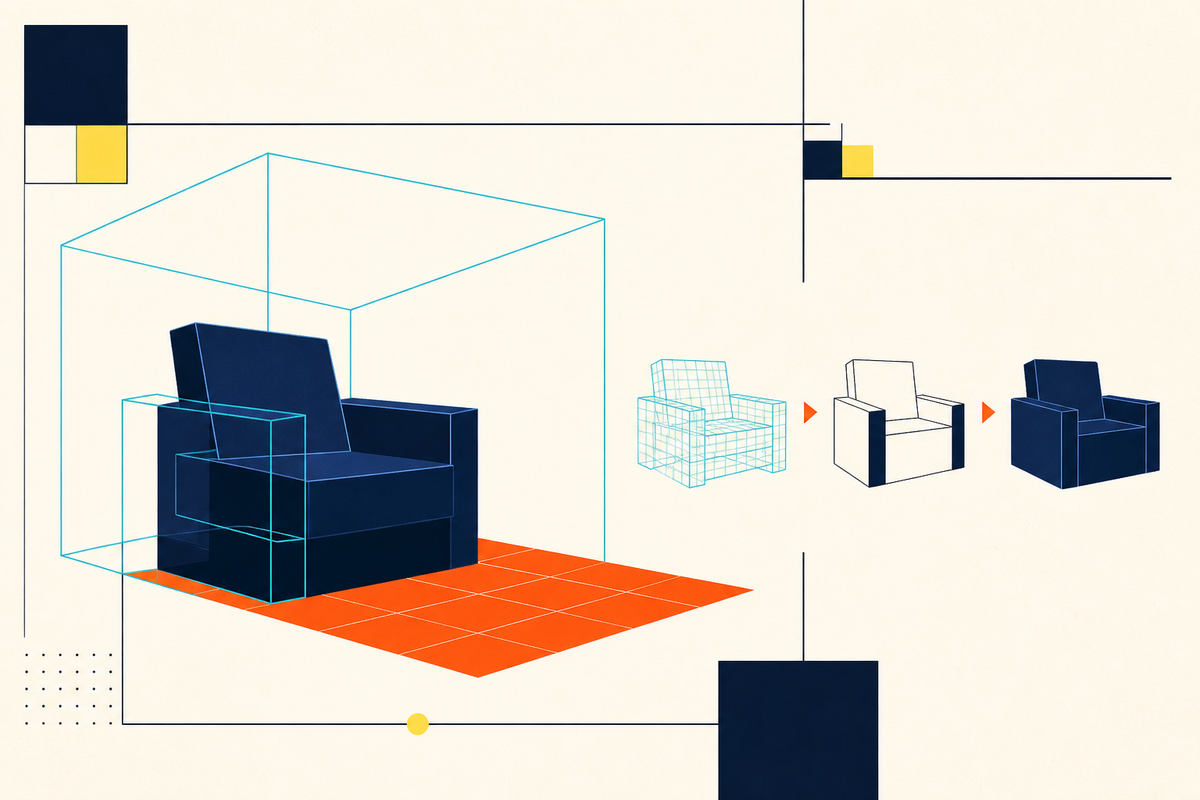
3D Cloud’s economic pitch is reuse. Once a manufacturer’s chair has been modeled, approved and joined to its data, the same asset can produce a product-page render, a 360-degree spin, a configurator, a room-planner object and an augmented-reality view. Update the source, and the applications can inherit the change. That replaces a collection of isolated image projects with a content supply chain.
The application list is consequently broad. There are product and modular configurators; consumer and professional room planners; kitchen, bath, storage and outdoor designers; automated product and lifestyle renders; 360 spins; and app-free WebAR. There is also a modeling network and managed services, because an enterprise cannot reuse a 3D asset it does not yet have. The business is SaaS with implementation, integration and content production attached. Pricing is negotiated rather than posted.
The best customers are retailers and manufacturers with large catalogs of expensive products that come in many variants. 3D Cloud names Lowe’s, The Home Depot, Macy’s, La-Z-Boy, Joybird, CITY Furniture, Ashley, John Lewis & Partners, Kingfisher, MillerKnoll, Herman Miller and HNI among platform users. These companies do not need a clever one-off demo. They need consistent content that works for shoppers, associates, designers and operations.
Move the mistake before the truck
The problem is less abstract when a purchase goes wrong. Returning a shirt requires a label. Returning a sectional may require a delivery crew, a truck, warehouse handling and a second attempt at the customer’s living room. A cabinet error can interrupt a renovation. Better visualization cannot remove every mistake, but it can move uncertainty earlier, when changing a fabric or dragging a wall costs almost nothing.
CITY Furniture offers a current example. In 2025 it put 3D Cloud-powered spins, WebAR and a room planner on its site, then added a sectional configurator. The retailer said 89 percent of users exposed to its 360 spins interacted with them, while 57 percent of room-planner users saved projects. Early sectional results said nearly one in 10 shoppers created a customization and 30 percent of those configurations reached a cart. These are customer-specific, company-published metrics, not promises for every deployment. They show what 3D tools can measure once they are tied to a real shopping journey.
This is also where 3D Cloud separates itself from horizontal 3D tools and stand-alone studios. Competitors such as Threekit, Cylindo, Roomvo, VividWorks and a growing set of configurator vendors can solve portions of the visual-commerce problem. An internal team can assemble its own stack. 3D Cloud’s claim is narrower and deeper: furniture and home improvement, enterprise catalog complexity, a shared asset-and-rules layer, plus enough content operations to get the system live.
That vertical focus has a cost and a benefit. A fashion brand looking for a quick shoe spin may find broader tools simpler. A furniture group managing several banners, regional prices and thousands of material combinations is closer to 3D Cloud’s center of gravity. The company has accumulated a vocabulary for sectionals, cabinetry, desks and decks, along with procedural tools and snap points that reflect how those products are assembled. Its market is therefore not every object that could be rendered in three dimensions. It is the narrower set of expensive objects whose complexity can slow a sale, create a bad order or require a specialist to explain.
AI meets the cabinet constraint
The next interface may be conversational. In March 2026, 3D Cloud announced U.S. patent protection for chat-based product configuration covering single and multiple products, validation, model assembly, placement, iterative changes and purchasing. In May it introduced plans for an AI kitchen-design assistant. A user describes a kitchen in ordinary language; the proposed system produces a validated 3D design, price and bill of materials while accounting for industry standards.
This is a sensible direction precisely because the company already owns the boring layer. A general image model can dream up a handsome kitchen. It does not automatically know whether a particular cabinet is sold in a 27-inch width, whether the chosen door works with the frame, or whether the quote contains every required part. Grounding an assistant in a governed product catalog turns a visual suggestion into something closer to a transaction.
Capital has followed that long build. Publicly reported rounds include a $10 million Series B in 2016, a $15 million Bellini Capital-led Series C in 2021, a $7.5 million Series D in 2023 and a $20 million growth investment led by Bellini Capital in 2024. As a private company, it does not publish current revenue or valuation. Its longevity is the more legible signal: 15 years across mobile apps, VR showrooms, WebAR, visual CPQ and now AI, all orbiting the same stubborn catalog problem.
The company’s culture writing has been unusually persistent, too. It describes servant leadership, curiosity, generosity, accountability and a willingness to make instructive mistakes. One employee summarized the engineering problem as learning to do something once, automating it, then teaching the company to do it 100,000 times. That line could double as the product strategy.
3D Cloud fits into the market between digital asset management, product configuration, rendering and ecommerce infrastructure. The shopper may never know its name. They will know the feeling it is selling: the sofa fits, the finish is real, the pieces connect and the room looks familiar before the truck arrives. In visual commerce, confidence is the final render.