The humble product page works beautifully until the product refuses to be humble. A T-shirt can survive a few photographs and a size menu. A bow with accessories, a refrigeration case with dependent parts, or a boat with choices in hull, upholstery and engine is a different animal. The shopper is not selecting a color. The shopper is assembling a small system, often without the product expert who knows which bits fit together. Dopple exists for that uncomfortable moment.
The Charleston, South Carolina company builds browser-based 3D configurators, visualizers and augmented-reality experiences. A buyer can rotate a product, swap finishes, add components, inspect hotspots, save an image and, on a supported phone, place the result in the room. Behind the visible choreography sits the less glamorous machinery: models trimmed for web delivery, compatibility rules, ecommerce connections and analytics that record what people tried before buying or leaving.
That makes Dopple part software platform, part 3D studio and part translator of industrial catalogs. Its public customers range from Hoyt Archery and football-equipment maker Xtech to office-chair brand Anthros, fence supplier Jewett Cameron, refrigeration specialist Carlson Airflo and bedding seller Smart Bamboo. The common denominator is not an industry. It is a purchase with enough visual uncertainty or combinatorial mischief to make a static gallery feel evasive.
The picture is not the product
Dopple's roots help explain its point of view. The business describes a lineage beginning in 2014 with 3D application software for manufacturers and the CRM, configure-price-quote and visual-CPQ systems around them. The current Dopple company dates its founding to 2021 and unveiled the Dopple-branded platform in September 2022. The name changed and the shop window widened, but the inherited problem remained: product configuration is a rules engine wearing nice clothes.
Consider Carlson Airflo's C5X-LE refrigeration case. The equipment can be built in many ways, but some options cannot be paired. Dopple worked with Carlson and its agency to simplify what the buyer saw, foregrounding combinations people commonly purchased while preserving dependencies underneath. The first project focused on one popular unit for sales conversations and trade shows. It was a pilot, not an overnight conversion of the entire catalog.
This product has been a game changer for us in our sales process. It has saved us countless hours of time and labor when building estimates and working with clients during the sales pipeline.Sharon Johnson, Director of Sales & Marketing, Carlson Airflo
That is what Dopple actually did: discovery sessions, asset collection, 3D art creation, feedback, configuration setup, integration, testing and launch. The customer needs a product expert, a marketing owner, development help and a sponsor. Dopple uses tools such as Slack, Jira and shared plans to shepherd the work. If usable CAD, architectural files, patterns or photographs do not exist, physical samples may be required. The polished viewer arrives at the end of a rather adult project plan.
What it costs - and what fails first
There is no public Dopple price card. The company quotes production, integration and hosting according to the number and complexity of models, configurable options, available source assets and traffic. Hosting is tiered by usage. Recurring revenue begins at contract signing because the platform is used while the project is being produced. In plain English, this is SaaS with a meaningful services layer, not a plug-in that turns one JPEG into a flawless digital twin before lunch.
The earliest thing to fail is usually the fantasy that 3D is merely a visual upgrade. A heavy model loads slowly. A gorgeous texture looks different under mobile AR lighting. A missing dependency lets shoppers construct nonsense. A sprawling catalog makes the first project impossible to approve. Dopple targets broadband load times under ten seconds and says simpler visualizers can approach five. Its guidance favors small web assets, progressive texture loading and carefully separated meshes. The company cannot standardize every browser, phone camera or source file.
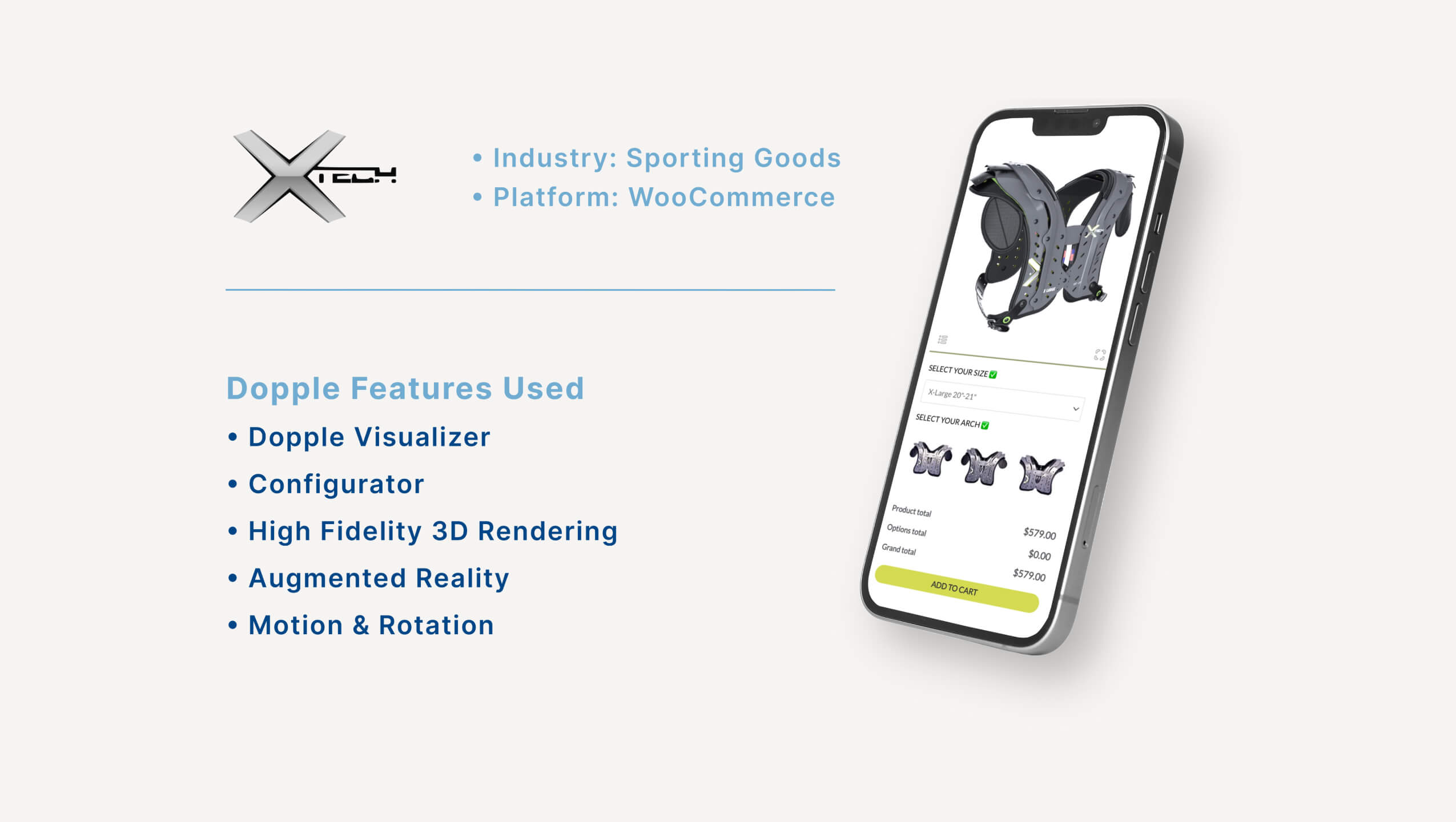
The 2023 work with Xtech shows both the promise and the need for restraint. Xtech built a configurator for custom shoulder pads, including real-time changes, rotation and AR. Dopple reported that 39 percent of sessions engaged with 3D. Those sessions added to cart at 6.9 percent, versus a 3.2 percent site average, and stayed for 6 minutes 13 seconds, versus 2 minutes 52 seconds. It is a strong company case study, not a randomized trial. People willing to configure may already be better prospects. The copyable idea is to instrument the journey so the argument can graduate from applause to evidence.
The business inside the picture
Dopple sells to enterprise ecommerce teams, manufacturers, distributors and B2B sellers. Its integrations include Shopify, and its 2025 field notes repeatedly mention BigCommerce and Shopware. The platform can also be embedded through a visual component or accessed through an API. That flexibility matters because the viewer is only useful when it can talk to the catalog, price, cart and analytics systems already running the store.
The differentiation is a blend. Dopple has an in-house 3D art team, a platform tuned for web delivery, configuration logic, no-app WebAR, virtual photography and customer-success services. Competitors such as Threekit, Expivi, Cylindo, Zakeke and Configure One attack overlapping pieces. A brand can also commission a custom WebGL or Unity experience. And the incumbent competitor remains a folder of photographs plus a knowledgeable salesperson on the phone.
Virtual photography may be the sleeper feature. Once a product exists as a configurable digital twin, teams can export high-resolution images of variations without building and shooting every physical combination. The same asset can support the product page, sales presentation, AR placement and marketing library. This is where the economics get more interesting than a lift in clicks: one expensive model has several jobs.
Then there is product intelligence. Dopple can record rotations, zooms, option changes, AR launches and configured products added to cart. That gives merchandisers a view of combinations people investigate, not just the page they visited. A popular abandoned build may indicate price resistance. An ignored finish may deserve less inventory. A common configuration can become the default preset. The data is directional, and privacy and analytics design still matter, but it is richer than a page-view counter.
Who should copy it
Good conditions
High-consideration products, many visible options, compatibility rules, costly samples, high return risk, healthy traffic and a team able to maintain product data.
Bad conditions
Simple commodities, thin margins, weak source assets, little traffic, no integration owner or a product whose value cannot be communicated visually.
The most portable Dopple lesson is ruthless project selection. Do not begin with the whole catalog. Choose one product that is valuable, confusing and visually distinctive. Find the uncertainty that makes a buyer pause. Model only the options that matter. Enforce the rules that prevent an invalid order. Decide in advance whether success means more add-to-cart actions, better leads, shorter estimate cycles, fewer returns or cheaper content production. Then launch where enough shoppers can encounter it.
- Start with expensive confusion. The best first product has enough margin and enough buyer uncertainty to pay for clarification.
- Simplify before rendering. Carlson did not expose every possible choice at once; it emphasized common combinations and encoded the dependencies.
- Reuse the twin. Make the same asset earn its keep in configuration, AR, sales, virtual photography and marketing.
- Measure intent, not novelty. Watch option patterns, valid builds, add-to-cart behavior, lead quality and returns, not just spins.
- Budget for maintenance. Products, prices, parts and browsers change. A digital showroom is a living sales system.
Dopple's own evolution supplies the final clue. Its founders did not discard configuration expertise when visual CPQ stopped being the most legible story. They moved that expertise closer to the buyer and attached it to commerce outcomes. The modern product page is where the rules, pictures and purchase meet. For the right catalog, turning that page into a small piece of software is not decoration. It is the shortest route from “I think this fits” to “I know what I am ordering.”