The most revealing thing about the original FashionMetric store was what it refused to let a shopper do. Before buying clothes, customers had to answer a short sizing survey. At checkout, they did not choose a size; the store chose for them. Daina Burnes, who ran the business with co-founder Morgan Linton, says its return rate was 1.8%. For a clothing retailer, that is an arresting number. For a software founder, it was a clue.
- The moveTurn a store’s sizing system into software for other brands.
- The methodEstimate a body, then compare it with the garment’s actual dimensions.
- The customerApparel retailers and custom clothiers who pay for fit guidance.
The store sold ready-to-wear and custom clothing. Burnes came from a family of master tailors and had worked in data science; the survey borrowed from both worlds. It used answers a customer already knew to estimate measurements a tailor would usually take in person. When the founders saw what that process did for their own returns, they changed the business. FashionMetric stopped being a shop and became Bold Metrics, a software provider for shops.
That is the pleasing reversal at the center of this company: a retailer discovered that its best merchandise was the fitting room. In 2016 the founders changed the name from Fashion Metric to Bold Metrics. The broader name suited a platform that could sell fit intelligence to many brands, rather than clothes to a single audience.
A letter is not a measurement
Most online clothing pages ask shoppers to pick from S, M and L, sometimes with a chart of body dimensions nearby. That chart places the burden on the customer: find a tape measure, measure correctly, guess how much room the garment has, remember whether the brand runs large. The same medium may be roomy in one shirt and tight in another. Even within one label, a jacket and a T-shirt do different jobs.
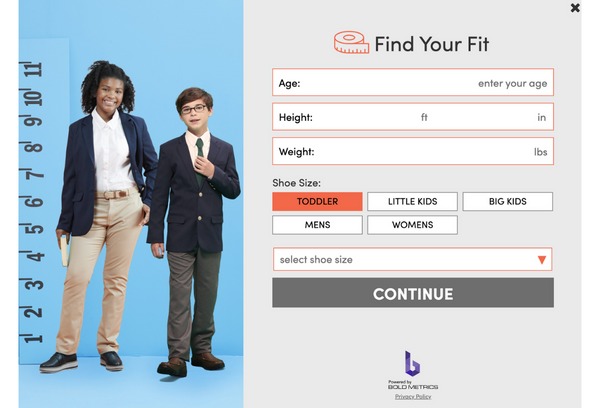
Bold Metrics asks a few simple questions, such as height and weight, and its machine learning models estimate more than 50 body measurements. The resulting profile is what the company calls a digital twin. It then compares the estimated body with a brand’s garment specifications and fit rules. The useful output is more than a letter: a shopper can learn that a size should fit overall yet feel snug in a particular place. Preference still matters. One person wants a close fit; another wants room for a sweater.
This is why Bold Metrics occupies a slightly different place from a virtual dressing room. It does not require a photo, a phone scan or a 3D animation of the customer wearing a jacket. Its bet is that fewer steps mean more shoppers will actually use the advice. It also has to collect and interpret each brand’s sizing data; a fluent answer built only from a generic size chart would miss the point.
The store became a toolkit
The front door is Smart Size Chart, a fit tool on a product page. For brands that want a custom interface, Virtual Sizer exposes the recommendation engine through an API. Mizzen+Main has used that flexibility for personalized shirt and pant finding, moving fit advice from a small button near the size selector into product discovery.
Custom clothing presents a sharper test. Blue Delta Jeans traditionally needed 16 body measurements taken in person for a made-to-order pair. Bold Metrics’ Virtual Tailor lets a remote shopper answer a few questions while the system estimates more than 50 measurements. Blue Delta’s published case reports a 7% net return rate. That figure describes one customer deployment, not a promise that every tailor will get the same result. But it shows why remote measurement matters: the customer need not live near a fitting appointment.
“We are able to collect these same measurements from anyone, anywhere, anytime.”Josh West, co-founder and CEO, Blue Delta Jeans Co.
The fourth product, Apparel Insights, moves behind the storefront. Aggregated shopper measurements, purchases and returns can tell a design team where its size run misses actual customers. That is a different buyer inside the same brand. Burnes has said the ecommerce team usually comes first; product teams often become interested after the retailer starts accumulating fit data. The initial sale is a size recommendation. The longer use is a better informed cut, grade or inventory plan.
These are company platform totals, not independent measures of individual shoppers or proven return savings.
Where the business earns its keep
Bold Metrics sells business software to apparel brands and retailers. It lists no public price, so the cost of an installation depends on a commercial agreement. Its $8 million Series A, announced in 2022 and led by Bessemer Venture Partners, funded a company already working with brands such as Canada Goose, SuitShop and Blue Delta. Current customer material also names Helly Hansen, Pact, Mizzen+Main and others.
The company reports that shoppers who engage with its sizing solution convert at four times the rate, spend 22% more per order and generate 17% fewer fit-related returns on average. Those are engagement comparisons from its own deployments, and shoppers who open a fit tool may already have higher purchase intent. A retailer should therefore judge a pilot by its own return rate, conversion, adoption and margin, preferably with a controlled comparison. The fair question is not whether the model sounds impressive, but whether fewer parcels come back.
Helly Hansen offers a useful reminder that geography complicates even a well-built tool. Its published case reports a 1.8-times conversion lift in North America and a 3.8-times lift in Europe among tool users. The numbers differ, and they do not isolate every cause. They do suggest that a brand serving several markets should measure fit guidance locally, with local garments, stock and customer behavior.
The next fitting room has no room
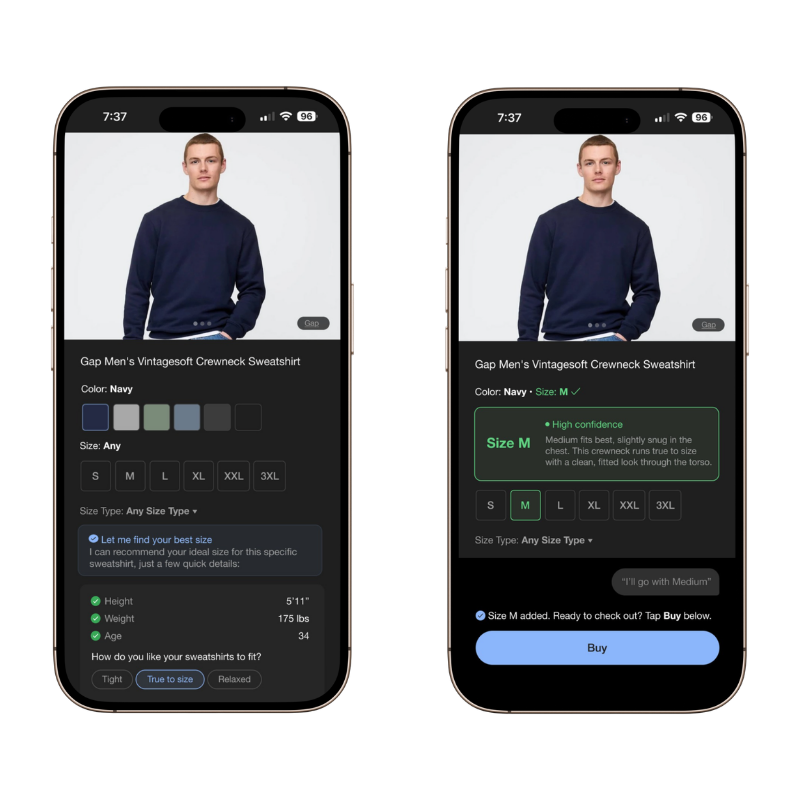
In 2026, Bold Metrics introduced Agentic Sizing Protocol and announced Gap as a launch partner. The idea is to let an AI shopping assistant request a size recommendation without sending the customer away to a separate chart. An agent can find a jacket and talk about its color. To say whether that jacket will feel tight across the chest, it needs a relationship between the person’s measurements and that particular garment. Bold Metrics wants to supply the answer in a form the agent can use.
There is a practical lesson in the history. FashionMetric did not begin by asking every apparel brand to change its process. It solved a problem inside its own store, watched the outcome, then sold the repeatable part. A retailer considering the same path can start smaller: identify a costly decision customers make with poor information, collect the data that bears on it, and test whether better advice changes what they keep. The data must describe the real product. A chart built on vague labels merely automates the old guess.
Bold Metrics’ own story is still subject to the ordinary limits of retail. A model cannot repair inconsistent garment specifications, and a recommendation cannot make a bad pattern fit well. The company’s distinctive move is to make those inconsistencies visible at the moment a shopper decides. The old store asked customers to surrender the size picker. The new company gives brands a reason to ask what the picker knew in the first place.