On a battery assembly line, the machine knows something. The technician knows something else. The test bench knows still more. Years later, when that battery begins to fade in a storage cabinet, a service engineer may know only its serial number. The rest of its biography is scattered among databases, paper forms and proprietary equipment. This is the kind of mundane mess from which expensive industrial surprises are born.
Peaxy, founded in San Jose in 2012, sells a way to connect the fragments. Its software captures data at the edge, organizes it around an individual asset and uses the resulting history for analytics and digital twins. Battery makers, energy storage operators and defense teams can follow an object from construction to operation, ask why it is behaving oddly and estimate what it may do next. The phrase “industrial AI” is on the label; the useful work begins with data plumbing.
- Peaxy builds a searchable life record for each battery or industrial asset.
- Its software joins factory, test, sensor and service data by serial number.
- A disclosed battery deployment reports 25,000+ batteries managed and five times faster data acquisition and verification.
- The same approach extends to Navy equipment, hydrogen plants and energy communities.
First, the paper failed
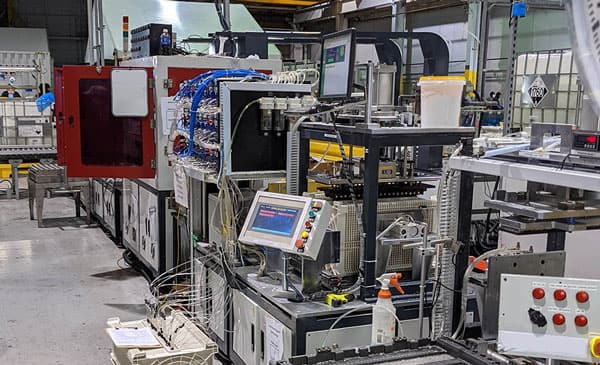
One of Peaxy’s published manufacturing cases begins at a new US battery plant. Assembly stations came from different suppliers, each with its own database. Progress was still recorded manually. Engineers needed the records for quality control, but answers arrived late and root-cause investigations were laborious. The first failure was not a machine failure. It was a failure to put the facts in one place.
Peaxy put its Digital Traveler module on the line. At each step, it collects equipment feeds or validated operator input against the battery’s serial number and stores the record in the cloud. A later quality concern can be traced to a time window, component lot or piece of equipment. A test result can point a production manager toward a calibration issue while there is still time to act. Factory history can then be compared with the way the same unit performs in the field.
Figures reported by Peaxy for one customer manufacturing deployment.
Peaxy says the project digitally threaded more than 94% of available operational parameters and managed more than 25,000 batteries. Its reported fivefold gain concerns data acquisition and verification, not total factory output. That distinction matters. Faster access to evidence is valuable even when it does not, by itself, guarantee fewer defects or longer battery life.
“With Peaxy’s Digital Traveler, we now have automated, granular data capture on our assembly lines.”VP of Quality & Environmental Health and Safety, unnamed customer in Peaxy’s case study
Give the object a memory
Peaxy calls the record a battery passport. The term sounds bureaucratic, but the mechanics are direct: associate test results, parts, operating conditions and service events with a durable identifier. A passport can narrow a recall, support a warranty decision or reveal whether a particular production lot ages differently. It also gives a predictive model a more honest starting point than a fleet average.
That is also how Peaxy differs from a dashboard that merely displays current sensor readings. Its Lifecycle Intelligence platform aims to preserve the route from research and production to operating fleets and end of life. Its models can then compare an asset’s expected behavior with what its sensors report. Peaxy describes cloud deployment and, for defense use, vessel-based deployment where a connection to the wider internet cannot be assumed.
The method has an obvious prerequisite. A serial number must survive handoffs, and data from machines and partners must be accessible and reliable. Where those conditions are weak, the first job is painstaking integration. Peaxy’s own description of typical deployments is about 120 days. That is a claim about its process, not a universal clock for every plant.
A narrower question, a bigger market
Peaxy did not begin as a battery specialist. At launch it promoted Hyperfiler, software for accessing and managing large, unstructured datasets. In 2015 it raised $15 million in Series B funding for enterprise data access. Its 2018 Inc. 5000 listing, at number 327, came as Lifecycle Intelligence and industrial proposal software were taking shape. The company announced another $12 million Series B-II in 2023 to expand battery analytics. The record shows a product focus moving from data in general toward identifiable, costly physical assets. Terranova said at the time that customers were finding battery data increasingly challenging and costly. That is a practical reason to narrow the question: which exact battery produced which exact evidence?

Terranova co-founded the company with Federico Faggin, among others; Faggin also sits on its board. Peaxy’s expertise is an unusual mix of software architecture and industrial domain work. The customer list is similarly varied. Eos Energy Storage chose it to connect R&D, manufacturing and operating data. ZincFive publicly describes using Peaxy for battery manufacturing, service and end-of-life traceability. Peaxy also names work with US Navy systems, where maintenance records and sensor streams must be joined under demanding security rules.
There are newer branches of the same idea. EcoGrid measures and manages energy use for commercial sites and renewable energy communities; in 2025 Peaxy announced a deployment with the Cagliari Provincial Industrial Consortium in Sardinia. That year it also announced a hydrogen plant digital twin for an unnamed Fortune 200 customer, joining physics models and cost calculations so designs could be tested before construction. These products sit in different markets, but each asks the same question: can a physical system have a record detailed enough to make the next decision better?
What the buyer buys
The business is enterprise software, usually with implementation work to connect existing systems. Peaxy’s published terms describe subscriptions that default to a 12-month term, with annual renewal unless a proposal says otherwise. Its buyers are battery manufacturers, integrators, fleet operators, utilities and government teams; its users include engineers, production managers, service staff and executives. An off-the-shelf analytics stack or an internal data team can solve parts of the same problem. Peaxy’s pitch is that the capture, traceability and models already belong in one industrial workflow.
There is a useful lesson here for any factory with ambitious prediction plans. Start with a single asset and ask whether its build record can be matched to its field record. Choose a durable identifier. Capture the information at the point where it is created. Make the trail queryable before adding a forecast. If the answer to the first question is no, the most elaborate twin may still be a polished portrait of somebody else’s battery.