The first sign of a wind-turbine failure is often unimpressive. A bearing vibrates at a frequency it did not last month. A gear tooth begins to pit. A rotor slips out of balance. The machine may keep turning, making electricity and looking perfectly healthy from the ground. Somewhere inside the nacelle, however, a repair clock has started.
ONYX Insight sells time on that clock. The Nottingham company mounts compact sensors on turbines, pulls information from equipment already in place, gathers operational data in cloud software and puts engineers behind the screen. Its customers are the people who own and operate wind farms, from utilities and independent power producers to turbine manufacturers. They are not buying a prettier graph. They are buying the chance to schedule a crane in summer instead of begging for one after a winter breakdown.
The product is the warning window
The hardware is called ecoCMS. Its MEMS accelerometers listen to drivetrains and can be extended to structures and oil-debris sensors. ONYX says a retrofit can be operating in less than four hours, across more than 120 turbine platforms from at least 15 manufacturers. Its published warning range for some drivetrain problems is six to 24 months. That is long enough to inspect the suspected damage, decide whether to derate the machine, order a component and combine work with a planned outage.
The software is fleetMONITOR, a web application that combines vibration, SCADA, oil, maintenance and other condition data. The awkward capitalization is worth tolerating because the idea is sensible: a wind-farm owner should not need one screen for Vestas turbines, another for GE machines and a spreadsheet for the old Suzlons acquired with a portfolio. Portuguese producer Finerge uses the system across five turbine makers and more than 15 monitoring systems. EDF has centralized more than 6GW across six CMS types and seven OEMs.
This independence matters most after a portfolio changes hands. Wind assets are traded, bundled and repowered; their monitoring systems arrive with them like mismatched cutlery. Replacing every working sensor to satisfy a new software vendor wastes capital and history. ONYX instead tries to ingest what is already there, then fill the blind spots with its own equipment. The approach is especially useful for older machines that lack modern condition monitoring but still have years of profitable operation ahead of them.
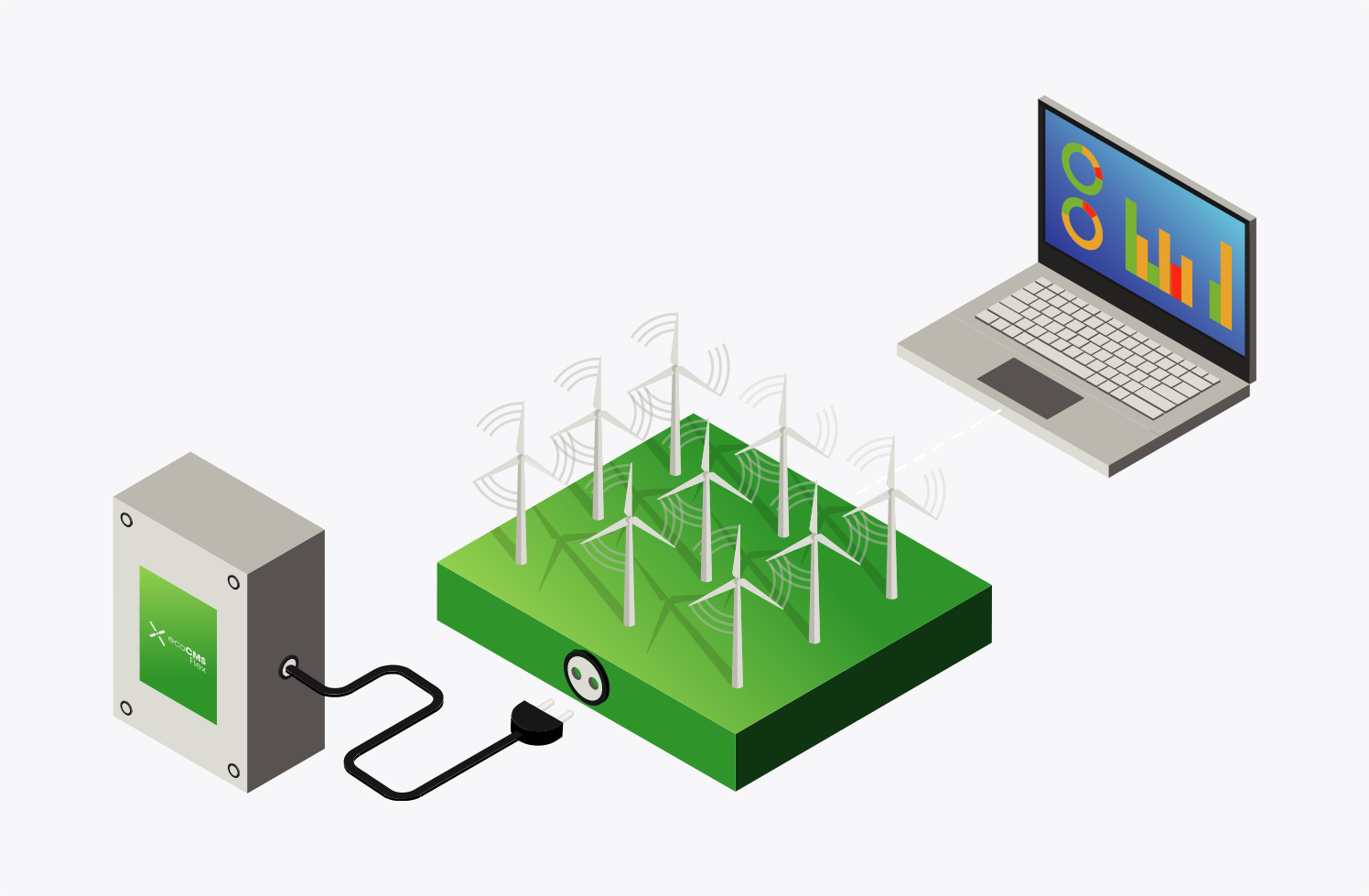
Illustration: from faint anomaly to urgent repair
A sensor, a case file and a human being
ONYX is best understood as three businesses bolted together. It makes sensing hardware. It sells recurring software and monitoring. It also performs engineering work: borescope inspections, root-cause analysis, due diligence, remaining-life models, end-of-warranty assessments and OPEX forecasts. A customer may let ONYX's monitoring centers watch the fleet, or train an in-house team to use the platform. Public list prices do not exist because the package changes with turbine count, installed hardware and the amount of human analysis.
That last handoff is where monitoring projects often become shelfware. A red alarm does not negotiate a crane contract. It does not tell the site team what evidence supports the diagnosis or preserve the inspection record. ONYX and bp developed a case-management layer to carry an issue from detection through inspection, asset decision and repair. Pattern Energy later rolled the workflow across a 4.2GW North American portfolio.
“By leveraging ONYX's technology, we can better understand the life span of turbine components, improve maintenance schedules, reduce costs and avoid breakdowns.”Alistair Warwick, then CEO of bp Wind Energy
The customer who changed the size of the bet
bp began with fleetMONITOR on 242 North American turbines in 2016, then put ecoCMS on 133 machines. According to the joint case study, the hardware paid back in under 12 months. That result changed the commitment: bp made ONYX its standard predictive-maintenance technology and expanded the deployment to 525 turbines across several makes and models. In 2023, it signed a five-year extension covering technology and engineering support.
The actual contract price remains private. ONYX markets ecoCMS with a claimed nine-times return and payback inside a year, but the more honest way to read that claim is conditional. Value depends on catching an expensive fault early enough to change the repair, avoiding lost generation and having an operations team able to act. A small fleet with new machines under comprehensive OEM warranty may produce a different equation from an ageing, mixed fleet whose owner self-performs maintenance.
Not every useful finding begins with a damaged bearing. At Evergy's 281MW Western Plains wind farm in Kansas, ONYX worked from existing SCADA data across 122 Siemens turbines. It found rotor overspeed protection systems triggering repeated shutdowns and quantified the portfolio's lost production at a reported $450,000 a year. The first thing to fail, in that case, was not a gearbox. It was a setting that was too eager to protect one.
From drivetrain specialist to whole-turbine view
The company's roots are in Romax, the British gearbox-engineering business. Romax InSight launched fleetMONITOR, installed the first ecoCMS units and formed a predictive-analytics venture with Castrol before adopting the ONYX name in 2017. bp Launchpad acquired it in 2018. Macquarie Capital bought 100 percent in March 2024 for an undisclosed sum and kept it operating independently.
Ownership changed; the engineering bias did not. What changed was the perimeter. ONYX moved outward from gears and bearings to foundations, towers, pitch bearings and blade roots. In 2025 it acquired British blade-monitoring specialist ELEVEN-I. In April 2026 it launched ecoBLADE, using two three-axis accelerometers inside each blade to watch structural behavior continuously. The product won a Wind Investment Awards technical-innovation prize the following month.
The market position is now clearer. Hardware-only vendors can capture excellent signals. Software specialists can normalize fleet data. OEMs know their own machines. Inspection companies can document visible damage. ONYX competes with all of them at the edges, but its pitch is the integrated, OEM-agnostic loop: sensors, multiple third-party data sources, a database informed by more than 50,000 failure events, diagnostic software and engineers who can enter the turbine when the chart deserves a second opinion.
What operators can copy
The portable lesson is not “buy more sensors.” Start with the failure modes that create the largest combination of repair cost, downtime and safety risk. Use existing SCADA and CMS data before fitting every surface with hardware. Establish a baseline, demand a diagnosis rather than an alarm, and give every credible issue an owner, evidence trail and decision date. Measure avoided secondary damage and recovered production, not the number of alerts generated.
A practical buying test
Ask a monitoring supplier to show how one historical fault moved from raw signal to confirmed diagnosis, work order and financial result. If the demonstration ends at a dashboard, the expensive organizational work is still yours.
There are limits. Predictive monitoring needs adequate sensor placement, clean and accessible data, recognizable failure signatures and enough warning time to intervene. It performs poorly when damage is sudden, a relevant component is not instrumented, communications are unreliable or alerts sit untouched. It also cannot manufacture spare parts, good weather or crane availability. ONYX's hybrid model is an implicit admission that prediction is an engineering process, not an oracle.
That makes the July 2026 pilot with Aviva interesting. The insurer and ONYX are testing packages that pair condition monitoring, analytics and remaining-life work with risk management for policyholders. If better evidence helps an owner prevent a loss and gives an underwriter more confidence, the economic buyer may extend beyond the maintenance department. The turbine's faint rattle could affect not only when a bearing is replaced, but how an asset is insured and financed.
ONYX employs more than 145 people from over 20 nationalities and is led by Alexis Grenon, the former head of Schneider Electric's Digital Grid division. The company says it has completed due-diligence work covering more than 180GW and protects more than $14 billion in assets. Those figures are company claims, but they describe the scale of the wager neatly: learn from enough machines and the next odd vibration is less mysterious.
A wind turbine will always be an unruly patient. It works hundreds of feet in the air, under changing loads, in weather that keeps technicians on the ground. ONYX Insight cannot remove that uncertainty. It can make the uncertainty arrive as a case file instead of a phone call at 3 a.m. For a wind-farm operator, that is the difference between hearing bad news and having time to do something useful with it.