A motor does not need a microphone to tell you something is wrong. The electricity feeding it already carries clues. Jim Dechman has spent years explaining how to read them, an occupation that requires a mechanical engineer’s interest in machinery and a businessperson’s ability to make an invisible problem seem worth paying attention to.
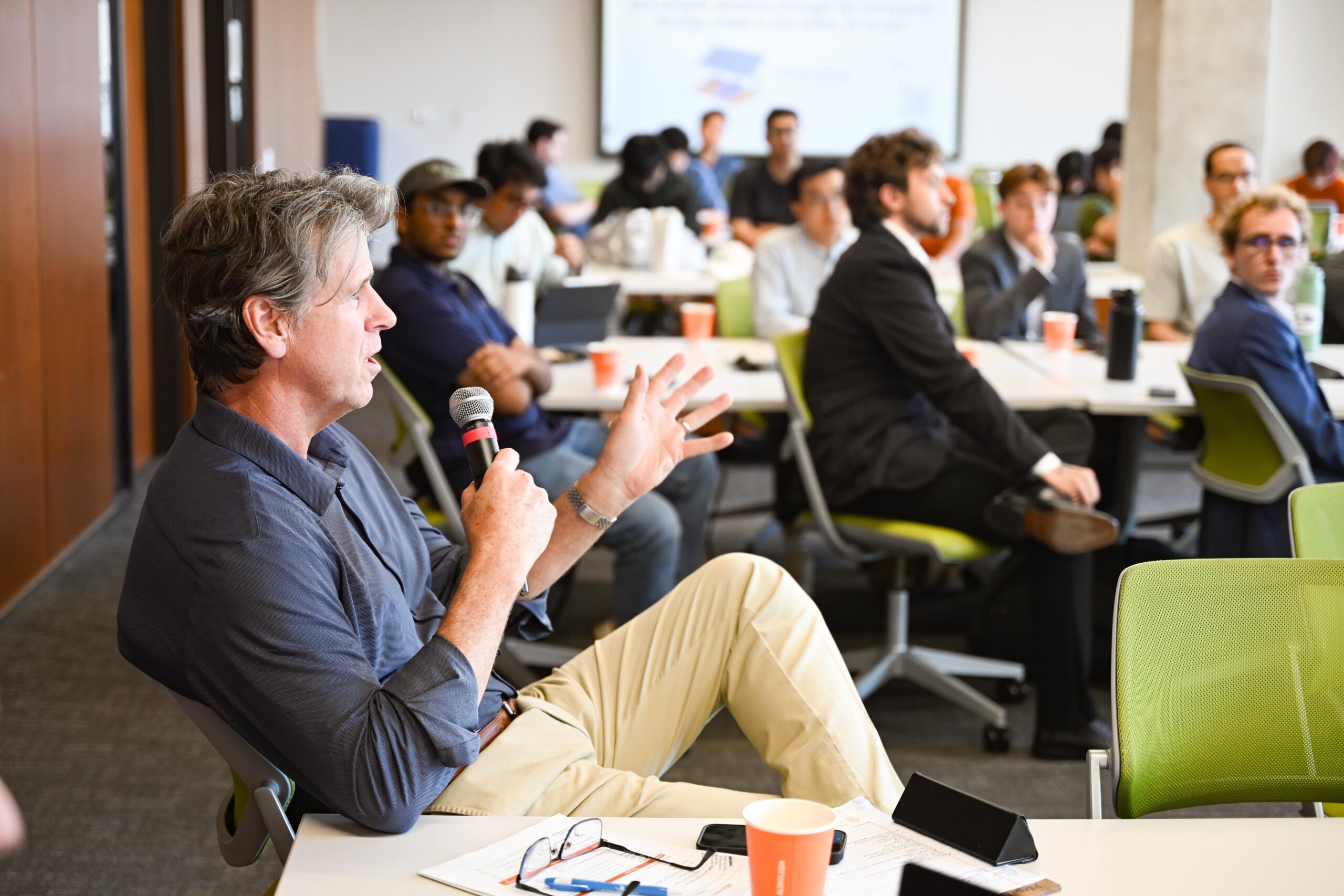
In March 2026, he was doing a different kind of listening. At the University of Texas at Austin’s inaugural Maseeh Innovation Competition, Dechman sat among the judges evaluating student ventures. A photograph from the event catches him with a microphone in one hand, the other raised as he gives feedback. Around him are students, laptops, paper cups and the practical furniture of an idea trying to become a business.
The setting suits the arc of his career. Dechman, chief executive of Veros Systems at Baker Hughes, has worked on the difficult passage from technical observation to something a customer will use. His subject happens to be equipment that most people notice only after it has stopped working. A pump is rarely thanked for an uneventful afternoon.
Before the waveform, there was the replay
Dechman studied mechanical engineering at the University of Texas and earned an MBA at Harvard. His career includes Procter & Gamble and Boston Consulting Group, followed by leadership of Monitoring Technology. That combination brought manufacturing, consulting and the business of industrial observation into the same professional life. It also preceded his appointment at Veros by years.
At Monitoring Technology, the object of attention was sometimes a packaging line moving too quickly for an operator to diagnose by eye. The company’s 20/20 Hindsight system recorded high-speed video and kept hours of footage in memory. When something went wrong, a bottler could replay the event. Machinery had acquired the industrial equivalent of an instant replay, with considerably fewer arguments about the referee.
Describing the purpose, Dechman said it was better “to fix the problem permanently so it doesn’t happen again.” The remark is practical and specific. Catching a defective item matters; understanding why a line keeps producing the defect changes what happens on the next shift.
The camera system also allowed recording, playback and review to happen simultaneously. An operator could investigate a jam without losing the evidence of the next one. This is an early glimpse of a recurring problem in Dechman’s work: useful information has to survive the speed and inconvenience of the place where it is collected. The factory cannot pause indefinitely while someone works out why it paused.
A business built around the power cable
In July 2013, Veros announced $5 million in financing from Austin Ventures and LiveOak Venture Partners and named Dechman its incoming president and CEO. He joined an existing business and technical team. Tommy Knight was its co-founder and chairman; the underlying research came from Texas A&M mechanical engineering professor Alex Parlos. Dechman’s task was to help bring that technology into commercial use.
Veros had licensed the technology from Texas A&M in 2006. Its proposition was to use variations in voltage and current to understand the condition and performance of motors and the equipment they drove. A motor turning a pump or compressor experiences the mechanical behavior of that load. The electrical waveform offers a way to observe what is happening along that connected system.
Dechman put the connection plainly: “We connect to the conductors that power motors.” The software could identify small changes and distinguish some effects of the power supply from developing equipment problems. For a customer, the useful result was an operating picture and an alert early enough to make a maintenance decision.
Chevron Technology Ventures invested later in 2013, bringing the announced Series A financing to $8 million alongside the two venture firms. The investment followed a technical evaluation conducted across multiple sites over several years. That sequence matters: the evaluation came before the funding announcement. Industrial adoption required the equipment to prove useful in operating facilities, away from a presentation screen.
Shell Technology Ventures joined the investor group in July 2014 after extensive testing of Veros ForeSight. The system connected at motor control centers or variable frequency drive enclosures and converted three-phase electrical signals into information such as shaft torque, mechanical load and power consumption. For offshore applications, gathering information from accessible electrical infrastructure offered a practical route to equipment that was much harder to reach.
Eight minutes in San Antonio
By 2015, Dechman was presenting at CERAWeek, where Veros appeared among that year’s Energy Innovation Pioneers. The program placed a machinery-monitoring business alongside companies working on reactors, valves and other energy technologies. For Veros, the stage widened the conversation beyond an individual installation to the possibility of serving many kinds of industrial equipment.
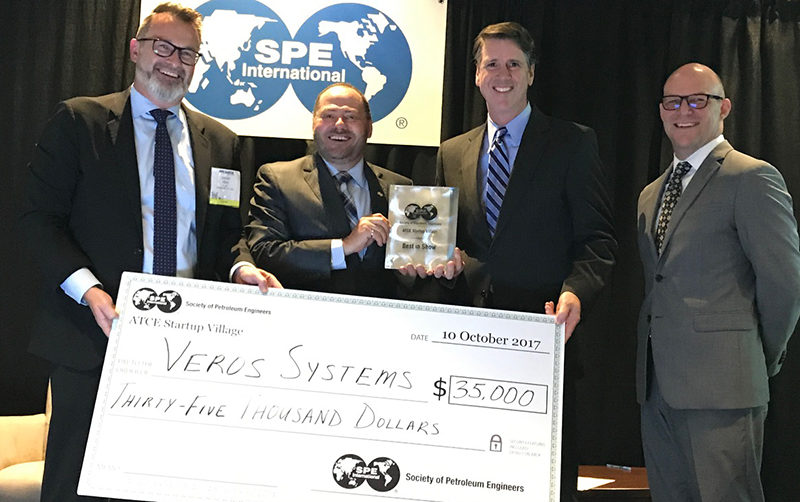
Two years later came a more compressed test. At the 2017 SPE Annual Technical Conference and Exhibition in San Antonio, Veros was one of 12 businesses chosen from more than 120 applicants for the Startup Village competition. Each presentation had a limit of eight minutes, followed by six minutes of questions. Years of engineering had to fit into a slot shorter than many coffee breaks.
Veros won both Best in Show and People’s Choice, receiving $38,500 in combined prize money. The two decisions came from different constituencies: a panel of industry and investment specialists, and conference attendees. Judges considered eight criteria, including field results, the management team, market strategy and financial projections. The technology had to make sense as a business as well as a technical proposition.
The circuit-breaker thought experiment
Dechman’s way of describing the longer-term opportunity could be surprisingly domestic. In 2019, he imagined a shopper choosing between two circuit breakers at Home Depot. One simply did the familiar job. The other, at a higher price, could tell the homeowner weeks ahead that an air conditioner was likely to fail. He was describing a possibility, rather than announcing a retail product.
The example took a technology associated with pumps and compressors and gave it a place on an ordinary shopping list. It also made the business ambition easier to understand: useful monitoring could become part of electrical equipment people were already buying. The prospect was less about adding another destination for an operator to visit and more about making existing infrastructure informative.
By 2020, that ambition had an industrial counterpart. Veros said Siemens Large Drive Applications would deploy its monitoring with new shipments, and five installations were monitoring subsea pumps at Shell’s Perdido facility in the Gulf of Mexico. A $2.2 million Series C round, led by Shell Ventures with existing investors participating, was intended to expand installations and cloud-computing capabilities.
“Veros is working to allow industrial motors to talk.”Jim Dechman, June 2020
The machinery still needed a translator. In a 2020 technical account, Dechman described sampling electrical waveforms with an edge device in the cabinet, then digitizing and compressing the information for cloud analysis. The company reported processing just under 400,000 data points per second for each motor. The important destination for all those numbers was a maintenance choice someone could act on.
The approach followed the motor’s rotor and the way mechanical changes registered electrically. Machine learning helped separate changes in the process and power supply from other signals. This was a specific industrial use of the technology: interpreting equipment behavior through its electrical input. Dechman’s explanations kept returning to the practical payoff of having time to arrange repairs or replacement.
A larger organization, and a return to campus
Veros subsequently became part of Baker Hughes. Its technology added electrical-waveform analysis to a business already offering remote monitoring and digital services for rotating equipment. In the public welcome to the Veros team, Dechman expressed enthusiasm about the new working relationship. The move connected the specialist company’s work to an established industrial services organization and its customer operations.
A Baker Hughes presentation identifies Dechman as Veros CEO and sets out applications including artificial lift, cryogenic pumps, pipeline pumps and motor-driven reciprocating compressors. The variety shows why the original idea could travel. Reading electrical behavior is a method with several industrial settings, each requiring knowledge of the machinery and the job it is supposed to do.
His ties to engineering education extend beyond his own degrees. In 2015, Jim, David and Ken Dechman established the Dechman Scholarship through Tau Beta Pi to honor their father, Don A. Dechman, on his 80th birthday. It is a family tribute expressed through support for another engineering student. A birthday present can have a rather longer working life than the wrapping paper.
UT Austin also lists Dechman on the Cockrell School of Engineering’s Engineering Advisory Board. At the March 2026 student competition, his fellow judges included National Instruments co-founder James Truchard, entrepreneur Mark Desantis and Longhorn Ventures’ Weston Waldo. The winning team paired an environmental engineering student with an accounting student. Technical work and commercial reasoning were sharing a table again.
There is a pleasing continuity between the replay camera, the motor waveform and the university pitch session. Each asks someone to look closely enough to identify what deserves attention. Dechman’s documented career moves through those settings without requiring a dramatic reinvention: manufacturing experience, an industrial monitoring company, Veros, and participation in the engineering community that helped educate him.
The results of machinery monitoring can be conspicuously quiet. Equipment keeps running; a repair is scheduled; an operator has more time to think. For a career organized around detecting trouble, that is a fitting ambition. The motor continues its ordinary work, and the people responsible for it have a better chance of understanding what it is trying to tell them.